After an incredible first hike along our taste of the Tour de Mont Blanc (TMB) into Courmayeur’s Val Ferret, we were thrilled to be doing our second hike in her neighbor, Val Vény. Val Vény is a pastoral valley of the Mont Blanc massif, that like Val Ferret lies southwest of Courmayeur. Val Vény was formed by two glaciers, the Miage Glacier and the Brenva Glacier which literally cut off the valley like an island by two massive moraine walls of the glaciers on each side. Val Vény is quite a magnificent place to hike.
After a filling breakfast of local cheese, cotta ham and fruit, we headed out to grab the local bus in the direction of Val Vény. This time we rode in the opposite direction of Val Ferret and followed the bus through yet another winding path inching us through the lush wide valley. About twenty minutes later, we reached the end of the line and got off at a tiny hamlet called La Visaille.
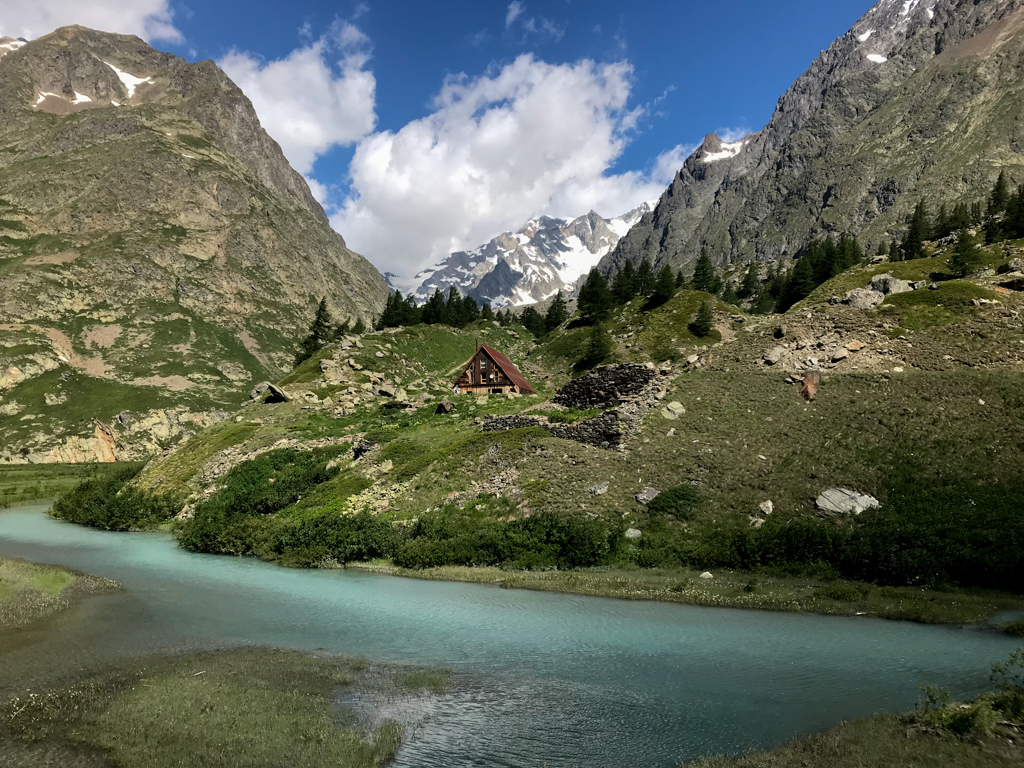
From La Visaille, we crossed a bridge and began our hike down a wide path sliced within a valley to the Rifugio Elisabetta, another stop along the TMB. It was another postcard-perfect day and I couldn’t have felt more alive. There is something about hiking and being surrounded by mountains that always makes my heart sing.
Arriving at the start of the hike in La Visaille
The start of the hike is breathtaking and gives you an idea of the treasure that awaits.
Our first hike along our taste of the Tour de Mont Blanc (TMB) was in the Val Ferret, one of two breathtaking valleys that cut through Courmayeur, Italy on the southeastern side of Mont Blanc. Known as one of the most stunning hikes in the area, especially if blessed with good weather, hiking in Val Ferret would set the tone of what would be a stunning eight full days of hiking around the TMB and leave me longing to go back.
We rose early to one of many mouth-watering, gorgeous mornings in the Alps. The sky was cloudless and eggshell blue and the view of the towering, snow-capped jagged Graian Alps pierced through the sky like lightning. We enjoyed a lovely breakfast of fresh Italian parma ham, local cheese, homemade bread, and sweets before lacing up our hiking boots and heading out.
View right outside my hotel window in Courmayeur, Italy
Although we had rented a car for the week, our hotel recommended taking the bus to the start of our hike since parking is difficult on busy weekends in the summer. With our backpacks ready to go and a picnic lunch of fresh Italian baguette, local cotta ham, tomatoes, and Piave cheese, we set off. We caught the bus at the city hall (Municipio) stop located a few short blocks from our hotel in the direction of Val Ferret.
As we left Courmayeur, it was obvious that the rest of the fully packed bus was also heading to the Val Ferret for a hike. The thirty-minute ride was filled with fellow trekkers from all around the world, sharing stories of their routes and experience on the TMB. It was fun to chat and compare notes, and I especially was excited to meet fellow women older than me partaking in the tour self-guided. Everyone was filled with smiles and laughter. Obviously, their souls were happy and fulfilled from the fresh mountain air and stunning views afforded along the TMB. It made me even more excited to start our day and do our first hike.
The bus drove through a winding valley road and we got off at the stop marked Rifugio Bonatti where we would access the trail.
The air was fresh and pure, and as soon as I was off the bus and on the trail, I felt alive with excitement and anticipation for our day. I was in my element, and all I could think of was the famous John Muir quote: “The mountains are calling and I must go”.
Heading off into Val Ferret
Sensational views like this are common on a lovely day in Val Ferret
Tucked within two valleys, the Val Ferret and Val Veny on the southeastern side of Mont Blanc in the Aosta Valley of Italy lies the lovely alpine town of Courmayeur. Known for its divine scenery and proximity to three iconic long-distance hikes, Courmayeur is the perfect place to base your stay for exploring its stunning alpine scenery.
Courmayeur is actually a series of small hamlets peppered throughout the valley with a historic central village within the heart. Linked by both a tunnel and (for the more stunning view) a cable car to its counterpart, Chamonix, on the other side of Mont Blanc in France, Courmayeur offers a great mountain holiday any time of year.
Before the opening of the 11.6 kilometer-long tunnel in 1965, Courmayeur was relatively small and isolated. Today Courmayeur is known as one of the best ski resort towns in the Alps as well as a wonderful base for hiking, biking and exploring the divine beauty of the Italian Alps.
Why Go
When dreaming about an idyllic European town, Courmayeur is just what comes to mind. Courmayeur is a charming town awash in history, quaintness and ethereal beauty. It’s pedestrian-friendly walking streets are filled with lovely shops and boutiques, and a multitude of open-air cafes and restaurants that dazzle any foodie. Her lovely stone villas and glorious architecture all set against the sensational backdrop of the Italian Alps make Courmayeur the perfect place to base your stay for the Tour de Mont Blanc (TMB) or for those who want to refuel and relax in a lovely intimate Italian town.
View right outside my hotel window in Courmayeur, Italy
View from our hotel down Viale Mont Bianco one of the main streets into town.
Known as one of the greatest multi-day treks in the world, the Tour de Mont Blanc (TMB) is a circular tour of 105 miles/170 kilometers around the mighty Mont Blanc massif traversing three countries – Italy, Switzerland and France, over the course of 10-12 days. Passing through some of the most divine high alpine scenery on earth, the TMB is one of the most stunning multi-day treks of all and is a dream for many avid trekkers.
Ever since my dad and I did the lesser-known Tour de Vanoise back in 2012 (located in Savoie, the eastern Rhône-Alpes region of France), I had dreamed of doing the popular TMB. My father too had wanted to complete some of the TMB after scaling Mount Blanc in 1998. Thankfully, the opportunity finally arrived this summer and better yet, it would be not with two generations of trekkers but three.
On July 4th, my father, 14-year-old son and I left for a ten-day intergenerational hiking trip to Mont Blanc, devising our own Tour de Mont Blanc to fit our needs. Armed with maps, internet resources, and guide books, we set off and had a magnificent time. I learned a lot along the way about what works and what can be improved with planning your own Tour de Mont Blanc. Here is what I discovered and my thoughts on planning your own Taste of Mont Blanc.
My dad, me and my son on our own Tour de Mont Blanc.
Why Go
At 15,771 feet (4807 m), the mighty snow-capped Mount Blanc soars 12,000 feet (3700 m) over Chamonix, dominating the region and controlling the weather in all the surrounding valleys. As the masterpiece of the Mont Blanc massif, an area measuring 29 miles (46 km) long graced with numerous peaks and aiguilles, jaw-dropping sheer rock walls, ridges and tumbling glaciers, the TMB is known as one of the most stunning multi-day treks in the world.
What makes Mont Blanc even more unique is her incredible location at the crossroads of three European countries – France, Italy and Switzerland – giving the trekker a unique cultural experience as well as extraordinary views. Two distinct towns converge below Mont Blanc: Courmayeur (Italy), and Chamonix (France). Given its high elevation, with 11 summits measuring over 13,123 (4000 m), most of the surrounding area is snow and ice-covered with glaciers pouring down the steep mountain-sides creating a magical, breathtaking scenery that delights the eyes and fills the soul.
If you have one long-distance trek to do on your bucket list, then the TMB is the one for you.
With stunning views like this on the hike through Val Veny in Italy, the TMB will never disappoint.
It was yet another beautiful day hiking in the Alps. The sky was a robin’s egg blue dotted with powderpuff clouds. A gentle breeze kissed my face and the stunning scenery of the Alps made me continually want to pinch myself to make sure it wasn’t all just a dream. It was our third day of hiking during a ten day intergenerational hiking trip around Mont Blanc. So far our trip could not have been more surreal.
As my dad and son climbed up the steep path leading us higher and higher above the dazzling aquamarine Moulin Dam far below, all I could think about was the reward for our efforts. A view of the legendary Lac Mort, a high alpine ice-covered lake at 2843 meters (9327 feet) above the Aosta Valley on her perch in the Italian Alps. But then, after two hours of hiking and only twenty minutes to go to our destination, the wind began to change. We could see a series of rain-laden clouds off in the distance over the Aosta Valley. I checked the radar and knew we would be fine however my dad grew nervous. He had been caught in a ravaging thunderstorm atop a mountain before and swore he’d never do it again. He wanted to turn back.
My son and dad on the long hike up from the glorious Moulin Dam to Lac Long
We had just reached the first of two alpine lakes, Lac Long, and it was stunning. It would only take another twenty minutes to reach Lac Mort but my dad said we couldn’t go. An argument brewed because I hate to not complete a hike especially when I knew we could make it before the rain. But I had to respect my dad’s decision despite my displeasure and disappointment. Upset, we turned around and headed back without ever seeing the prize.
Me and my son Max at Lac Long in Aosta, Italy
We were painfully close to the prize destination
I didn’t talk for the next hour of the hike down to the car and purposely held back on my pace letting my dad and son go ahead. Yet it was at that moment when I fully realized the true beauty and power of intergenerational travel.
From a distance, I observed and listened to my dad and teenage son talk about life, the world, their hopes and dreams. Slowly my disappointment and anger eased and instead a deep sense of gratitude grew. For this is what it is all about and why it is so incredibly meaningful to travel as family. This unburdened time together in the middle of nowhere. Sharing our common love of nature and mountains, creating bonds that somehow are often harder to create at home. It is magical and priceless.
My Dad and son talking away
Me and Max
The trip ended up being all I had hoped for and more. It gave me precious time to reconnect with my teenage son, spend more time with my dad and realize what an incredible gift all of these priceless memories are. I look forward to sharing my stories in the upcoming months and reliving the beauty of not only the Alps but of spending sacred time with family. Stay tuned.
After an exhilarating time exploring the wild jungles and mysterious Mayan ruins on mainland Belize, it was time to soak up some surf and sun on one of Belize’s many cayes (islands). I couldn’t think of a more perfect way to end my wonderful week in Belize than in Caye Caulker. Located roughly 21 miles northeast of Belize City, Caye Caulker is one of 400 cayes along Belize’s 180-mile long coastline and after Ambergris Caye is the second most visited. However, don’t let her popularity fool you. This tiny island offers island and ocean loving travelers a wonderful refuge to swing away lazy afternoons in a hammock or take an adventure of a lifetime swimming with nurse sharks and sting rays in the nearby Belize Barrier Reef. Best of all, Caye Caulker still has retained her laid-back island charm despite the upswing in tourism. Whether a few days or a week, there is plenty of things to do in Caye Caulker. Check out my guide on how to go slow, as the locals say, in Caye Caulker.
The motto in Caye Caulker is “Go Slow” and after a few days on this lovely, tropical paradise you will easily slip into this mentality.
After almost a week in Belize exploring the ancient Mayan masterpieces of Lamanai, Xunantunich and the depths of the mystical underworld of the Actun Tunichil Muknal (ATM) Cave, one would think that I’d had my fix of Mayan ruins. However, as soon as I realized that one of the grandest ancient Mayan cities of all, Tikal, was right across the Guatemalan border from our base in San Ignacio, I knew I’d have take a day trip to Tikal. With over 3,000 buildings spreading across 212 square miles of thick rugged jungle, Tikal is the largest and most restored archaeological site of the pre-Columbian Maya Civilization. Yet, the plot thickens. Recent LiDAR (Light Detection and Ranging) mapping has revealed that the ruins of Tikal are even grander and more magnificent than ever imagined.
Deep beneath the jungle canopy lies 61,000 hidden structures representing part of a vast network of ancient Mayan cities that were perhaps the most advanced civilization of its time. The historical and archeological significance of the findings is immense. Could Tikal be even grander than the ruins of ancient Rome or Egypt? With all the mysteries surrounding Tikal, I knew I’d have to see for myself.
View of half of the Grand Plaza of Tikal, the most excavated area of the ruins.
Intrepid Travel -one of the world’s largest adventure travel companies – is changing the way we see and impact the world. With over 1,000 tours in 120 countries, Intrepid has done wonders to promote responsible tourism and help make a positive impact on where they travel. As part of the Intrepid Group which includes fellow tour operators Urban Adventures, Peregrine, and Adventure Tours Australia and runs The Intrepid Foundation, Intrepid is on a mission to change the way people see the world by delivering sustainable experience-rich travel products while also harnessing the power of travel to benefit the places and people they visit.
As a global leader in sustainability within the travel industry and a signatory to the United Nations Global Compact, Intrepid is dedicated to being a company committed to purpose beyond profit. Some of Intrepid’s accomplishments in responsible travel include becoming a carbon neutral business in 2010 and becoming the first global travel company to ban elephant rides on its tours in 2014. By 2016, Intrepid’s philanthropic fund distributed more than AU $6 million towards healthcare, human rights, child welfare and environmental and wildlife protection programs in the communities in which it operates. In June 2018, the company launched vegan tours and most recently, in August 2018, Intrepid became a certified B Corporation making Intrepid the largest Travel B Corp in the world.
I heard about Intrepid Travel by fellow travel blogger Alison Armstrong, the beautiful mind behind Adventures in Wonderland who has written about her own experiences traveling with Intrepid to China last year. Wanting to learn more, I reached out to Rebecca Shapiro, the Senior Editorial Manager of Intrepid Group North America. We talked for over an hour about all the amazing work that Intrepid is doing to change the face of travel and improve the world. Here is what she had to say.
Intrepid Travel Tour in Iran. Photo courtesy of Intrepid Travel
Next summer of 2020, join GOOD Travel on one of their upcoming Mother-Daughter Trips to Peru! As an avid traveler and mother of two kids, it has always been a dream of mine to show them the world and instill a love of travel and exploring new cultures while they are young. These are my children’s formative years and I know that time is going all too fast. Before I know it my kids will be out in the world and I want to do my part in spending as much time as I can with them and teaching them some lifelong lessons at home and abroad. That is why I can hardly wait to bring my 12-year-old daughter Sophia to Peru with me next summer on a GOOD Travel trip.
I first went to Peru in 2001 not long after the horrendous 9/11 attacks. I recall being a bit fearful to travel out of the country in such a difficult time yet I didn’t let it stop me. Instead, my dad and I went on a father-daughter trip to hike the Inca Trail to Machu Picchu setting off a lifelong passion to explore the world and understand it. I hope to be able to give these opportunities to my own children as travel has changed my life and made me who I am today, a global citizen, humanitarian and writer.
My Dad and Me at Machu Picchu circa 2001
What makes GOOD Travel trips so unique is that their mission is to do good, give back and interact with the local communities within the destination. This is very important to me as I view these travel experiences as the best. In Peru, GOOD Travel is proud to have partnered with Peruvian Hearts to bring a once in a lifetime mother-daughter trip to this amazing country.
The trip will provide moms and their daughters (ages 6 to 16) with the unique opportunity to spend time immersed in Peruvian culture with the girls involved in Peruvian Hearts projects. Activities are developed with various age groups in mind to ensure unique experiences for all.
Every aspect of this trip – from the hotels to Machu Picchu to the llama hikes to the chocolate making – has been designed to ensure that the local community, economy and environment benefit from your visit. I personally can’t think of a more impactful way to travel.
Meet GOOD Travel
GOOD Travel was founded in 2013 by four women from Peru, USA, South Africa and New Zealand. Their vision is to transform the tourism industry into a force for GOOD by promoting and facilitating travel that gives back to the local community, economy, and environment.
Highlights of Mother Daughter Trip to Peru
Spend time with like-minded moms in a true community of travelers.
Group size averages 8 moms and 10 daughters to ensure a personalized experience.
Hike one of the 7 wonders of the world, trek with llamas, make chocolate, visit indigenous communities, shop in local markets … all with your daughter!
Understand the culture in Peru – something you cannot do from a tour bus.
Create memories that moms and kids will share for their lifetimes.
Show your kids how to be responsible travelers, kind and compassionate friends, researchers of new cultures, explorers of new experiences and appreciative of all they have. And prove to our formidable enemy – time – that we moms can connect with our kids in meaningful and memorable ways.
Resting majestically atop a plateau overlooking the Mopan River and the Guatemalan countryside of Western Belize lies Xunantunich, one of the largest ancient Maya cities ever built. These impressive yet mysterious ruins were lost for centuries until discovered in 1890 by a local villager who mistakenly thought he had seen a ghost of a maiden giving Xunantunich its infamous name which translates into “Stone Maiden”. Built in the 7th century, these incredible ruins feature some of the most stunning hieroglyphics and friezes in ancient Maya culture as well as intricately carved stellas, 25 temples and well-preserved palaces.
Today Xunantunich is Belize’s most visited site, and the surrounding area of the Cayo District has become one of the most popular destinations in mainland Belize known for its multitude of Maya sites as well as its incredible caves, waterfalls, rivers and lush jungles. There are tons of adventure activities to be found which include hiking, kayaking, swimming, canoeing, zip-lining and of course exploring the incredible cave systems. You can easily spend a few days here with the highlight of your visit being a trip to Xunantunich.
Exploring Xunatunich
The Maya empire evolved around 2000 BC and thrived until their decline in 1500 AD. The highest point and power of Maya Civilization was known as the Classic Period from 250 AD – 900 AD. It was during this time that the political system changed into a Theocratic system where rulers represented the Gods to the lower class people on earth. Knowledge was power and since low-class people had no education, they believed whole-heartedly in their rulers. The Classic Period was a flourishing period of massive growth and the building of the incredible temples, pyramids and cities that are left behind today.
Xunantunich may have been occupied as early as 1000 BC but it was little more than a village. The large architecture that we see today began to be built in the 7th century AD. An estimated 7,000-10,000 people lived at Xunantunich during its peak and the city was quite possibly politically aligned with neighboring Naranjo just 9 miles west in Guatemala. In 1000 AD Xunantunich was abandoned right around the time that many other large Maya cities were being dismantled as the Maya civilization was falling apart.
Xunantunich is unique because it is the oldest continuously excavated Maya site in the country. The ruins were first explored in the 1892 by Dr. Thomas Gann, a doctor from Britain. Gann returned a second time in 1924, unearthing many Maya treasures which have tragically been lost or given away to private collectors. There has been continuous excavations and restorations since 1990 by the University Of California (ULA) under the direction of Dr. Richard Leventhal. These excavations continue to bring new discoveries and treasures helping historians and archeologists piece together the ancient Maya past.
One of the biggest and most impressive Maya buildings ever found was discovered in Xunantunich. Known as “El Castillo” (The Castle), it is covered in elaborately carved friezes, and remains the second-tallest tallest man-made structures in Belize. One of the figures carved on El Castillo is a three-dimensional seated person which is rumored to be the “stone maiden” that the villager saw when he stumbled upon the site.Continue reading →
I woke up to the singsong sound of birds as the sun burst through the drapes, casting a zigzag of light across my room. After two carefree days at the Black Orchid Resort near the tiny village of Burrell Boom in Belize, I’d finally been brought back to life with a newfound energy that had long disappeared. I jumped out of bed, excited for the day ahead as we were heading to San Ignacio, the heart and soul of the Cayo District in Western Belize where we’d be swallowed into a world of thick, lush jungle, mysterious caves and extraordinary Maya ruins. But first, we were making a stop in the village of San Antonio, home of the largest Maya community in all of Belize. In San Antonio, we would learn about an exciting initiative helping to empower local Maya women called the San Antonio Women’s Cooperative supported by our tour company G Adventures and their nonprofit partner Planeterra.
As our group gathered into the van, I sat up front next to the driver so I could learn more about the four different ethnic groups in Belize. Our driver Carlos was Mestizo (a mix of Spanish and Indigenous descent) which is the largest ethnic group in Belize making up approximately 34% of the population. After Mestizo, the next largest group is Creole followed by Maya and Garifuna. The Creole and Garifuna population both are descendants of African Slaves whereas the Maya population is centered within the tropical lowlands of Central America. Over time, the Maya spread out into parts of Mexico, Guatemala, Honduras, El Salvador, and Belize. The Maya make up about 11% of the population in Belize and there are three different linguistic groups: The Yucatec Maya who came from Mexico and live in the north, the Mopan Maya who live in the Southern Toledo district, and the Kekchi Maya who live in Western Belize.
Nestled in a verdant valley, about a 20-minute drive from the twin towns of San Ignacio and Santa Elena in the heart of the Cayo District of Belize lies the village of San Antonio. Populated by primarily Yucatec Mayas, the village is known for its beauty and art, and has a strong farming and agricultural heritage. When we arrived at the co-op, the first thing I noticed was the beauty and lushness of San Antonio. We were surrounded by tropical trees and flowering shrubs. It was no surprise that the Yucatec Mayas chose to settle in San Antonio for its fertile land. Agriculture is king in San Antonio yet it has its downfalls especially for the women who have large families and don’t have the means to earn an income outside of farming.
Arriving at the San Antonio Women’s Cooperative in Belize
The San Antonio Women’s Cooperative was founded in 2001 to help promote and conserve Maya heritage, culture and tradition within the community and provide women with an alternative, sustainable income outside of farming. Since most Maya families have on average seven children and education is not free in Belize, girls are often the ones left behind and have few options besides raising a family. Poverty is a big issue and finding employment (especially without an education) in a small village is challenging. The San Antonio Women’s Co-op offers education in traditional pottery making, embroidery, cooking and serving guests through sustainable tourism as a means to preserve their culture and make a living. Today, there are 25 women in the co-op and they are working to encourage youth to participate as well. Continue reading →
We’ve all seen it. You arrive at the Taj Mahal or the Louvre, filled with pure anticipation to see a world-famous landmark for the first time. Yet when you finally reach the perfect spot for your long-awaited view you get hit in the head with a selfie stick. As you inch your way into the mass of fellow tourists, craning your neck to get a peek, you are rudely shoved aside by an Instagram wannabe star who elbows you in the ribs to get their winning shot. Disheartened, you step aside being engulfed in the swarm of people beside you.
Welcome to the distorted world of social media, a world filled with Instagram influencers who are literally falling to their death to get that perfect shot or buying their followers, comments and likes on some underground website to reach their dreams of becoming a wealthy, world-famous star.
But the obsession with social media comes with a huge price. Not only to our sanity but to the way we view and see the world. Here are some of the problems we face and how we can survive online without jeopardizing our soul.
Contributing to Overtourism
One downfall of social media is its influence on overtourism in already popular, ecologically or culturally sensitive places around the world. Think about Iceland, Machu Pichu, Angkor Wat and beaches in Southeast Asia filled with trash and being trampled almost to death, and it is heartbreaking. Even once far-flung destinations such as Myanmar and Palawan in the Philippines have become Instagram sweethearts with millions of pretty posts. The world is your oyster and up for grabs for anyone with a cellphone and a social media account. However, the surge in tourism for that instagram-worthy photo of that popular place does not come without a price.
A recent article in AFAR states: Social media is increasingly taking its toll on some of the world’s most photogenic locations, with growing numbers of Instagram-inspired travelers causing concerns about site crowding and conservation. Recently, hugely popular destinations have implemented new rules aimed at combatting overtourism. Just this year, Machu Picchu introduced a stricter ticketing system and Venice announced a visitor tax. Now, an extremely recognizable natural landmark in the United States has joined the expanding list. For the first time ever, travelers must pay an entrance fee to visit Horseshoe Bend, a regularly photographed spot in Arizona’s Glen Canyon National Recreation Area where the Colorado River takes a dramatic U-shaped turn.
Esteemed travel bloggers such as The Expert Vagabond also question Instagram and Social Media’s role in hurting travel. In his thought-provoking piece, Matt states that “Instagram has become a publicly accessible bucket-list of places you NEED to visit, fueling a FOMO (fear of missing out) attitude. We’re trying too hard to impress everyone with our list”. I couldn’t agree more.
Isn’t it wonderful to have a view like this all to yourself? Photo credit: Pexels