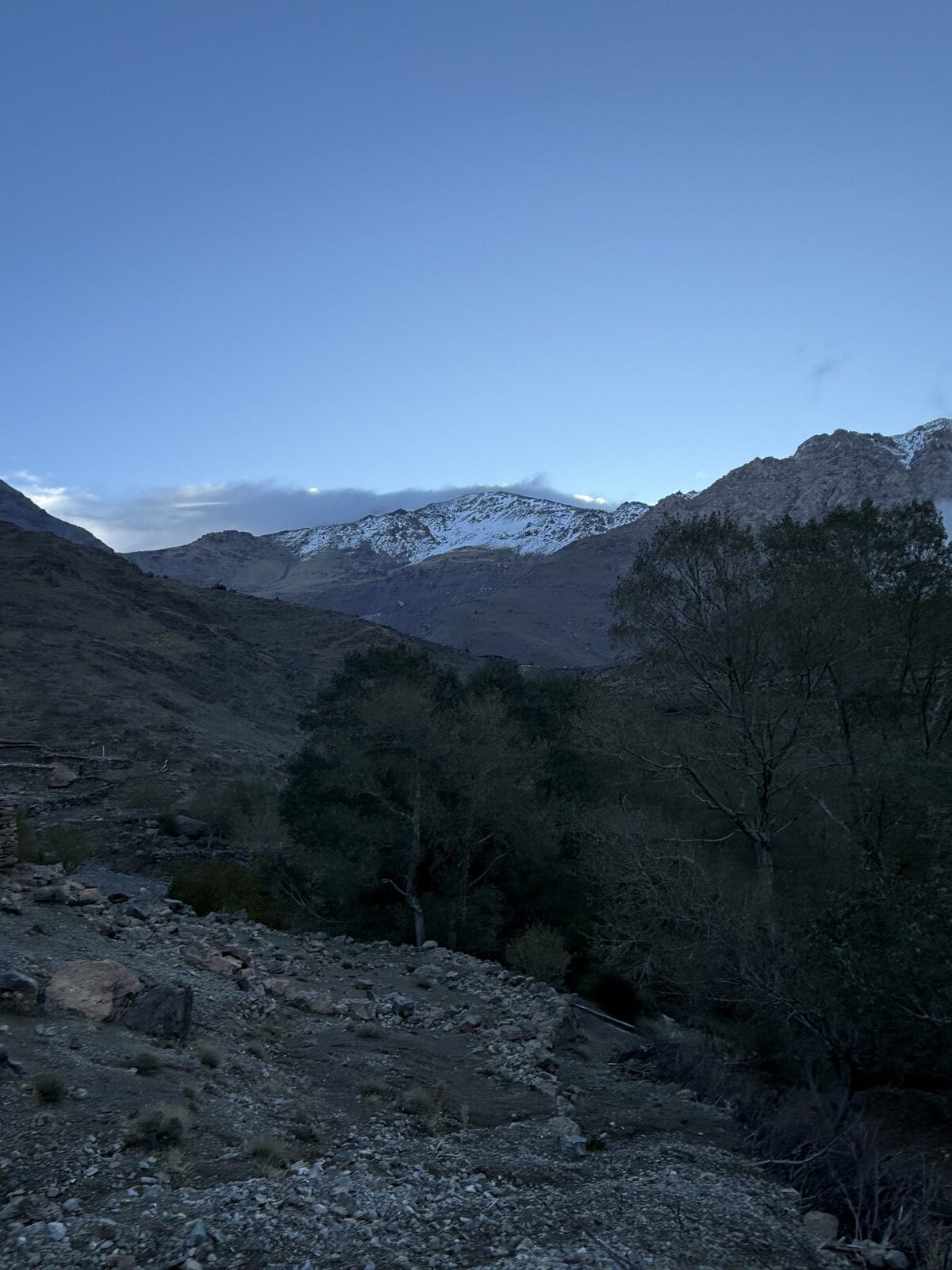
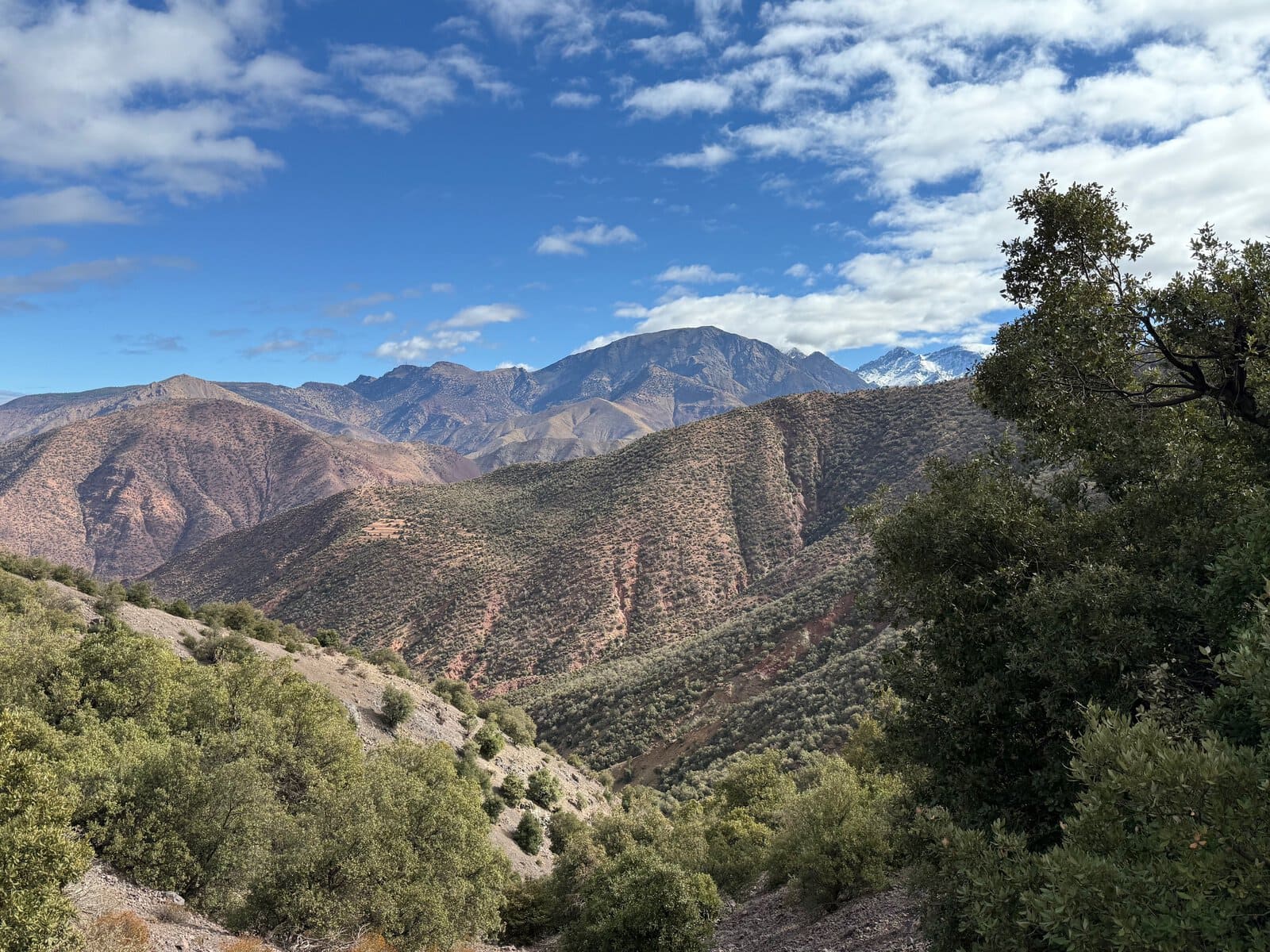
After a hot Moroccan breakfast with sweet Berber tea, we set off on our last day of hiking in the Atlas Mountains. Today, we would complete our hike from Tizi Oussem to the beautiful village of Imlil, a village easily reachable from Marrakesh making it a popular day trip for those who want to experience the Atlas Mountains and Berber hospitably.
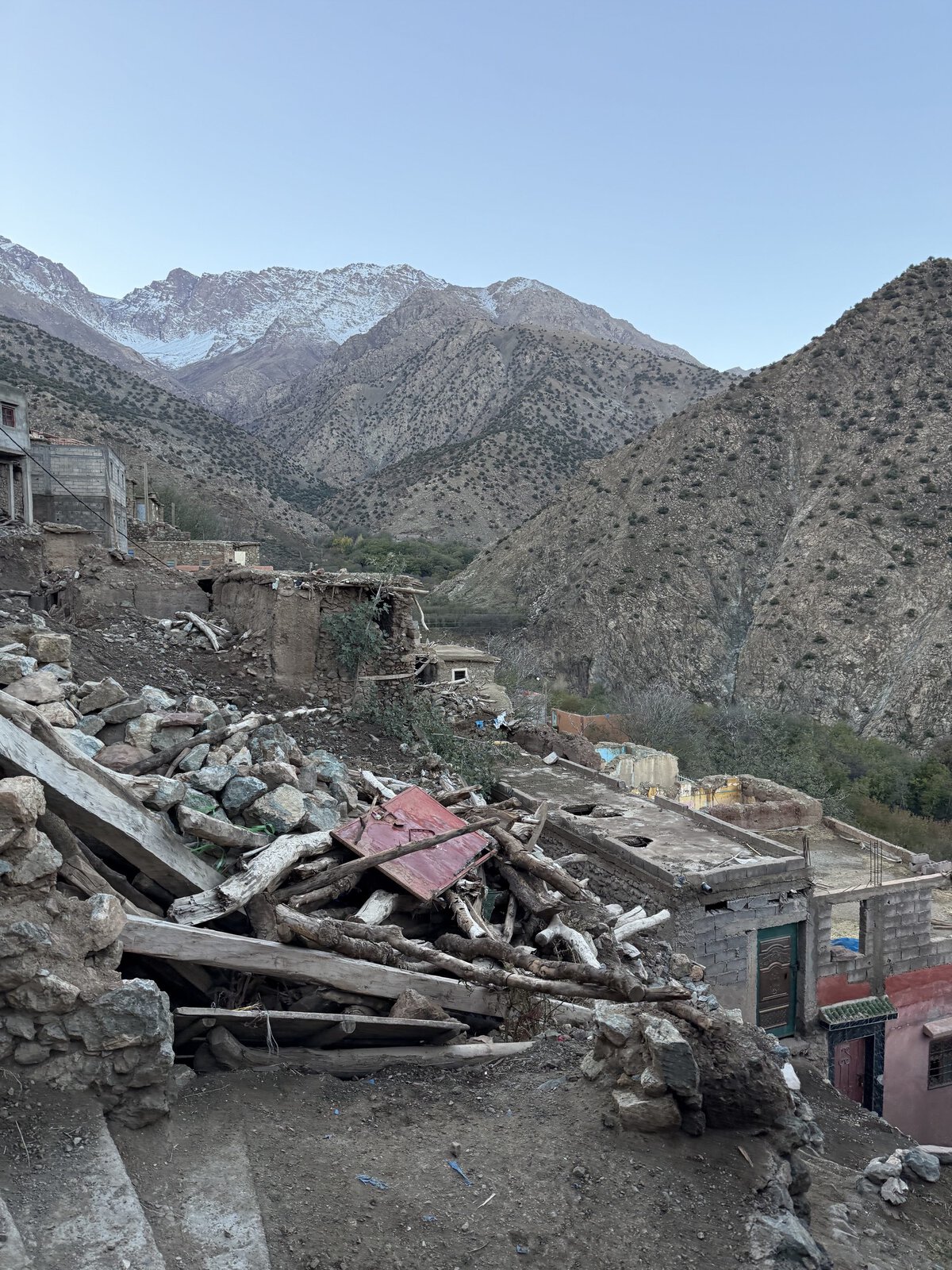
As we left Tizi Oussem, our guide Mohamed showed us some of the leftover destruction from the earthquake a few years back. It had hit this community really hard and they were still trying to rebuild years later. Many Berber homes were built the traditional way using stone to keep the heat in during the winter and hot sun during the summer. Since Berbers are mostly farmers and goat herders, livestock would often live on the bottom floor of the home using their feces to heat the house in the winter months. While a practical style of home, many did not survive a major earthquake so the new homes built by the government and NGOs were made of concrete to last the weather and survive future earthquakes.
Older homes on the left and a newer concrete home pictured on the right. Continue reading →
Our third day trekking in the Atlas Mountains in Morocco was one of the longest days, hiking from the remote village of Imgdal to the even more remote community, Tizi Oussem.
We rose early to the sound of the call to prayer echoing melodically through the valley and the sun was beginning to rise above the village. By day three, I was finally accustomed to sleeping in an unheated gite on a somewhat uncomfortable futon on the floor in a room with six others. It had been quite some time since I traveled this basic and while I would have preferred a warm, cozy bed and a hot shower, the camaraderie of it all made the trip the more memorable.
The second day of trekking the Atlas Mountains ended up being one of my favorites for its sheer wow factor and beauty. Day two took us from the lovely village of Tiziane to the remote Imgdal, a lovely Berber village in the heart of the Atlas Mountains. The five-hour hike would take us up along the Assif n’ait Oussaden valley, passing through walnut groves, climbing up via switchbacks through the clouds until our descent into the village of Imgdal.
After an early morning breakfast, we packed our gear and set off to the rising sun and the echoes of the call to prayer. As we left the village, school children were already up and ready for their walk to school while farmers were heading out to the fields for their day of work. Just like the day before, we did not see another tourist and had the entire trail to ourselves.
Heading out for our hike a little after seven am from the lovely village of Tiziane
Few treks in the world feel as timeless and captivating as the four-day journey through Morocco’s Atlas Mountains. Hailed as one of the world’s great hikes, the trail winds through dramatic mountain scenery and centuries-old Berber villages hidden deep within the valleys, places so untouched that it often feels like stepping back in time. Stone homes cling to steep hillsides layered like a wedding cake, while lush terraced fields snake up the mountains, irrigated by ancient systems still used by farmers today. Life here moves slowly, to rhythms that have endured for generations.
Morocco’s cultural identity is deeply rooted in the heritage of the Berbers (also known as the Amazigh people), who are the Indigenous tribes of North Africa, and the country’s oldest inhabitants. For centuries, the Amazigh have called the Atlas Mountains home, building villages in remote valleys and forging a way of life inseparable from the rugged landscape around them. Intrepid travelers can witness the Berber way of life on foot, hiking through the ancient mule trails that connect these mountain communities.
The trails weaving through the high peaks and valleys of the Atlas Mountains were once vital mule tracks used by Amazigh traders, shepherds, and families to travel between villages. Walking these same routes offers far more than a hike; it is a journey through living history. Around every bend are sweeping mountain vistas, terraced hillsides carved by hand, and villages where traditions and daily life remain deeply connected to the land.
Marrakesh is one of those cities that takes you by surprise. I had been to Morocco before visiting its capital city of Rabat and also Casablanca. Yet once I arrived in Marrakesh, I realized that I hadn’t been to the real Morocco.
Marrakesh, the fourth-largest city in Morocco, located at the foothills of the High Atlas Mountains and one of the country’s four imperial cities, is a place that requires the use of all five senses. From its elaborate, colorful, and endless souqs to its eye-popping architectural treasures, and the plethora of smells, sounds, and oddities of its main square, Jemaa El-Fnaa, Marrakesh is a city that will inspire you, overwhelm you, and keep you exploring its endless serpentine streets until your feet ache.
Have you ever had a dream for so long that it never stopped bugging you until you decided to just do it? For me, it has always been Kilimanjaro. I had wanted to climb this epic mountain ever since my father did it in October 1999. There really had not been any dream or travel goal that I have had for that long.
Like most dreams, there have been many obstacles and roadblocks along the way. It wasn’t until a few years ago that my decades-long dream became a reality. I had wanted to make this climb special and have it be somewhat similar to my life-changing trip to Nepal. Serendipitously, I was connected with the U.S.-based non-profit Solar Sister, an organization that provides solar electricity in Sub-Saharan Africa. For their fifth anniversary, an international team was planning to climb Kilimanjaro(opens in new tab) in June of 2015. Each climber was required to raise $4,000 to support the hiring and training of 8 new Solar Sisters employees in Africa, and to celebrate the success of Solar Sisters, we would climb Kilimanjaro together as a multigenerational, international team. It was a perfect opportunity, and I seized it. Looking back today, it was even better than I ever dreamed it would be. It was truly epic. Figuring out what on earth to do next after such an incredible climb will be the challenge.
Can a First-Timer Climb Kilimanjaro?
Yes, absolutely, first-timers can and do summit Kilimanjaro every year. No technical climbing experience is needed which is why this is such an epic hike. Kilimanjaro soars to 19,340 feet (5,895 m) and the summit night is grueling,but the Machame Route, which I climbed with some prior high-altitude experience (did the Annapurna Trek a few years before(opens in new tab)), is well within reach for anyone who is aerobically fit, mentally determined, and willing to go slowly.
Why go to Kilimanjaro?
Kilimanjaro, the fourth highest peak among the seven summits, soaring at 19,340 feet (5,895 m) and one of the world’s highest freestanding mountains, has long been one of the most popular climbs given its relative ease of climbing (no technical climbing ability is necessary) and beauty. Located 200 miles (330 km) south of the equator in Northern Tanzania, the snow-capped volcanic dome of Kilimanjaro dominates the skyline like no other mountain on earth.
Kilimanjaro is actually not a single peak but a vast complex of cones and cores spreading over 38 miles (61 km) long by 25 miles (40 km) wide. There are three distinct volcanic cones: Kibo, Mawenzi, and Shira. Uhuru Peak is the highest summit on Kibo’s crater rim and is the hopeful destination of thousands of climbers every year.
For me personally, I had grown up hiking, and climbing Kilimanjaro had been a long-term goal of mine after seeing my dad’s photos of his own climb back in 1999. I also desperately wanted to get there soon before the snow that caps the top of this mighty beast and makes it so stunning, is gone forever. Some scientists predict that the glaciers atop Kilimanjaro will be gone as early as 2030. What a tragedy!
What Route to choose?
There are six main climbing routes on Kilimanjaro with the Marangu Route (also known as the “Coca-Cola Route”) being the easiest and most popular. Our group chose the longer, more scenic Machame route that can take anywhere from 6-7 days and is known as one of the most beautiful routes on the mountain, passing through five distinct ecological zones and affording dramatic views every single day of the climb. The Machame Route also has one of the highest success rates for reaching the summit since it allows proper acclimatization before the final summit push.
Total Length of Hike: 62 miles (100 km) up and 24 miles (38 km) down.
Image of Mount Kilimanjaro Climbing Routes (Wikipedia). Our route was the Machame colored in brown.
For many of us, clean water is so plentiful and readily available that we rarely, if ever, pause to consider what life would be like without it. – Marcus Samuelsson
Today, March 22 is World Water Day, a day designated by the United Nations to bring attention of the importance of water. Today, 2.1 billion people live without safe drinking water affecting their health, wellbeing, education and livelihoods. Water is life and in my opinion access to safe water is a basic human right. Water is so critical to life and wellbeing that it was added by the UN as a Sustainable Development Goal (SDG 6) which commits the world to ensuring that everyone has access to safe water by 2030, and includes measures to protect the natural environment and reduce pollution.
In my work, I’ve had several opportunities to write about water and have recently witnessed firsthand the impact of bringing safe water to communities during a trip to Western Kenya last month with LifeStraw.
In light of this important day, I wanted to share with you a few shocking facts about the lack of safe water around the world, ways that single use plastic water bottles are threatening our planet and ideas on how you can help. Please feel free to share this post and help spread awareness of this critical issue.
Demonstrating washing hands with safe water
Trying out the LifeStraw Community Filter
The youngest child at the school, age 3, takes her first sip of safe water
Did you know….
World population impacted by unsafe water:
Globally, 2.1 billion people lack access to safely managed drinking water services. By 2050, the world’s population will have grown by an estimated 2 billion people and global water demand could be up to 30% higher than today. (UNESCO-United Nations World Water Development Report 2018)
Today, around 1.9 billion people live in potentially severely water-scarce areas. By 2050, this could increase to around 3 billion people.
2.5 million children miss school every day around the world due to waterborne illness
29 percent of the global population (2.1 billion people), and 42 percent of Sub-Saharan Africa, lack access to safe drinking water services. (UN)
I rose with excitement and anticipation to the pre-dawn sound of the birds outside my hotel room in Kakamega, Western Kenya. Although the sky was still an inky black, the world outside my window was alive with noise and commotion as drivers rolled into the parking lot thumping African rap music and fellow LifeStraw staff for the LifeStraw Follow the Liters Campaign began to start their day. The smell of breakfast being served two floors below crept through the cracks in my door. Despite not having a huge appetite in the early hours of the morning, I knew that the omelette and perfectly ripe mango I had that morning at 6 would have to fill me up until dinner time.
I jumped out of bed, untangling myself from my mosquito net and quickly dressed in my uniform for the day. A blue LifeStraw t-shirt, a long pair of gray cargo pants, closed-toe hiking shoes, sunscreen, hat and ponytail. Today was to be my first day out in the field and I didn’t want to be late. Despite utter exhaustion, jet lag and concern that I had only slept a little over an hour the night before, I could hardly wait. It was the start of our campaign to reach the one millionth child to receive safe drinking water. Little did I know what a massive operation this would be and how incredibly inspired I’d feel by the end of the week.
Given the size and scale of the campaign, our international team of 130 LifeStraw staff and volunteers were divided up into 15 teams with the goal of reaching 3-4 primary schools per day all in different parts of Western Kenya. My team was called “Team Crocodile” and was lead by Rebecca Masoni, the local Area Coordinator for LifeStraw. We also had local Sub-Country Coordinators Vincent, Patrick and Dorice (known as Mama LifeStraw) and Dehli-based Raju, myself, and mother and daughter pair Detria and Sophia, from California. Over the course of the next five days, our team alone would reach 15 primary schools and 11,923 school children throughout Vihiga, Hamisi, Khwisero, Butere, and Lurambi counties in Western Kenya.
By 6:30 am, the parking lot was jammed pack with a motorcade of SUVs, drivers and enthusiastic LifeStaw staff and volunteers all setting out to start the day. Some of the teams had already departed as early as four in the morning to reach some of the most remote schools. We were lucky to have the region surrounding Kakamega meaning our daily drive to reach the first school would only take about two hours.
As we left our base, we set off into the rising sun leaving behind the chaos of early morning in Kakamega. Markets of fruits and vegetables stands were being set into place. Clumps of shoes, clothing and homewares were laid out on colorful blankets across the dirt ground. Motorcycles of entire families and buses packed to the rim were scurrying around. Children in their school uniforms of baby blue and white, pink and green, maroon and navy blue, were walking alongside the road heading to school.
After a half of hour, the paved roads ended and we began our trek along the bumpy, pot-holed dirt roads of rural Kenya. The roads that always remind me of what it is like to get around in the developing world. The urban landscape began to fade and the beauty of rural, Western Kenya greeted my hungry soul. The lushness and greenery such a delight to see after so many months of colorless winter back at home.
We pass several small towns like this one
Then we reach the countryside
Children are walking to school
Farmers are tending their crops
We pass several small farms
And homes until we reach our first school
1 / 7
We passed several single-plot farms growing maize and tea surrounded by traditional mud huts interspersed by small rural towns of nothing more than a few shacks and rundown buildings. Women walked side by side gracefully balancing 20 liter jerrycans of water on top of their head while farmers worked the fields. Children frantically waved and yelled “Mzungu!” (foreigner) as our car passed them by along the way. As the morning dew began to lift off the horizon, the beauty of the landscape took my breath away. It was spellbinding.
The arrival
An hour and a half later we reached the entrance of our first school, the Khanirir G. Jeptorol Primary School in Hamisi. A faded hand painted wooden sign stood proudly at the gate beckoning us to enter. Our caravanof three SUVs slowly drove up the dirt path to the school, to the sound of laughter, cries of joy and song. As we got out of the car, a large cow bell was rung and out came 500 excited school children dressed in green and pink uniforms, running out the open doors of the school rooms thrilled to meet us.
As much as we ached to say hello and greet the children, I quickly learned that proper protocol is of utter importance in Kenya. The first thing our team had to do was go inside to meet the Head Teacher and cover a few formalities. We briefly introduced ourselves and went over the plans for the next two hours. At the first school, we would be installing five LifeStraw Communities. Each LifeStraw Community can serve 100 children and five would serve the entire population of the school.
While our drivers began installing the LifeStraws, our team assembled inside a large circle with the children surrounding us, for introductions which of course involved song and dance. This was my absolute favorite part of the presentation! It is hard to put into words the feeling of being surrounded by hundreds of joyous children singing, dancing, clapping and laughing together as one. By the end of the week, I couldn’t get the songs out of my head and still wake up in the middle of the night singing them.
Since I had such a hard time capturing my experience into words, I created this short video of some of the footage I took during the week. Every time I watch the video it makes me smile. Hope you can get a sense for what my week was like by viewing it
“Do the difficult things while they are easy and do the great things while they are small. A journey of a thousand miles must begin with a single step”. – Lao Tzu
I left for Kenya on a Thursday afternoon feeling the normal pre-trip jitters of an exceptionally long 24 hours of travel ahead. I was flying from Minneapolis to Amsterdam with a five hour layover, and then I had another eight hour flight to reach Nairobi. I knew that it was going to be a long, exhausting journey yet I was exhilarated all the same to be off on a trip into the unknown.
I boarded my first flight with anticipation wondering what was in store for me when I finally arrived in Kenya. I had been chosen to join LifeStraw’s Follow the Liters campaign to reach the one millionth child to receive safe drinking water. I had a packet of detailed information about the program and the campaign but that was all I honestly knew. I was traveling alone and would meet up with ten of the 130 members of the the LifeStraw team in Amsterdam to continue our journey.
LifeStraw, a part of the Vestergaard global health company, began the Follow the Liters program four years ago in Western Kenya after realizing they could be a catalyst for positive change throughout the region. Children were missing many days of school due to waterborne diseases and illness caused by drinking unsafe water. Some were even dying. The need was immense, and LifeStraw had the answer.
With over twenty years of experience working on global health issues in Kenya, Vestergaard understood that Western Kenya was the perfect place to launch the campaign given the fact that it is one of the most populous, rural parts of the country which is in dire need for safe water. At the end of 2014, 158,000 school children were reached during the first Follow the Liters Campaign. Four years later, we would be reaching one million kids! I could hardly wait to be a part of it.
Giving Back through Retail
LifeStraw is not a pure one-for-one program (like TOMS shoes) because the needs of the retail market and local market on the ground in Kenya are quite different.
For each LifeStraw product sold in retail markets in Canada and the U.S, one child receives safe drinking water for a year. It is not a “buy one give one” model but instead a comprehensive program implemented and adapted for the needs of the local market. For each school LifeStraw serves, they provide ongoing training, education and follow-up for a minimum of five years. It is a long term commitment that employs local staff from the community to ensure sustainability of the program.
This is the consumer LifeStraw product. The straw inside allows you to drink untreated water safely.
This is the LifeStraw Community (LSC) that is provided to the schools. Each LSC filters out harmful waterborne parasites and bacteria which lead to disease.
“For it is in giving that we receive”. – Francis of Assisi
Sometimes life takes an unexpected curve and you just have to go for it. Back in December, as I was preparing for the busiest time of the year for me and my family I received an email telling me about an opportunity to join LifeStraw, a water filtration social enterprise owned by Vestergaard,on their upcoming trip to Kenya in February on a special project: To reach the one millionth child to receive safe drinking water.
I dropped everything I was doing that December day and applied for one of three spots to attend as a storyteller and volunteer on the trip. I hoped for the best and left for the holidays returning right after the New Year to receive the exciting news that I was selected to join the 2018 Follow the Liters team to Kenya!
As I prepare to leave for the trip today, I want to tell you a little bit more about LifeStraw and the what I will be doing for the next week in Kenya. I am thrilled to be going and doing the work I love so much. Traveling, volunteering and doing good! Making a difference has become so important to me throughout the years. I have been blessed with so many opportunities to travel and have realized how inequitable the world can be. Giving back to my family, friends, community and those around the world in need is a critical aspect of my life. I look forward to making a difference over the next week.
Last July, I spent two days with a Maasai community at The Mkuru Training Camp in Uwiro Village, about a three-hour drive away from Moshi. The Mkuru Training Camp is located at the foothills of Mount Meru, just outside Arusha National Park, within one of the most important biodiversity areas of Tanzania: the Maasai Steppe.
My visit still remains one of the most spectacular cultural experiences of my life. I was literally the only guest there and had the thrill of doing a four-hour tour on foot with one of the Maasai warriors and a taking a one-on-one beading class with his mother. Despite modernization and the threat to their way of life, the Maasai still continue to live the way they have for centuries. Their beautiful dress and faces are unforgettable.
Over the past twenty years, the world has truly become a smaller place. Once hard to reach, remote parts of the planet that used to be only for the most adventurous of tourists, have become more accessible. Places like the Himalayas of Nepal, the tiny fishing villages of Southeast Asia and the bushland of the Maasai have opened their doors for travelers, allowing us to see their beautiful unique cultures as never before.
Although it is wonderful that more of the remote corners of the world are now accessible, it comes with a price. The negative impact of tourism on the environment, culture and people of a place, threatens it’s very own authenticity and landscape. This is why choosing sustainable travel is critical if we want to preserve and protect these destinations for the future.
Maasai beadwork has been integrated into the Mkuru community to empower women and give them economic opportunities to sell their work.
Me and Mary learning how to bead
Receiving a gift of earrings
My father and I have been trekking in remote places for decades and every place we go we use local trekking guides and companies. I honestly admit that the initial reasons behind our choice were purely convenience and economical. However, the more we began using local guides, it became clear how incredibly rewarding and important it is to hire locally. Not only do you get a more intimate cultural experience by getting to see a country through their eyes, your investment also greatly supports the local community in which you are visiting. By hiring local, all money you spend on your trip is directly reinvested back in that very place that is so special instead of profiting an international corporation who only has financial interests to gain.
Furthermore, the cross-cultural friendships and understanding that are made and shared by hiring local are priceless. Not only does it create goodwill, it brings a new perspective and understanding on both sides of the relationship. As a client, you get to learn as much as possible about a culture, history, society, life, flora and fauna and environment. As a guide, you gain a better understanding of people who are so different from those portrayed in the media. Together, you can create life-long friendships that promote cultural understanding and peace.
Our group heading down the trail on Kilimanjaro.
Here are three examples of why supporting local guides matters.