On our last day in Courmayeur, we decided to take in the stunning surroundings of the Alps from the top of the Skyway Monte Bianco. Opened in 2015, the Skyway Monte Bianco whisks passengers up to the top of Punta Helbronner at 3466 meters/11371 feet where you can get a bird’s eye view of the entire Mont Blanc Massif. After two days of hiking in Courmayeur’s two valleys, Val Ferret and Val Vény along the Tour de Mont Blanc (TMB), I wanted to show my son from high up above where we had been and where we were headed over the next week hiking along the TMB. We also planned to go to the top of Aiguille du Midi on the French side at the end of our trip when we were in Chamonix.
The “Road to the Sky” as they call it, is not cheap. Round trip tickets start at 52E for adults and 28E for children under 17. Then it is an additional 31 E to take the Panoramic Mont Blanc from Punta Helbronner to Aiguille du Midi, and another fee on the French side to continue down to Chamonix. Since we were short on time, we decided to only take the cable car to Punta Helbronner and back. However, as soon as we lifted off into the clouds and saw the sensational scenery around us, we realized it was worth every euro to ride up to the top of the sky.
After an incredible first hike along our taste of the Tour de Mont Blanc (TMB) into Courmayeur’s Val Ferret, we were thrilled to be doing our second hike in her neighbor, Val Vény. Val Vény is a pastoral valley of the Mont Blanc massif, that like Val Ferret lies southwest of Courmayeur. Val Vény was formed by two glaciers, the Miage Glacier and the Brenva Glacier which literally cut off the valley like an island by two massive moraine walls of the glaciers on each side. Val Vény is quite a magnificent place to hike.
After a filling breakfast of local cheese, cotta ham and fruit, we headed out to grab the local bus in the direction of Val Vény. This time we rode in the opposite direction of Val Ferret and followed the bus through yet another winding path inching us through the lush wide valley. About twenty minutes later, we reached the end of the line and got off at a tiny hamlet called La Visaille.
From La Visaille, we crossed a bridge and began our hike down a wide path sliced within a valley to the Rifugio Elisabetta, another stop along the TMB. It was another postcard-perfect day and I couldn’t have felt more alive. There is something about hiking and being surrounded by mountains that always makes my heart sing.
Arriving at the start of the hike in La Visaille
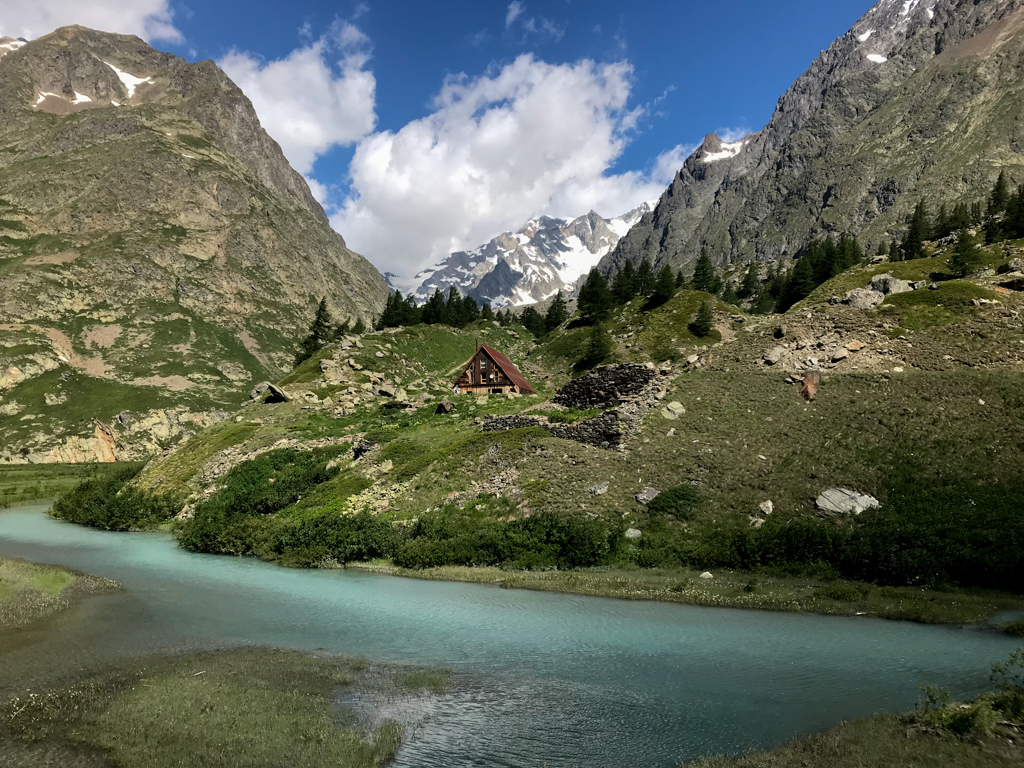
The start of the hike is breathtaking and gives you an idea of the treasure that awaits.
Our first hike along our taste of the Tour de Mont Blanc (TMB) was in the Val Ferret, one of two breathtaking valleys that cut through Courmayeur, Italy on the southeastern side of Mont Blanc. Known as one of the most stunning hikes in the area, especially if blessed with good weather, hiking in Val Ferret would set the tone of what would be a stunning eight full days of hiking around the TMB and leave me longing to go back.
We rose early to one of many mouth-watering, gorgeous mornings in the Alps. The sky was cloudless and eggshell blue and the view of the towering, snow-capped jagged Graian Alps pierced through the sky like lightning. We enjoyed a lovely breakfast of fresh Italian parma ham, local cheese, homemade bread, and sweets before lacing up our hiking boots and heading out.
View right outside my hotel window in Courmayeur, Italy
Although we had rented a car for the week, our hotel recommended taking the bus to the start of our hike since parking is difficult on busy weekends in the summer. With our backpacks ready to go and a picnic lunch of fresh Italian baguette, local cotta ham, tomatoes, and Piave cheese, we set off. We caught the bus at the city hall (Municipio) stop located a few short blocks from our hotel in the direction of Val Ferret.
As we left Courmayeur, it was obvious that the rest of the fully packed bus was also heading to the Val Ferret for a hike. The thirty-minute ride was filled with fellow trekkers from all around the world, sharing stories of their routes and experience on the TMB. It was fun to chat and compare notes, and I especially was excited to meet fellow women older than me partaking in the tour self-guided. Everyone was filled with smiles and laughter. Obviously, their souls were happy and fulfilled from the fresh mountain air and stunning views afforded along the TMB. It made me even more excited to start our day and do our first hike.
The bus drove through a winding valley road and we got off at the stop marked Rifugio Bonatti where we would access the trail.
The air was fresh and pure, and as soon as I was off the bus and on the trail, I felt alive with excitement and anticipation for our day. I was in my element, and all I could think of was the famous John Muir quote: “The mountains are calling and I must go”.
Heading off into Val Ferret
Sensational views like this are common on a lovely day in Val Ferret
Tucked within two valleys, the Val Ferret and Val Veny on the southeastern side of Mont Blanc in the Aosta Valley of Italy lies the lovely alpine town of Courmayeur. Known for its divine scenery and proximity to three iconic long-distance hikes, Courmayeur is the perfect place to base your stay for exploring its stunning alpine scenery.
Courmayeur is actually a series of small hamlets peppered throughout the valley with a historic central village within the heart. Linked by both a tunnel and (for the more stunning view) a cable car to its counterpart, Chamonix, on the other side of Mont Blanc in France, Courmayeur offers a great mountain holiday any time of year.
Before the opening of the 11.6 kilometer-long tunnel in 1965, Courmayeur was relatively small and isolated. Today Courmayeur is known as one of the best ski resort towns in the Alps as well as a wonderful base for hiking, biking and exploring the divine beauty of the Italian Alps.
Why Go
When dreaming about an idyllic European town, Courmayeur is just what comes to mind. Courmayeur is a charming town awash in history, quaintness and ethereal beauty. It’s pedestrian-friendly walking streets are filled with lovely shops and boutiques, and a multitude of open-air cafes and restaurants that dazzle any foodie. Her lovely stone villas and glorious architecture all set against the sensational backdrop of the Italian Alps make Courmayeur the perfect place to base your stay for the Tour de Mont Blanc (TMB) or for those who want to refuel and relax in a lovely intimate Italian town.
View right outside my hotel window in Courmayeur, Italy
View from our hotel down Viale Mont Bianco one of the main streets into town.
Known as one of the greatest multi-day treks in the world, the Tour de Mont Blanc (TMB) is a circular tour of 105 miles/170 kilometers around the mighty Mont Blanc massif traversing three countries – Italy, Switzerland and France, over the course of 10-12 days. Passing through some of the most divine high alpine scenery on earth, the TMB is one of the most stunning multi-day treks of all and is a dream for many avid trekkers.
Ever since my dad and I did the lesser-known Tour de Vanoise back in 2012 (located in Savoie, the eastern Rhône-Alpes region of France), I had dreamed of doing the popular TMB. My father too had wanted to complete some of the TMB after scaling Mount Blanc in 1998. Thankfully, the opportunity finally arrived this summer and better yet, it would be not with two generations of trekkers but three.
On July 4th, my father, 14-year-old son and I left for a ten-day intergenerational hiking trip to Mont Blanc, devising our own Tour de Mont Blanc to fit our needs. Armed with maps, internet resources, and guide books, we set off and had a magnificent time. I learned a lot along the way about what works and what can be improved with planning your own Tour de Mont Blanc. Here is what I discovered and my thoughts on planning your own Taste of Mont Blanc.
My dad, me and my son on our own Tour de Mont Blanc.
Why Go
At 15,771 feet (4807 m), the mighty snow-capped Mount Blanc soars 12,000 feet (3700 m) over Chamonix, dominating the region and controlling the weather in all the surrounding valleys. As the masterpiece of the Mont Blanc massif, an area measuring 29 miles (46 km) long graced with numerous peaks and aiguilles, jaw-dropping sheer rock walls, ridges and tumbling glaciers, the TMB is known as one of the most stunning multi-day treks in the world.
What makes Mont Blanc even more unique is her incredible location at the crossroads of three European countries – France, Italy and Switzerland – giving the trekker a unique cultural experience as well as extraordinary views. Two distinct towns converge below Mont Blanc: Courmayeur (Italy), and Chamonix (France). Given its high elevation, with 11 summits measuring over 13,123 (4000 m), most of the surrounding area is snow and ice-covered with glaciers pouring down the steep mountain-sides creating a magical, breathtaking scenery that delights the eyes and fills the soul.
If you have one long-distance trek to do on your bucket list, then the TMB is the one for you.
With stunning views like this on the hike through Val Veny in Italy, the TMB will never disappoint.
It was yet another beautiful day hiking in the Alps. The sky was a robin’s egg blue dotted with powderpuff clouds. A gentle breeze kissed my face and the stunning scenery of the Alps made me continually want to pinch myself to make sure it wasn’t all just a dream. It was our third day of hiking during a ten day intergenerational hiking trip around Mont Blanc. So far our trip could not have been more surreal.
As my dad and son climbed up the steep path leading us higher and higher above the dazzling aquamarine Moulin Dam far below, all I could think about was the reward for our efforts. A view of the legendary Lac Mort, a high alpine ice-covered lake at 2843 meters (9327 feet) above the Aosta Valley on her perch in the Italian Alps. But then, after two hours of hiking and only twenty minutes to go to our destination, the wind began to change. We could see a series of rain-laden clouds off in the distance over the Aosta Valley. I checked the radar and knew we would be fine however my dad grew nervous. He had been caught in a ravaging thunderstorm atop a mountain before and swore he’d never do it again. He wanted to turn back.
My son and dad on the long hike up from the glorious Moulin Dam to Lac Long
We had just reached the first of two alpine lakes, Lac Long, and it was stunning. It would only take another twenty minutes to reach Lac Mort but my dad said we couldn’t go. An argument brewed because I hate to not complete a hike especially when I knew we could make it before the rain. But I had to respect my dad’s decision despite my displeasure and disappointment. Upset, we turned around and headed back without ever seeing the prize.
Me and my son Max at Lac Long in Aosta, Italy
We were painfully close to the prize destination
I didn’t talk for the next hour of the hike down to the car and purposely held back on my pace letting my dad and son go ahead. Yet it was at that moment when I fully realized the true beauty and power of intergenerational travel.
From a distance, I observed and listened to my dad and teenage son talk about life, the world, their hopes and dreams. Slowly my disappointment and anger eased and instead a deep sense of gratitude grew. For this is what it is all about and why it is so incredibly meaningful to travel as family. This unburdened time together in the middle of nowhere. Sharing our common love of nature and mountains, creating bonds that somehow are often harder to create at home. It is magical and priceless.
My Dad and son talking away
Me and Max
The trip ended up being all I had hoped for and more. It gave me precious time to reconnect with my teenage son, spend more time with my dad and realize what an incredible gift all of these priceless memories are. I look forward to sharing my stories in the upcoming months and reliving the beauty of not only the Alps but of spending sacred time with family. Stay tuned.
There is perhaps no other more mystifying place on earth than Iceland. Known as “the Land of Fire and Ice”, Iceland is home to extreme geological contrasts being blessed with some of the largest glaciers in Europe and also some of the world’s most active volcanoes. Iceland’s extreme beauty has captured the world’s attention making this small Nordic country one of the hottest tourist destinations in the the world. Many travel companies have opened up shop to support the growing tourism industry especially in a sustainable, responsible way. Hidden Iceland is one small tour company that is breaking the way in sustainable travel.
I went to Iceland in the summer of 2008 filled with anticipation. I had heard so much about Iceland’s stunning natural beauty of rushing waterfalls, massive blue icebergs, and her expansive, mysterious landscape. I wanted to see for myself if this magical place was real and within the first day I fell in love with her mystical power and beauty. While there were tourists around most of the sights during my visit, it wasn’t as popular ten years ago as it is today. Over the past few years, tourism has exploded which of course has its pros and cons. Per the Icelandic Tourist Board, “The total foreign overnight visitors to Iceland was around 2.2 million in 2017, a 24.2% increase from 2016, when foreign visitors numbered around 1.8 million”. With Iceland’s small population of approximately 338,000 this surge in popularity has not come without its price and there have been lots of people wondering how to travel to Iceland sustainably and protect its unique culture and environment.
One way you can travel responsibly is by choosing a sustainable tour company that offers off the beaten path tours to lesser visited areas, employs local guides and also takes care of the environment and culture. Hidden Iceland is a boutique travel company that focuses on immersive experiences with passionate guides in remote settings such as glaciers, volcanoes, Northern Light spots and ice caves. Hidden Iceland is also a Certified Climate Neutral Partner offsetting their carbon emissions, and also maintains a strict sustainability policy of offering only small guided group tours. They are currently ranked number 3 in all of Iceland on TripAdvisor out of 386 tour outfitters (with all five star ratings!), and their unique approach to combining personalised service, expert knowledge and a love of all things Iceland is what makes them stand out as one of the best.
Sólheimajökull Blue Ice. South Coast. Photo credit: Norris Niman/Hidden Iceland
I had the opportunity to learn more about Hidden Iceland from Ryan Connolly, one of the co-founders and here is what he has to say about what makes their trips unique. Continue reading →
While Paris has always been my first love, little did I know that I’d also fall madly in love with the old world charm and beauty of Prague. In my opinion, few cities in the world compare to the magical architecture of these two cities, both equally adored in my eyes. I first saw Prague while I was living and studying abroad in Paris back in 1993, just four years after the Velvet Revolution. With over 40 years of communism, much of Prague’s beauty had been shroud in mystery and wasn’t unveiled for the world to see until 1989 with the fall of communism.
Prague’s history is long and deep which makes this charming city even more fascinating. Founded around the end of the 9th century at the crossroads of Europe, Prague became the seat of the Kings of Bohemia with a thriving marketplace alongside the River Vltava. Feuding kings, bloody wars, and the building of the Old Town Square surrounding the immense Prague Castle defined this prospering city that reached its glory in the 14th century during the reign of Charles IV. Charles IV commissioned the building of New Town, the spectacular Charles Bridge, the Gothic masterpiece Saint Vitus Cathedral and the Charles University, the oldest in Central Europe. Thanks to Charles IV, the “golden age” inspired much of the beauty you see in Prague today.
When to Go
Today, Prague relishes as one of the top major tourist destinations in all of Europe where people from all over the world come to take a step back in time and marvel at this masterpiece of architectural delight. Prague’s multi-layered history of architecture takes us back to her founding 1,100 years ago in the Romanesque era to her flourishing by the Gothic, Renaissance and Baroque eras, all within 3.34 square miles.
With only 1.3 million inhabitants, Prague sometimes can feel overrun with tourists blocking its tiny, winding cobblestone streets and filling up its squares. But despite the hordes of tourists, the magic of this city is spellbinding and is bound to take your breath away.
The best time to go to Prague if you want to avoid tourists yet take a little bit of a chance on weather is during the shoulder season meaning either Spring or Fall. We went in early May and had fairly good weather with a little spring rain. It wasn’t too unbearably crowded or hot like it gets during the busy summer months. I imagine September would be lovely in Prague.
Neighborhoods to See
Prague is made up of five independent municipalities: Hradčany (Prague Castle), Lesser Town (Malá Strana), Old Town (Staré Město) and New Town (Nové Město) and Josefov (the Jewish district) was added in 1850. Although Prague was one of the few European cities untouched by WWII, the Nazi occupation lead to the demise of the Jewish population who either fled or were killed in the Holocaust. The Germans who had formed the largest ethnic group in the city were expelled after the war. Then came 40 years of communism followed by freedom and an opening to the world.
In this guide, I will focus on the top touristic neighborhoods to see first for old world charm and architectural bliss: Malá Strana (Lesser Town), Old Town (Staré Město), Malá Strana (Lesser Town), and Hradčany (Prague Castle). We stayed in Nové Město (New Town) which despite its name, is not new as it was founded in 1348 by Emperor Charles IV to link Old Town with other parts of Prague. There is plenty to see in Nové Město as well in terms of stunning architecture, the Wenceslas Square, department stores, shops, restaurants and more. Another district you must visit is Josefov, Prague’s old Jewish ghetto filled with beautiful synagogues, an old Jewish cemetery and the Jewish Town Hall. We only had time to briefly visit the Old New Synagogue (Staronová synagoga), one of the oldest and most valuable European and world Jewish monuments, and the oldest synagogue in Central Europe. We simply ran out of time. I would highly recommend spending at least half a day in Josefov if not more. If you like to shop, then you could also easily spend a half to full day in New Town as well. The itinerary below is meant for at least 2-3 full days to explore at a leisurely pace.
Located a short distance off the shores of Lake Traunsee in the lovely Austrian town of Ebensee is the hiking region of the Feuerkogel. Accessed either on foot or via cable car, the Feurerkogel is one of Austria’s sunniest high altitude plateaus with astounding panoramic views of the Salzkammergut lake region and the Austrian Alps. For those hiking enthusiasts, the Feurerkogel has a variety of traditional Austrian lodges where you can grab a delightful bit to eat or spend the night hiking hut to hut along the many high alpine trails. For us, it was yet another fabulous area for us to hike that was not far from our farm stay at the Landgut Wagnerfeld in Altmünster.
We left for Ebensee shortly after breakfast, following Hauptstraße/B145 south for about thirteen kilometers as it swerved around the edge of Lake Traunsee and finally turned inland towards the mountains. We passed through a lovely residential area that was built around the Traun river as we headed towards the cable car station. As I looked around at our surroundings, it was hard to fathom that such a beautiful town was once home to one of the most horrific Nazi concentration camps of all time. Today a memorial is all that remains of the Ebensee Concentration Camp. The barracks and camp were destroyed after the Liberation in 1945.
After days of late June rain, we finally rose to a glorious robin egg blue sky at our farm stay in the lakes district town of Altmünster in Austria. We could not have been more thrilled! Finally the sun had arrived and we could see The Salzkammergut region of Austria in all her glory. The view of Lake Traunsee juxtaposed against the incline of the Austrian Alps was even more spectacular than I had pictured in my dreams. It was going to be a perfect day for a hike and we knew exactly where we intended to go: Back to The Dachstein Krippenstein in the UNESCO World Heritage Site of Hallstatt and Daschstein where we would complete the Heilbronner Circular Trail on top of the Alps. We had been to the Dachstein Ice Cave a few days ago in the rain and knew that once the clouds lifted it was going to be a magical place to see.
We left Altmünster around nine o’clock and arrived in Obertraun an hour later to find a full parking lot, a far cry from what we had the rainy day before when we visited the Dachstein Ice Cave. To our dismay, the queue for the cable car was very long, filled with families, hikers and tourists who were waiting just like us to be carried up to the top. Normally I would have been perfectly patient but I had waited so long to see the sun and get out on a hike that I was getting a bit restless. Unfortunately we waited over an hour until it was our turn to continue on up however once we arrived, it was so breathtaking that I soon forgot the long wait to get there.
Austria is a country filled with mountains. Did you know that the Alps take up almost two-thirds of Austria? It is a hiker lover’s dream!
We walked off the platform of the Dachstein Krippenstein Mountain station to the surreal beauty of the Austrian Alps. At roughly 6,886 feet (2100 meters), we felt like we were on top of the world. While the majority of the visitors veered to the right towards the 5fingers viewing platform, we choose to go to the left and take a hike on the Heilbronner Circular Trail, a two-hour roundtrip hike with dazzling, jaw-dropping views of the snow-covered peaks of the Alps, the Hallstätter Glacier, and the lovely town of Hallstatt and the brilliant blue lake Hallstätter See, in the green valley far below. We would head over to 5fingers after our hike.
Getting off at the mountain station into a breathtaking world.
Located high above the deep blue waters of Hallstätter See in the Salzkammergut region of Austria lies the Dachstein Krippenstein, home to amazing hikes, spectacular alpine views and mysterious caves. This stunning area includes the fairytale world of the Dachstein Giant Ice Cave, the Mammut and Koppenbrüller caves, the spellbinding viewing platform at 5fingers and the extraordinary hike to the Heilbronner Cross where you can see panoramic views of the Austrian Alps, the historic town of Hallstatt and the Dachstein Glacier. There is also a nature park for children, a cave museum and many educational exhibits to keep young ones and old alike entertained.
You can spend an entire day or two exploring the Dachstein Krippenstein which is located not far from the charming town of Hallstatt, another must-see destination in the Salzkammergut region of Austria. For those adventure junkies, you could probably spend even more time by taking a whirl at paragliding, rock climbing or doing long distance hiking way up high atop the Alps. Whatever you desire to see or do, you will certainly find it at the Dachstein Krippenstein.
For us, since it was a rainy day and I have never been in an ice cave before, we opted to explore the Dachstein Giant Ice Cave and save the hiking for a nicer day. The only downfall is that we had to pay the rather pricey cable car fees twice since we couldn’t do it all in one day. But it would have been a tragedy to not come back on a nicer day and see the extraordinary views from high above. The benefit of having poor weather is that it kept the crowds away and it also meant beautiful views like this one below along the way to Obertraun.
We arrived at the Dachstein Krippenstein Cable Car station to find the parking lot empty. The rain had kept people away and we had a relatively short wait to catch the cable car up to the middle station Schönbergalm (section I). There are three different cable stations that bring you up the mountain and for the cave visit, we only visited the first. As we moved up the mountain, we suddenly busted through fog and clouds to reach the first stop at the mountain restaurant where we purchased our tickets for the Ice Cave tour and ate lunch. Unfortunately we didn’t have the incredible, panoramic views that day that really sells this eating venue and our meal was a little disappointing after all of the delightful dishes we have eaten so far on our trip. But on a gorgeous day, I bet it is a fantastic to sit and eat out on the terrace even if the food is not the best.
Riding up through the clouds on the Dachstein Krippenstein Cable Car
I can only imagine how gorgeous this view of Hallstatt would be on a sunny day!
Nestled between the edge of the mystical shores of Hallstätter See and the dramatic Dachstein mountains lies the small village of Hallstatt, a UNESCO World Heritage site and perhaps the most postcard picture perfect village in all of Austria. Hallstatt deserves its place among the covers of travel guides and as one of the most photographed villages in all of Austria. It is one of the most stunning villages I have ever seen.
Located in the district of Gmunden in Austria’s Salzkammergut region, Hallstatt and the rugged Dachstein mountains and caves are a popular destination for tourists and nature lovers alike. You can easily spend a couple of days here exploring the beauty and culture of Hallstatt, hiking high above in the Dachstein mountains and visiting the Dachstein caves. The only downside is that Hallstatt can be crowded and touristy so you have to plan your timing right. Summer is obviously high season yet sometimes the weather can keep the crowds away.
On our first morning in The Salzkammergut, we rose to yet another unfortunate day of rain. Disappointed that we still had not fully seen our supposedly beautiful surroundings at our farmstay near Lake Traunsee, we decided to make the best of the day and plan something indoors. We had wanted to go hiking but not in the rain as we would not have any views. So instead, we decided to drive to Hallstatt and visit the nearby Dachstein Ice Caves later in the afternoon. What we didn’t realize is the it ended up being a blessing in disguise that it was raining because it kept the tourists away and afforded rather magical views of Hallstatt and Hallstätter See.
We set off after breakfast, heading south on B145 for the hour drive from Altmünster to Hallstatt. Cold rain fell against the windshield and heavy clouds blanketed the sky. We hoped that this would be the last of the rain for a while as we were desperately wanting to get up in the mountains and hike. We didn’t come all the way to Austria to be stuck inside!
As we neared Hallstätter See, we were spellbound by the extraordinary view of the clouds hovering over the lake. We pulled over in the tiny town of Steeg where I captured my first few shots of the lake and surrounding area. I was in awe of its beauty.
I couldn’t believe my eyes. The scenery was so surreal. I felt like we were in Ireland, not Austria. Without the rainy day which was unusual for early July, the view would have been completely different. I realized how grateful I was for the poor weather as it provided some lovely reflections and mystery in the setting. Obviously if it was rainy every day we were in The Salzkammergut I would have been very disappointed because we never would have seen the snow-capped mountains juxtaposed against the aquamarine lakes and sky.
Hallstatt’s history dates back thousands of years to the days of the Early Iron Age civilization and the Celtics from 800-450 BC and derives its prosperity and name (“place of salt”) due to its production and wealth of salt. Settlers to Hallstatt mined salt for centuries, and visitors today can explore some of Hallstatt’s oldest mines such as the Salzwelten located high above Hallstatt on Salzberg (Salt Mountain) and visit a nearby Iron Age burial ground. Continue reading →