A day in Colonia del Sacramento


It was my second trip to Argentina and my third trip to Patagonia. For some reason, I could not get enough. Patagonia is one of the most mystical, magical places in the world. Its remoteness (Patagonia is one of the most remote places on earth and literally at the end of the world), rugged beauty and wild extremes in climate make it like no other place on earth. Perhaps that is why so many others, like me, have fallen in love with the place. There is something otherworldly about it.
My obsession with Patagonia began eight years ago when my husband and I spent ten amazing days trekking and exploring Chile’s national jewel, Torres del Paine National Park. It was a trip of a lifetime that changed my mindset and made me decide that I wanted to travel by foot as much as possible. I realized during that trip that there is truly something unique about going to the middle of nowhere, where there are no phones, no cars, no airplanes, no noise—only silence and nature. It was the first place that I ever truly felt like I was able to escape and relax, as if nothing else mattered in life except the rising and setting of the sun and the song of the birds. The landscape was so wild, so extreme and so above one’s imagination, that it felt like I was on another planet. The splendor and hardship of hiking several hours a day in sometimes extreme weather conditions made me feel at one with nature and with my own inner being. It was almost a spiritual journey. So perhaps that is why I’ve become so obsessed with Patagonia and always want to go back.
November of 2009 was my second trip to Patagonia with my father. The first trip we visited the vibrant, multicultural Buenos Aires and then headed to the Patagonian Lakes District, San Carlos de Bariloche. The trip was wonderful and the beauty was supreme. However, Bariloche was not the wild, intense, extreme Patagonia that I experienced in Chile’s Torres del Paine and I ended up being slightly disappointed. Thus, we had to go back and we had to go further south, deep into the real Patagonia.
This time, after much research, we opted to spend a few days in Buenos Aires (since it is such a fantastic city), do a day trip to Colonia del Sacremento in neighboring Uruguay, and then take two more flights south to the almost the end of the road: El Calafate, the heart of Argentina’s Patagonia.
The flight to Buenos Aires from the States is not bad. American Airlines flys non-stop from Atlanta and the flight was a little over ten hours. One of the pleasures of flying south as opposed to east or west is that there is little change in time. Thus that dreadful jetlag is almost completely avoided, which is a huge bonus in my mind. I find jetlag to be very difficult so I was happy that this time we would hardly feel a thing. Only a two hour time change for me.
We landed in Buenos Aires the next morning, feeling ready to go. I remember seeing the verdant green pastures and fields of Argentina, calling my name, from far below. It was approaching winter in Minnesota and everything at home was brown, bare, and dead. The brilliant green rolling hills below were like a magical shock to my eyes. My heart beat faster as we made our final descent. I couldn’t wait to get on the ground, feel the warm, gentle breeze on my skin and not be bogged down with a heavy winter coat and cap.
The airport was exactly how I had remembered: Big, busy and chaotic. Yet this time I was prepared and the endless swarm of people holding up white signs and placards in the Arrivals Lounge did not overwhelm me. Of course it took over twenty five minutes to find the one man holding the sign that said our name, but we found it. We had our driver and were on our way to our lovely hotel in Palermo Soho, a trendy, newly gentrified neighborhood on the northwestern side of Buenos Aires.
Driving in Buenos Aires takes some series guts. Cars speed in and out of lanes without a skip of a beat and sometimes three lanes of traffic suddenly become five. You feel like you are going to get in a major accident almost every second of the ride and horns are used constantly. When we asked our driver how he does it, he said it takes a good pair of “white knuckles”.
Palermo Soho is a wonderful neighborhood full of hip, boutique hotels, restaurants, designer shops and bars. The streets are tree-lined and full of outdoor cafes and bars. It is a young, urban neighborhood that is so full of energy and excitement that it is impossible not to feel alive. You can find anything you want to eat, whether it be a traditional Argentine Parrilla (grill), café food, or any kind of multicultural food possible. It was the perfect place to unwind after a long day of sightseeing and enjoy an outrageously delightful dinner and bottle of Malbec at a good price.
Since it was our second time in Buenos Aires, we decided to do something different. I had heard a lot of talk about neighboring Uruguay, the second smallest country in South America that has its own unique culture and is a rather unknown hidden treasure to most tourists. Argentina and Uruguay are divided by the brackish Rio de la Plata, and daily ferries, buses and flights are available between Buenos Aires and the three main Uruguayan tourist destinations: Colonia del Sacramento, Montevideo and Punte del Este. We decided to take the morning speed ferry to the tiny gem of Colonia del Sacramento, a UNESCO World Heritage site.
The ride was short but sweet, lasting only forty-five minutes from port to port. The only downside of the trip was that we had to go through customs on each side. But other than that, it was a pretty easy way to visit another country in only a day. Being so close, you would think that Uruguay and Argentina would be exactly the same but there were not. Despite a shared language, a land of gauchos, and a love of football, Argentina and Uruguay are quite different. Although I only had a few hours there to explore, I found Uruguay to be a very intimate, peaceful, easy-going place. There was almost something lackadaisical about it, and it felt like it was set back in time. Here are some of my favorite pictures from my short stay:

Beautiful tree-lined cobblestone street:

For some reason, I just couldn’t get enough of all the old cars. Especially the broken down ones that probably have been here forever.


View down cobblestone street of the river separating Buenos Aires and Colonia:


Pastel painted buildings and colonial architecture:


Plenty of beautiful outdoor cafes. Yes the Uruguanian wine is delicious too.

Another picture of café life. Quiet, relaxing and excellent ambiance. Felt like you were in a long-forgotten world from the past. Very removed from the rapid pace of Buenos Aires. Quite a lovely place.

The Handprints

One of the first things I noticed when I walked into the CCS Home Base in Cartago was the handprints. They were everywhere. Coated across every wall in every room (including the bathrooms!) and covering every single empty space, making them hard to miss and hard to resist.

Every single volunteer that comes through CCS Cartago’s door is invited to paint their handprint, artwork and a quote on the walls of the inside of the home base before they leave. The handprints represent the mark they made in Cartago and I found it truly inspirational to read them. Not an ounce of wall was free from art, quotes, poetry, songs, handprints and names of past volunteers. I could not believe my eyes and would spend any free moments I had during the week reading the walls and reflecting on what each volunteer had said. I also had to think about what I would want to say before I left and where in the heck I would put it since the free space was very limited.

Reflecting back, of course I was very skeptical about the impact I’d have on others in only a week’s time. However, by the end of my week volunteering I was pleasantly surprised to see that all my doubts were proven wrong. I knew I had made a difference in the smiles and hugs I received by not only the friendships I made at the Hogar Jesus de los Manus Nursing Home and Dona Melba’s foster children, but also in the cultural exchange and friendship I shared with the staff at all places including the CCS Home Base (Santi, Jose, Lucy, the cooks and the security guards) and the volunteers as well. However, by far the most surprising thing of all, was that I realized that I received a gift as well. The gift of an overwhelming sense of satisfaction, contentment and joy by the power of giving back. That is a gift that will forever change me and continue me on my path to somehow, if even small, make a difference in this world.

I thought about the quotes and what my week long volunteer stint had meant to me. It meant many different things. Beautiful, compassionate things about how one can truly make a difference, even if it is small, by just giving someone in need a smile or a shoulder to cry on. The fulfillment and joy received by helping people who can’t help themselves due to poverty, abandonment, disability, drug or alcohol abuse or simply old age. In our busy lives back at home in the States, yes of course we have problems, yet it is easy to loose sight of the bigger picture in the world and all those people who are suffering and could use our help. That is what my week volunteering in Costa Rica taught me. That anything is possible and that anything can help. I feel I can no longer travel without giving back, whether it be volunteering, making a new friend abroad or raising money at home to donate to a local NGO in the country I’m visiting. This is my new mantra and raison d’être. I can no longer be just someone passing through. When a place shares their country and all its wonders with me, I am obligated to give back something in return. That is the promise I made myself after Costa Rica. Now it’s time to start fulfilling my dreams!

Here are some of my favorite quotes that touched me deeply:


Handprints at the front entrance:

Handprints leading into my bunk room:

This is a photo of Cassiano and Lindsey, two fellow volunteers, painting their quotes on our last night in Cartago:

Their quotes:

Here is my quote:

Here is a picture of the entire volunteer group in Cartago:

More pictures of the volunteers:


CARPE DIEM!

P.S. For those who are wondering….where is she off to next? I am heading out April 15th to Rabat, Morocco to complete another international volunteer program with Cross-Cultural Solutions. I will be working with Moroccans and African Refuges on learning English. Stay tuned!

Holy Week on Speed

When I booked my volunteer trip to Costa Rica I picked the week that coincided with my children’s school Spring breaks. I would be coming home the day before Easter and that would be give us enough time to have a nice meal Easter Sunday and hid some eggs for the kids. I had no idea that the week before Easter, Holy Week, was one of the most important weeks in the Costa Rica, amass with celebrations, parades, religious processions, fireworks, theater and plays, all in the name of Jesus. Thus you can imagine my surprise and delight that first day I spent in San Jose, Palm Sunday, to see the true meaning of Holy Week on Speed! (Sorry if I offend the more religious types).

The entire week was full of celebrations. As I mentioned in an earlier post (“Fireworks at Noon”) fireworks and processions were huge, day and night. Santi and Jose told us that there would be events occurring every eventing in Cartago and San Rafael and they were indeed correct. A couple of nights we heard the approaching beat of a marching band and were delighted to see a candlelight processional right through town. We also went to a gorgeous candlelight quartet in the Cultural Center and viewed the masses of pilgrims coming to the infamous Basilica daily. It was quite an experience!

Towards the end of the week, San Rafael (the more religious part of town) set up and staged an entire reenactment of The Last Supper. It was held at 8 pm after the sun had set and all light up by candles and torches. Practically the entire town was there with children in tow, watching in awe. The play lasted over two hours and of course I couldn’t understand a word (it was all verses from the Bible in Spanish—a double whammy for me) except the Spanish “Jesus” over and over again. The grand slam of the week was supposed to be the reenactment of the Crucifixion. But I was going to be on my plane ride home to the States so I would unfortunately miss it. Here is a photo of the setting up of the stage:

What the most ironic thing of all about Holy Week was the ban on alcohol. I thought Minnesota’s laws were strict such as no alcohol sold on Sundays and no alcohol sold in grocery stores (not even wine!) but I was completely thrown off guard when I discovered how strict the Costa Rican’s view alcohol (even wine and beer) during Holy Week. All alcohol sold in restaurants, bars, and stores is completely banned from the Thursday before Easter until noon on Easter Sunday! I had never heard of such a strict enforcement anywhere (except of course the Middle Eastern countries which I haven’t had the opportunity to visit yet). The most ironic thing of all is that we were not allowed as volunteers to drink even a glass of wine throughout our week in Cartago, given it is a very religious town and it would not look good having the volunteers partying in front of the locals). However, once we hit Friday night we were free to do as we wished since the program was over. We searched and searched for a place, even a simple restaurant, where we could order a beer or just a single glass of wine and were refused everywhere. Not one single place in or out of town could serve even one glass. It was strictly enforced everywhere. It would have to wait until the plane ride home to the States!

Despite the alcohol ban, we of course still found other ways to celebrate. Friday afternoon, after our volunteer work was completed, Cassiano, Lindsey and I hired a driver to take us to the nearby Tapanti Rainforest. It was only supposedly only an hour or so away but wound up taking a lot longer due to the road conditions near the park (i.e. mostly gravel). But we didn’t mind, we were on an adventure and excited to see the flora and fauna that Costa Rica is world-renowned for.

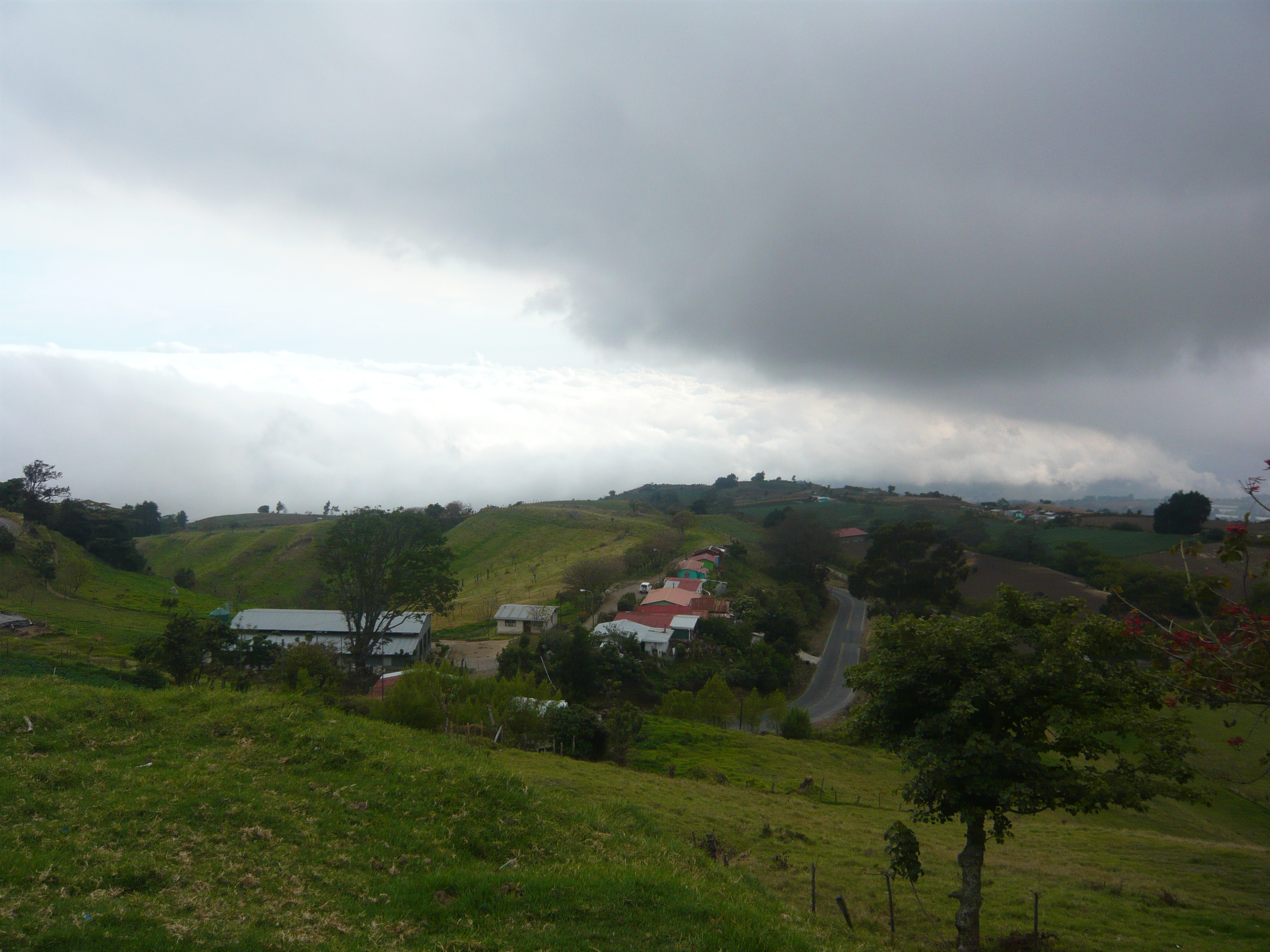
Our drive took us to a beautiful lookout area above Cartago city. Here is a picture of the city laying within the lush, verdant valley:

As we headed towards the park, we passed through a small, lovely village called Orosi. It is about a forty minute drive from Cartago and home to Lucy, the CCS Office Manager. We stopped in Orosi to visit the beautiful, main church which was of course preparing for the upcoming Holy Week Festivities. Here are some pictures of lovely Orosi:
The town square (note the homes going up the hillside):

The main church:

The stage for the upcoming reenactments and plays for Holy Week:

After our visit to Orosi, we got back in the bumpy cab ride with our driver who didn’t speak a lick of English and continued along towards Tapanti National Park. We passed coffee trees going along the way and saw farmers harvesting the beans. Here is a picture of the coffee trees growing right along the road:

We kept thinking we were getting near the park but it was taking forever. We asked the driver how much further in our broken Spanish and he continued to say not much longer. To our dismay, it was getting close to three o’clock which was much later than we had expected. The paved road mysteriously ended and signs of civilization disappeared. The sun was lower in the sky and we were getting worried until we finally saw a sign for the park. We continued on a gravel, bumpy road for almost an hour, my stomach churning due to the motion, and then we finally saw it: Tapanti National Park. Relieved, we got out of the car to pay our entrance fee to the park and saw that the office was closed! The signs at the park said open until 4 pm. It was 4:05. After three and a half hours riding in a hired taxi cab, we were going to get in, somehow. Luckily, Lindsey knew some Spanish and with the help of our driver was able to convince the guard to reopen the park just for us. One hour, we promised, and the gates were opened.

Tapanti was indeed everything a rainforest should be, except the hidden monkeys (which we heard in the distance but did not see). It was lush, wet, and full of life. We walked around for our allotted time, snapped some pictures and enjoyed the silliness of our adventurous day. It was of course raining so we didn’t get much in the way of pictures but here are a few to give you an idea of the misty, secluded rainforest:


A giant mushroom:

The misty view of a hidden waterfall:

A rambling brook:

And finally, the gravel road leading out of the park at dusk:

We were back in the taxi by 5 PM and were not looking forward to our long drive back. Our adventure ended up costing us about $150 but was well worth the trip. We dreamed of having an ice cold beer that night but to our chagrin, the entire country was in an alcohol lockdown. It would have to wait until the plane!

The House of Children

Volunteers were not needed Friday morning at the nursing home so instead Cross-Cultural Solutions (CCS) arranged another volunteer opportunity for the day. CCS works with a variety of different non-profits in Cartago and places their volunteers on an as-needed basis. When you sign up on a CCS volunteer program, you do not find out exactly what your assignment will be until two to three weeks before departure. You have an idea of what it may entail. Normally CCS volunteers work in nursing homes, hospitals, orphanages, centers for disabled children or adults, or teaching English. Thus, when you sign up to volunteer you know it will be one of the above programs. The in-country home base typically evaluates the needs in the community and at each agency to see what the best fit is for the available volunteers. For our week-long program, the nursing home was the best match for the given amount of time and number of volunteers. However, Friday we were not needed thus Santi and Jose found another, exciting opportunity for us: Taking the 35 foster children of Dona Melba’s foster home to the park.

Dona Melba and her husband were well-known throughout Cartago as a wonderful, caring couple who had established a foster home for unwanted, abandoned and abused children over 25 years ago. Their family began slowly, taking in a few children here and there who needed homes and over time grew into a large, close-knit family of adopted and foster children all under one roof.

We had received an update from another volunteer named Julia who was an early high school graduate from St. Louis, Missouri spending three months in Cartago volunteering with Dona Melba’s children. It was a chaotic household with children of all ages and varying degrees of emotional and mental stability living in a small house and being cared for by only Dona Melba and her husband. Occasionally, they would receive local volunteers and ones from other international organizations but most of the time they and their 35 children were on their own. You can imagine the work involved in caring for such a large household. Laundry was done all day long in a large room with piles of washed and folder clothing assorted by age (this was the easiest way for children to find clothing. No one had their own clothing. Everything was shared). Cleaning and work around the house was taken care of by the older children in the family. Cooking was also a shared job by the older children which took hours.

Having two young children of my own, I couldn’t even fathom how much work 35 kids would be! I asked Julia tons of questions on our ride to the home. Over the last three months working with the children, she had become extremely attached and was very concerned about leaving them soon. She knew the ins and outs of each child and told us some of the most devastating, tragic stories of their young lives before they were saved by Dona Melba.

One boy, Alain, had an alcoholic mother who never fed him as an infant and abandoned him barely alive at Dona Melba’s doorstep. There was not even a note. Obviously, he was in poor health and was seriously malnourished which had lead to brain damage. At age eleven, he cannot talk, cannot eat unassisted and struggles with his motor skills such as walking and catching a ball. I spent some time hanging out with him at the park and he was a lovely child who was fascinated by tearing off weeds and throwing them into the creek and watching them float away. He would smile, frantically jump up and down and grunt in pleasure. It was heartbreaking but at least I knew he was loved and cared for with Dona Melba.

Another girl was named Anita who had also been abandoned in a terrible state. Dona Melba found her completely battered up. In a rage, her parents beat her up at two years of age and hurt her so badly that they broke both of her legs. She was rescued by Dona Melba and would not speak or smile for years. A year ago, a CCS volunteer from New York worked with Anita and felt compelled to do something about her terrible situation. Fortunately, her father had connections with a surgeon in NYC and they were able to raise enough money to fly Anita and Dona Melba to New York for surgery that enabled her to finally walk! Although she isn’t perfect on her feet, at least this special little six year old girl can finally get off her hands and knees crawling and walk and play like the others! It was quite a story and brought tears to my eyes.

Then there was Cesar, another disabled child, who was in his teens but was mentally about the age of four or five. He loved playing ball with the volunteers and loved the special attention. To think that this child was abandoned and mistreated just because he wasn’t perfect made me sick. It made me realize that we are all humans.

The morning at the park was delightful. We played ball, chased balloons, ran after the children and enjoyed their imagination and laughter. It was a special day. In light of the horrendous stories and tragic backgrounds, these children had hope. The love and care that they received from Dona Melba, her husband and the endless amount of volunteers flowing in, lead me to believe in the resilience and hope of the human spirit.

Here are some pictures from our visit to the park. In order to provide protection for the kids, I will not include any of their names. The beautiful, serene park:

The beautiful children from the foster home:


Life and Death in a Costa Rican Nursing Home

We spent our last day at Hogar Jesus de los Manos preparing for a big celebration. It was one of the resident’s ninetieth birthdays and as with all birthdays at the nursing home, it was celebrated with a grand ole party for all. A large sheet cake was ordered, balloons and decorations were put up, and music was played. Every able resident (save the ones who were bedridden or on their final days) was to attend and excitement was in the air the morning we arrived for our last day of volunteer work.

As we were preparing for the party we heard the sirens approaching. My heart sank. I knew only too well what that could mean. One of the gravely ill residents, Franco, had passed away. I knew it could happen. We were at a nursing home. Yet for some reason it caught me off guard. We were having so much fun with the residents that death seemed miles away even though many of the residents didn’t have much time left on this earth.

The day before Eduardo had us visit Franco, hold his hand and say our farewells. He was dying of cancer and the nurses ensured us that he wasn’t in pain. Yet there was something lost and far away in his eyes that made me deeply sad. His skin was pale and he was extremely frail. I searched his eyes for something but they were staring blankly into space. I grasped his limp hand, held it tightly and said goodbye. I have not idea if he felt anything yet I hope it at least gave him a little peace before he left. A priest was called to give Franco his last rites and floral arrangements were ordered for the chapel. There would be a funeral the next day, in the afternoon, after the birthday party and after we left.

The death put a more serious tone to the day yet the party was still to go on. While we were decorating the main foyer workers were simultaneously decorating the chapel for the afternoon funeral. The irony between life and death was uncomfortably present yet quietly accepted.

Throughout the day I reflected on how amazing it was that we were able to so quickly make wonderful bounds with the residents. I had initially thought a nursing home placement would be very depressing but I was completely surprised. The residents were very peaceful and were cared for by a very loving, caring staff. Each resident was treated with utter respect and dignity and love.

On the last day, we were able to take some photos of our new friends and I took the opportunity to get some of my favorite residents.
Here I am with Javier, one of my favorites.  He would go on and on about how he had traveled the world and was half American, speaking fiercely in Spanish and English.  His stories were always the same and he obviously forgot half the time that he just told you the same thing two mintues ago.  He was full of fire and life and truly made me laugh.  He grew a fondness of me and preferred to have me wheel him into the dining hall or entertain him.  He always wore his cap and would fold up his artwork (colored pages from a children’s coloring book) and hide them under his hat.  He also loved to keep a small ball under his cap as well.  He was one of the funniest residents I’d met:

Here is a picture of Javier alone.  His expression truly portrays his sarcastic, full-of-life attitude:


Here is a picture of our only male volunteer, Cassiano with one of the ladies, Carmen. I did a red manicure on her nails and she loved it.  She was very sweet and extremely quiet.   She also enjoyed coloring and doing crafts.

Elena with Lillian, one of the sweetest, cutiest grannies there. She married one of the residents and they always walk hand and hand, and smile. Love can happen anytime!
Me with the “primero el mundo” , the best boxer in his days in costa rica. He always loved to do his punches and he smiled a ton:

Me with Miguel, or Mike, as he liked to be called. He loves to dance thus when we put on the Latin music he would hold our hands and we would rock to the beat. He also spoke a little English.

The birthday celebration began mid-morning and it was quite an effort getting all 32 residents moved into the hall. It was nice that we were there to help the small staff as over half the residents are in wheelchairs while the ones that could walk needed assistance. The cake was cut and served and gobbled up much faster than lunch. Then the music began. Thanks to our earlier Latin Dance classes, we were able to strike up a beat with the residents. Costa Ricans LOVE to dance, regardless of age, ability or disability. We danced with the able-bodied men and women and even danced with people in wheelchairs. If the men were not able to dance, they loved to watch us dance as they still embraced the machismo culture despite their age. Men are men, young or old.
The residents smiles of joy were contagious and we had a ball. Here are some photos:
The residents loved to dance or watch us dance (if they were in a wheelchair). Me dancing with “La Cubana”, the cuban woman who loves to dance and still has her groove.
Here is a picture of some of the residents who sat around in a big circle, listening to the music and watching the dancing.  Note La Princessa, in pink. She is in her 90s and always wears make-up and was once very beautiful in her days.
We also sang La Bamba in Spanish to them and they loved it. Overall, the party was a big success and brought a little bit of sunshine to Hogar Jesus de los Manos.  Leaving was the hardest part.  We had grown attached in such a short time and felt like we truly made a difference.   After we said our goodbyes, I could hear Javier’s voice in the distance calling my name to come back.  Slowly his voice faded away until you could not longer here a sound except the rapid beating of my heart.

A Burst of Color and Life

I woke up as usual to the song of the birds and wonderful, fragrant smells flowing down the long corridor from the kitchen. It was six o’clock on the nose and time to start day 3 at the nursing home. I was looking forward to it as I truly felt like we’d made a lot of progress in the last two days. Doors were open to friendships and smiles were freely exchanged. I realized that it was a humbling experience working with the elderly. In our country, there really is no respect for them. Nothing like there should be at least, in my humble opinion. In Costa Rica, the grandparents were sacred and highly respected. That is why the reason behind Jesus de los Manos was so tragic; the most scared part of Tico life is family and here these grandmothers and grandfathers were discarded and forgotten, like a child’s old toy. Yet the resilience and desire to live (pura vida mentality) kept these abandoned abuelas and abuelos alive and well, even happy. It was a beautiful thing.

When we arrived, there they were, as expected, lined up outside on the terraces to greet us. It was another perfect day with highs in the low seventies and a crisp, fresh breeze descending off the mountain into the Central Valley. Today we were going to work on more beautification of the grounds and of course entertain the residents. We started by gathering the old, rusty paint cans out of the shed. On our short walk to the shed, Eduardo pointed out the gorgeous mural that was painted the week before by a group of High School students volunteering for the week with CCS. It was extremely impressive and the residents loved it. Here is a picture of the completed in a week, piece of art:

We grabbed the scarlet red paint cans, a couple brushes and some plastic tarp to lay down on the pavement and began painting. We were painting the old, worn out garbage cans (YES garbage cans) from a dirty green to a brilliant red as Eduardo had asked. Why? For two reasons: First, so they would stand out and the residents could easily locate the garbage cans. Second, and most important, to make them look prettier. Eduardo was big into spicing up the nursing home and landscape in order to make it a nicer place to live. These people enjoyed the Pura Vida so anything to make their final years better was done.

After the cans were painted, we headed on inside to the large, rectangular recreation room where long tables and chairs were set up and our friends were awaiting. We were going to do coloring, card games and more handicrafts for the rest of the morning. It was ironic doing some of the same games and activities with the elderly as I do at home with my children. It reminded me of the movie The Curious Case of Benjamin Button in a sense. The circle of life and how we all end up reverting to our infant years when we age and are no longer able to dress ourselves, feed ourselves or even color unassisted. I was expecting this realization to be sad but for some reason it was not. It was hopeful in a way to see how peaceful and happy you could be in your final years. Not the depressing, worrisome slow death that most people fear.

Each volunteer was quickly developing their unique friendships and attachments with certain residents. It was funny how that happened. There were preferences given to what volunteer would entertain them or which one would wheel them into the dining room. Each resident was so incredibly unique and had their quirks and their stories.

I had grown attached to a couple. Javier, the crazy, spit and fire Costa Rican man who claimed he had traveled the world and was half American, became one of my favorites. I also enjoyed spending time talking with a man named Juan Pablo whose English was excellent. Then their was the “best boxer in the world”, or “primero el mundo” as he would like to say. There was also Lilly who was a real sweetheart and actually recently married another resident the past month. The couple always sat side by side and they were the only residents to have a communal bed. Finally there was la Princessa who was simply lovely and Carmen who loved having her nails done. There were not just nameless souls. They were amazing, loving people with an entire history and life to share with those who listened and those for cared.

Here are a few pictures:
This picture shows the work involved in getting all the residents to the dining room and fed for meals. Since over half of them are in wheelchairs, it required at least ten to fifteen minutes getting everyone out of their rooms and moved into the dining room. When the volunteers aren’t there to help, it takes up to a half an hour to bring them to the dining room and back after the meal. Each resident also has their preferred seating (kind of like an assigned place that they assigned themselves). We quickly learned where each person went and who they sat next to. There were also about seven residents who needed to be fed and could not eat on their own. Thus, we hand fed these people just like I had fed my children as infants. It was a touching experience. You could see the appreciation in their eyes. It was very humbling.

Nightlife in a Sleepy, Catholic Town

As I mentioned in earlier posts, leaving the CCS Home Base at night was not recommended unless in a group or with a male companion. There was no going out to get a drink, no going to the club, just staying back at the Home Base eating a huge meal and hanging out with the group or reading. A big part of traveling for me includes the night life. I love to go out and have fun however I had to respect the circumstances of our volunteer commitment. Since there were no tourists in Cartago, we really stood out and going to the bars (if there were any) in a Catholic town would have looked really bad. I was to learn later just how strict the drinking policy was.

When Santi mentioned an evening outing a few of us practically jumped out of our seats with the opportunity to get out at night. Santi heard that the local Cartago Cultural and Music center was having a free performance in honor of Holy Week for whoever wanted to attend. I could hardly wait to check things out and have an escape.

We left after dinner and it was a perfect evening out. Fresh, light breeze and wonderful. The walk to the Cultural Center took about fifteen minutes heading down windy streets and passing through the center of town. There was not a whole lot going on. People were out and about, doing their business, yet I couldn’t see much in the way of nightlife.

The Cultural Center is a beautiful, traditional Costa Rican building set in the center of town with a gorgeous indoor courtyard full of fragrant flowers, plants and best of all, an opening up to the sky. The Cultural Center offers art and music courses to the people of Cartago at no charge thus you can see artists in residence painting and showing their art and music performances. That evening, we were attending a free musical performance by some of the students in honor of Holy Week. To my surprise, the lights were turned off and the entire piece of music was played by candlelight. It was a quartet of strings and absolutely magical. All the music played was catholic and had to do with Holy Week. There were slides played against the wall that complemented the music. It was very peaceful and put one in the spirit of the importance of the week, even for those who are not that religious.
Here is a picture of the lovely traditional courtyard of the Cultural Center:
After the performance, we walked back to the CCS Home Base and entered a nearby church that was just cleaning up after an evening service. Here are some photos of the outside and inside of the church:


Then, of course, we hit the grand-daddy of all churches, the Basilica light up at night and it was spectacular. Here are some photos:


It was a fantastic evening out and my eyes closed immediately once I hit my bottom bunk. I couldn’t wait for Day 3 at the nursing home. I knew that my friends would be lined up early, on the terrace, anxiously awaiting our arrival with delight.

The Circle of Life

I woke up Tuesday morning at the crack of dawn, as usual. The pale light was shining through the curtain cracks and the birds were chirping away in beautiful song. It was 6 am, and time to start the day. The breakfast was cooking (I could smell the hot cooked meal along with the freshly roasted java throughout the long corridor, entering my bunk room) and it was time to get up and ready for Day 2 at the nursing home. I knew they were waiting.

We loaded the van with the usual supplies and headed off to Hogar Jesus de los Manos, ready to practice our improved Spanish and see our new friends. We passed the twisty, serpentine roads once again, alive with chatter and laughter, and arrived at the gates ten minutes later.

As expected, there they were, all 32 residents lined up outside on their sunny terraces (save the gardener who was watering the plants, the man with dementia who was pacing up and down ranting loudly, unintelligibly to himself, and two others on “their final days” in bed). They were all smiles as they patiently awaiting our warm greetings and their eyes beamed with joy as soon as we grasped their hand to say buenos dias. It was if we had been friends all along, it was unbelievable and I realized just how hungry they were for our attention, care, and compassion.

The residents were not neglected at all and instead received an enormous amount of love and care from the small staff at Hogar Jesus de los Manos. Unfortunately being a non-profit meant there was not a lot of money to hire enough staff so the small staff in place worked long, hard hours for little pay. Yet each worker showed enormous compassion for the residents and knew their individuals quirks and needs. For example, Juan Pablo always sits out by the red bench next to Dona Maria each morning after breakfast, and Fernando sits next to Lilly each meal on the first table facing the entrance of the dining room. The staff had a huge capacity for remembering these tiny like idiosyncrasies which I found truly amazing.

Our plan of attack for day 2 was twofold: First we would work on planting new trees along the sidewalk and second we would entertain the residents with cards, coloring and the long-anticipated manicure and pedicures for the ladies. Eduardo dreamed of having a lovely, tree-lined sidewalk full of flowing eucalyptus trees that would beautify the courtyard and bring joy to the residents. Last year, a group of CCS volunteers planted small eucalyptus saplings and they had already grown six feet tall.
Insert: Here is a photo of the trees planted last year.

We were to plant four more saplings to hopes that they too would grow and help line the sidewalk. It wasn’t as easy as it looked. The ground was hard as a rock and we were thankful to have a young, strong male volunteer with us to help dig the holes. Cassiano was a wonderful man, mature well beyond his years, and a perfect gentleman. We dug the holes as deep as we could and Cassi did the rest.
Insert: Here is a picture of the saplings.
Insert: Here is a picture of us volunteers, dirty and happy after a hard days work.

While we were digging, we noticed the same old man dressed in long pants and sunhat out watering and tending the garden every day. He couldn’t speak but he would acknowledge our presence with a smile and he loved caring for that garden.
Insert: Here he is, tending the garden.

Eduardo was proud of the gardens. He knew the importance of nature and also responsibility. Having a garden that residents could tend, love, and care for was an important way that they could feel responsibility. Eduardo hoped that someday future volunteers could help plant a vegetable garden where the home could grow their own fresh produce. We started the digging but ran out of time since the work was extremely hard given our meager tools. The ground was much too hard and we needed better equipment. The vegetable garden would have to wait.

Insert: Here is a picture of how the garbage collection is done at the home. A local women brings her bull with a cart and all the leftover food is carried away and then composted. She lives a few blocks away and keeps her bull, goats, and chickens right her yard, a common practice in Costa Rica.

Our next piece of business for the day was “entertainment”. Some of the volunteers had stayed back from the manual labor and had interacted with the residents. We arrived to see them coloring out of children’s coloring books (one of their favorite activities), and making beaded necklaces. Some of the men were coloring too and others were outside playing ball. They all very lively and jovial. However, the real excitement came when we walked in as the ladies knew it was time for a visit to the spa!

We set up a table with different shades of nail polish-scarlet reds, bright pinks, sassy oranges, earthy browns-and then lined the waiting ladies up. They could hardly contain their joy and excitement at getting their nails done. Like most Latin cultures, female beauty is highly important and even these elderly women wanted to look beautiful. Given their arthritic hands and low dexterity painting nails was not an option for them. Thus getting their nails done by volunteers was a treat and a highlight of their day.

Not speaking much Spanish did not matter. It was the loving touch and delicate work on their old hands and toes that truly mattered. I loaded up my hands with lotion and gave their sore arms and hands a massage and they closed their eyes in relaxation. It was beautiful and nothing I say here can express how touching the experience it was. One woman, who everyone calls “La Princessa”, had been a real beauty in her days and was even beautiful now in her nineties. She always wore pink and always wore makeup and lipstick. She couldn’t speak anymore yet her pleasure at receiving a manicure was undeniable. I learned that morning that even small acts of kindness and love can make a difference and mean the world to someone else. It was a good lesson.

The Midnight Arrivals

I had slowly drifted off to a deep sleep, thanks to the cold medicine, and was out cold when I heard the gate buzz. It was pitch black in my spartanly furnished bunk room save the pale, low light shining in through the cracks of the open windows. It was so quiet that you could hear a pin drop making the opening of the gates sound like the crashing sounds of the weekly garbage collection. I pushed the light button on my watch and it flashed the time of 12:15 am. Judging by the noise and commotion, our three other volunteers from Atlanta had finally arrived. Of course I was happy they arrived safe and sound yet slightly unhappy about the fact that I most likely wouldn’t be able to fall back asleep again for hours. Unfortunately sleeping in new environments is not my forte thus I usually have trouble when I travel. That is where a good pair of ear plugs, an eye cover and a sleep aid come in handy.

Everyone was woken up and went out to meet the new arrivals: Beverly, Ophelia and Jo, all from “hot Lanta”. They were a gregarious, loud, cheerful group of ladies that came from the most opposite walk of life as could be. I had never met a Southern Baptist before and now I would have the opportunity to meet three! It was going to be interesting to see how their faith played a role in the volunteer experience as well as being in Costa Rica during the most religious week of the year. I realized that I would be exposed to a lot more culture this week than originally planned.

I woke up Monday morning around 6am as the sun slowly began to rise over the Central Valley. I could hear birds singing cheerfully, something I had dearly missed over our long Minnesotan winter. I laid in bed for a few minutes enjoying the beauty of the birds’s music and also trying to access how I felt. Tired, disoriented and still sick. Bummer. I truly didn’t want to infect any of the nursing home residents (luckily I packed plenty of Purell!) The smell of freshly cooked eggs found it’s way along the long narrow corridor and filled the rooms, making my stomach grumble. It was the first day of our volunteer work and I was looking forward to it.

One by one, the other volunteers began to rise and the once quiet Home Base came to life with movement and noise. Excitement was in the air about our new arrivals and the start of our work at our volunteer site. We did not have much information on the nursing home, just that it was located here in Cartago, not far from the Home Base and had about 40 residents, all abandoned abuelas and abuelos (grandmothers and grandfathers). To most Americans, nursing homes are a fact of life and perhaps the most common route for the elderly. In Costa Rica, however, the entire family structure is much different. Generations of families live together. Adult children are responsible for taking care of their parents as they enter the twilight years of their life. Thus most grandparents live at home with their children and grandchildren all under one roof. This is customary so you can imagine the stigma on the elderly people who are abandoned from their family and have no place to go. Hogar de los Monos de Jesus Nursing Home was established as a place for these kinds of people to live and be cared for in a loving, faithful manner. The residents had no family to visit them. They only had the staff and each other. That was why the volunteers were so important. Besides helping with various odds and ends around the nursing home, the main duty of the volunteers was to interact with the residents and entertain them. As we would learn, this was by far the most important gift we could give: Friendship, Companionship, Compassion and Love. This was how we would make a difference in only one week. Something that seemed impossible but was within our grasp.

Allan, our driver, pulled the van up outside the Home Base at 8 am. Jose told us to gather up a big sack full of supplies to bring to the nursing home so we loaded in markers, colored paper, balloons, beauty products (for the ladies), books, music and other miscellaneous items. We were all dressed in t-shirts and long pants, the uniform required for working in Costa Rica. Shorts or short skirts were not permitted nor were tank tops or flip-flops. We had to remember that Cartago was a very Catholic place and the nursing home was religious-based meaning we were expected to dress conservatively. I was curious to see what the nursing home would be like and had very mixed feelings about the placement. Would it be depressing? Would it be hard? Would I feel like we were having any kind of impact on the residents? Would we be able to make a difference in only a week? These were all thoughts that raced through my mind as we winded around the narrow, serpentine streets of central Cartago.

Here are some photos of the CCS Home Base:

Inside the building, the long corridor lined with lounge chairs for reading and relaxing:

Inside the entrance to the Home Base:

One of my favorite things about the inside of the Home Base, all the wonderfully, inspiring quote written by past volunteers. Each volunteer wrote a quote and added a handprint to the wall before they left Cartago. I could spend hours walking around and reading them. Here are a few of my favorites:

Dancing in the Sky

The flight began it’s approach into San Jose International Airport and my palms began to sweat in anticipation. Instead of seeing the lush vibrant green landscape that I had heard so much about before coming, the sky was dark save the thousand twinkling lights of the city below. I couldn’t wait to be on the ground! I was utterly exhausted from my cold and the pressure of the descent wreaked havoc on my eardrums. But despite it all, I was excited to finally be here in Costa Rica, a place I’ve wanted to visit for a long time.

I gathered my belongings, headed through customs and entered into the Arrivals lounge into a sea of black heads holding hundreds of white signs listing names of the passengers whom they’ve come to greet. I also find the Arrivals area in another country to be quite a stressful, disorderly place. You walk through the glass doors and there you are, voila, surrounded by hundreds of smiling, shouting people waving big white signs in your face. It is overwhelming to say the least. Especially when you are tired or jet-lagged (which I was not given only a two hour time change and a relatively short flight from Minneapolis).

I searched the eager faces, desperately hoping he was there. Then I found him, smiling and holding a sign that said Mrs. Melancon (so formal!) and was relieved that my driver had come. You never know for sure when corresponding and organizing all your travel details via email. Especially when there is a language barrier involved. Yet I was glad he was there to take me to my hotel. The last thing I wanted to do was have to haggle with an unknown driver in a language I wasn’t all that red hot at. Furthermore, it was almost nine o’clock and I was ready to relax.

The driver grabbed my bags, packed them inside the small, old sedan and sped off towards downtown San Jose. It was Saturday night and the city was incredibly alive. People were out, everywhere, walking down the streets, driving in cars, and going out to eat. I could feel the energy pull me in and instantly felt happy. It had been such a long cold winter!

My driver didn’t speak a lick of English yet that didn’t seem to faze him one bit. He talked boisterously and rapidly to me the entire ride, and was delighted by my second grade level Spanish. In fact, he encouraged it which was a relief and helped me let down my guard so I wasn’t so afraid of making my many mistakes. Somehow, like magic we managed to communicate and before I knew it, we were at my hotel, El Presidente, located right on the main drag. Gracias, I said cheerfully, glad that he got me there safe and sound and also put up with my terrible Spanish. I secretly cursed myself for majoring in French! The Ticos, as Costa Rican people are called, seemed extremely cool, gregarious people that I definitely wanted to get to know. It would have helped if I could communicate better in Spanish but I hoped that after a week long immersion, I would somehow become more proficient.

The hotel was large and quite modern. I had no idea at all what to expect so I was quite pleased to be in a clean, comfortable, safe place. The staff was overwhelmingly friendly and welcomed me with smiles. Despite my pounding sinus headache and sore throat, I had to get a drink before bed. I knew there was no way I could sleep so soon after arriving into a new country. Fortunately the hotel has a nice gringo bar that opens up onto the street, which enabled me, a blond American woman traveling solo, to have herself a glass of ice cold Sav Blanc and watch the world go by on a Saturday night. I was amazed by the people out on the streets. I had heard several times that San Jose can be dangerous, especially for foreign women and especially at night. The hotel staff reminded me gently to not leave the hotel at night alone. Period. Of course I didn’t. Thus finding the gringo bar was the perfect opportunity to explore my surroundings all under the comforts and safety of the hotel. Tomorrow I had the entire day to explore the city and I would talk with the front desk about where to go. I couldn’t wait to see for myself what all the fuss and fascination is about with Costa Rica. And, tomorrow was the day!

Pura Vida Costa Rica!

It was finally nearing the end of Minnesota’s infamous brutally cold, never-ending winters.  Winter has never been my cup of tea.  It is two things:  Too cold and too long.     Sometimes winter can last almost six full months making it hard to believe that anyone would ever choose to live here.  Yet, somehow, like other hearty Midwesterners, I manage to survive.    

Spring does not arrive until late April or early May.  Usually we would get a few teaser days when the temperature is well above average, and everyone is out and about enjoying the weather.  The lakes start to thaw, the birds reappear, and the snow slowly begins to melt making messy, splashy puddles everywhere.  But before you know it, winter magically reappears and people return to their long, lonely hibernation.  The winter-spring dance normally goes on for weeks until the ice on the lakes finally breaks free, the vibrant green buds burst into leaves and people actually come out of their homes.  It feels like some kind of strange, yet predictable rebirth as life once again returns to Minnesota. 

It is usually around this time of year, in mid-to-late March, that every sane Minnesotan is beyond stir crazy and is desperately seeking sun and sand.  Airplanes become packed with pasty, white, hearty Minnesotans heading south.  Schools close.  Homes become empty and there is no one around.  Many prefer to vacation in Florida or some other tropical paradise far away from anything white and cold.  Others prefer heading south of the border to some luxurious or cheap beachfront hotel in Mexico. 

For me, it was something similar yet different as well.  Like many others, I was also headed south, too, where I would happily be wearing my sandals and t-shirts that had been tucked away for months.  I was going to Costa Rica, but not to sit a beautiful beach and drink every worry in my life away.  I was going on a different kind of vacation.  A volunteer vacation. 

Volunteer vacation?  What in the heck is that?  friends asked, wondering how on earth the two words could go hand and hand.  Was it some kind of mid-life crisis?  friends secretly wondered.  Or some kind of “desperate housewife” kind of deal?  Was she going mad?  Although they didn’t exactly ask me these questions, their confused, bewildered faces clearly indicated what they were thinking.  They didn’t understand me.  They didn’t travel.  Well, at least they didn’t travel to the places I wanted to go.  And, that was the problem.   Even my own mother found the idea strange. 

So, why did I decide to leave my husband and two young children behind for a week and volunteer in Costa Rica?  Perhaps it was a little of all the above….mid-life crisis, desperate housewife, mad or so on.  But the real reason behind my decision was simply because I wanted to.   I had always wanted to. 

Ten years ago I saw the article on global volunteering and read it with high hopes that someday I’d be able to do the same.  The stories all sounded amazing:  Working in orphanages in Romania, teaching English in Tanzania, building a school in Peru.  Experiences that would last a lifetime, and would make you feel like you were doing something great in the world, not just earning a meager paycheck or climbing the corporate ladder.  I dreamed of someday volunteering abroad but I knew that it was impossible at that point in my life.  I clipped the article, kept it in my file cabinet, hidden away for years, hoping someday I’d be able to do it.  The path I was following in my life was typical for a young, college-educated American girl:  Work, building a career, marriage, and then finally kids.  I continued to travel internationally throughout the years with my boyfriend, then fiancé, then husband, but due to the pure lack of American vacation,  I never did a volunteer trip (vacation was only two weeks per year given at start of a job and taking more than a week off at once was highly frowned upon—those lucky Europeans!).  It was only when I had my children, they grew a little bit older (well, 3 and 5) and more manageable, that somehow or another I was able to pursue my dream of volunteering abroad.  My husband knew how badly I wanted to do it so he miraculously gave me the green light.  He would take the kids to see his parents in Virginia over spring break allowing me to travel to Costa Rica to volunteer. 

So, after ten long years of hoping and waiting, I finally found myself seated in coach on an American Airlines flight headed off to Costa Rica.  It was the last week of March which was the perfect time to leave.  All my love for Minnesota had dried up long ago and I was looking forward to seeing the color green once again, which had been absent for months.   I had never been past Mexico so Central America would be an entirely new place for me to visit.  I was extremely excited albeit a little nervous as well.  I was traveling alone and would be staying with seven other volunteers (strangers) for the next week, working together.  Who were they?  What would they be like?  What if I hated the experience? Worse yet, what if I never got over my miserable cold and remain sick in bed the whole time?   All these questions racked my brain, making me feel even more anxious than before. 

The one thing I kept reminding myself was the last words I heard before leaving the States:  Go with an Open Mind.  That was the one final piece of advice our program manager from Cross-Cultural Solutions (CCS) said before ending our volunteer conference call.  Those were also the words I kept reminding myself of over and over again when I learned what our volunteer experience would be.  Keep an Open Mind.  There are several volunteer opportunities planned at each site, however, due to the short length of our trip, volunteers going on the one-week “Insight” volunteer program typically do not find out what they are going to be doing until two weeks before departure.  This way CCS can ensure that the project or work can be completed in a week making the experience more worthwhile.  Thus when you sign up for a program with CCS, you are taking a leap of faith not knowing exactly what you will be doing but having an idea that it may involve one of the following opportunities:  Working with kids at an orphanage, teaching English to children or adults, working at a hospital or place for disabled children, or working at a nursing home. 

I was fine with all the potential volunteer opportunities except one:   Working at a nursing home.  I didn’t want to admit it but working at a nursing home seemed like the most depressing experience possible.  In fact, it scared me.  I didn’t like being around elderly people in wheelchairs, watching them wither away and revert to their infancy.  I’m not a religious person either so death scared me.  My only experiences with nursing homes had been negative.  When I was a girl, I was on a dance team who used to perform on Saturdays at the local nursing homes, trying to cheer the white-haired residents up.  It was horrifying.  Then, in my twenties I watched both of my grandparents die in dark, lonely nursing homes.  The experience was always the same.  Depressing.  So I secretly hoped that I would get any other assignment than that. 

Our program manager at CCS must have known that working at the nursing home was probably at the bottom of most volunteers list.  So she spent time setting it all up, emphasizing that before she told us what our volunteer work was going to be, that she wanted us to keep an open mind.  (Third eye, right?).  Those words sent chills through my bones because before she even said it, I knew.  We were getting the nursing home. 

When I told my family and friends that I had received my placement and would be working at a local nursing home for abandoned abuelas and abuelos (Grandmothers and Grandfathers), I tried to sound as upbeat as possible.  It would be great, I said a little too enthusiastically.  But I had my doubts. 

When I arrived in Costa Rica, one of the first and most important things I learned was the importance of the words:  Pura Vida, which literally means “pure life” or “full of life”.  However, the words have a much deeper meaning and can be used to describe a peaceful, tranquil life free from impurities. 

For the Costa Ricans, pura vida means everything and is truly their raison d’être.   At first I was surprised to learn how frequently pura vida is used in every day conversation.  It is used for both a greeting and a farewell, to express joie de vivre or simple satisfaction, to offer a difference of opinion or an agreement, or just to say “cool”.  How could one simple phrase mean so much and so many different things? I wondered in awe and mystery.  During a week long stint volunteering and living with the locals in Costa Rica, I was about to find out. 

Illegally Blond

We awoke early Monday morning, our last full day of the trip, to the usual sounds of life in Delhi:  non-stop honking, car wheel screeching, shouting, yelling, and godknowswhat noises.  I peered out the window of our hotel room and was not surprised to see a fire already burning.  Yep.  They were still there.  The tarp community who live on the dirty, loud street right across from the hotel.  The sky was the same gray-blue color.  The thin blanket had not lifted.  I had a feeling that it never lifts.

We had a brief breakfast of rolls, jam, fruit juice and tea on the rooftop terrace which affords a 360 degree view of smog-infested Delhi.  The orange-pink sun was beginning to rise, slowly, hesitantly above the great masses of people and buildings which make up this immense, chaotic city. 

“Come on, hurry up, Dad!” I told him impatiently.  Our driver for the day was waiting downstairs and we had to try to get out of Delhi as soon as possible, if that is even possible.   We had big plans for our last day of driving to Agra, the home of one of the most beloved, sought after sites in the world:  The Taj Mahal.  I couldn’t wait to go.  I’d always dreamed of seeing it in person and here was our chance.  Our flight didn’t leave from Delhi until one in the morning so we had the entire day.  We were told that Agra is about 124 miles south of Delhi so if traffic is alright, the drive usually takes around 2-3 hours, or 4 hours tops.  That was doable in one day, right, I reassured myself.  The flight attendants do it, or at least that is what they told me on the flight over from Chicago.  It is easy.  A no-brainer. We had all day, right.  No worries.

We set off at ten past eight into the throngs of traffic and all the craziness that driving in India has to offer.  We had an excellent driver, I reminded myself.  One of the best assured the hotel.  I marveled once again at how on earth people get around in such madness.  Cars, trucks, motorbikes, people, buses were all clogging the road well past capacity.  I sat back in my vinyl seat with my seatbelt buckled tightly and watched the world go by.  Entire families on motorbikes, with the sari-wearing women sitting precariously sideways on the bike, while holding her infant to her chest.  Twenty or more people crammed in like sardines into those funny looking three-wheeled carts that acted as a sort of taxi system throughout India.  People stacked inside, on top of and holding on to the sides, of over-packed ancient looking, pollution-infested buses.   Cows and water buffalos lounging in the middle or side of the street, munching on garbage.  Camels pulling huge wagons stacked high and bursting out the sides with some kind of enormous leaves.  Then, the people….EVERYWHERE.  A sea of black hair and brightly colored saris in glimmering gold, magnetic red, and pumpkin-colored orange.  The problem was how did it all work?  How were not hundreds of people killed daily on these roads?  I clung tightly to the door handle at every turn, worried we were about to take some unknown Indian out.  It was frightening as hell.  No wonder you must have a driver in India!  You would have to be completely insane to drive in such a place!   

The driver informed us that there were three things that made a good driver in India: 

  1.  The Horn:  Is used non-stop the entire way.  Talk about a major headache. 
  2. The Lights:  Used to flash people to warn them to get the “f” out of the way!
  3. Luck:  Probably the most important thing of all in a city of over 14 million in which traffic has no rhyme or reason whatsoever.

After an hour or so of this crazy, chaotic driving I casually asked the driver when we would get out of the city and on the highway.  He looked at me with a bemused look on his face and said, “What do you mean, Miss?  This is the highway”.  I nearly died.  How silly I felt.  I had been picturing a nice, relaxing peaceful drive into the countryside, where I could see the real India.   That was when I corrected myself.  This is the real India. 

It took me awhile to calm down and try to enjoy the ride as best as I could.  The problem was I had to use the restroom which although is a basic human need, there seems to be a real problem in India and Nepal in finding any public toilets.  I told the driver that I needed to find a bathroom and asked how far.  He said sincerely, “Things are different here in India.  It will take me at least another hour to find a place that is acceptable to you.  Can you wait that long”?  I had no choice.  I had to wait.  I secretly cursed myself for drinking so much coffee and juice before I left.

Uncomfortable, I sat back and tried once again to relax but this time with an incredibly full bladder.  Given the high volume of traffic on the road and the constant stopping and waiting due to congestion, I noticed that there was not a lot of space between other vehicles.  If my window was down, I could touch the person next to me.  This lack of personal space was something I was not accustomed to.  But even worse than my violation of space were the hard, unblinking stares that invaded the depths of my soul.  I tried to figure out why they were staring.  Not a few but all of them.  Children, Men, Women, Young, Old, them all.  Why were they staring at us?  Then, like a sudden surprise, I realized they weren’t staring at the driver or my dad.  They were staring at ME.  Ah-Ha….I gasped.  It was my hair!  My long, blond hair.  They were staring at me with those huge, wide-eye looks of shock and surprise.  Perhaps they had never seen a woman with blond hair.  I found that hard to believe.  Don’t they have TV?  Aren’t there tourists here? 

At first, I didn’t mind the looks and stares.  I thought it was funny.  But then after hour upon hour of countless, endless stares, it started to truly bother me.  I felt like a leper.  A pariah.  A freak.  It was a terrible feeling.  Like you were walking down the street naked.  And worse of all, I could not escape.  I was trapped in that car for hours, faced with those endless, wide-eyed stares.  I felt so uncomfortable I wanted to cry.  So I finally showed my pillow over my head and laid back, trying to hid my blond locks.  But it didn’t work.  My dad said that they still stared, non-stop, for hours.

The attention reminded me of many years ago, when I was a shy, honey-blond, blue-eyed six year old girl on her first trip to rural Mexico.  As soon as I got out of the car and stepped foot inside the village, I was surrounded and swarmed by screaming Mexican children, chasing me to touch my “angelic” hair.  I was horrified and hid behind my father’s legs.  The same experience happened again fifteen years later in Italy when my blond-haired friend and I were literally chased down the street in Bari by a horde of young Italian men, laughing and cat-calling us the entire way.  Not a pleasant feeling, that is for sure.  I was surprised to get this type of behavior in India because it never once happened in Nepal.  I felt trapped inside the confines of the car and hated every minute of it. 

The hour passed slowly and I thought my bladder was going to burst.  After much begging, the driver finally brought us into a small, decrepit looking gas station.  There were no other cars there.  I got out, and immediately felt the hard, cold stares watching me move.  Where is the bathroom? I asked desperately, almost in tears.  Around back, they answered.  Here is the key.

I went around the back of the station, unlocked the dirty door and there was the familiar squat toilet surrounded by flies and stink.  So, if this was an acceptable bathroom, I thought, what do the unacceptable ones look like?  I didn’t want to know.

I got back into the car and realized it was already eleven o’clock.  We had been driving for almost three hours and apparently we weren’t even close yet.  I sure hoped the Taj Mahal was worth it!  Finally, when all patience was ending and our tummies were growling, we arrived in Agra.  It wasn’t at all what I expected.  I was thinking it would be a lovely, historical city.  Perhaps a bit more peaceful than Delhi.  What I should have known by now is that there is no peace in Indian cities.  To my disappointment Agra was just another dirty, chaotic, overpopulated, annoying big town. 

Before meeting our guide for the highly anticipated, long awaited tour of the Taj Mahal, our driver brought us to the restaurant where we would be having lunch.  I should have known that it wouldn’t be good by the parking lot.  There were no cars there.  Just an old, rusty bus full of tourists remained.   The driver dropped us off and told us to take an hour for lunch.  Meanwhile the bus packed with tourists left.  We walked in to the restaurant and saw large table after table, empty.  The lights were off.  It was dark inside.  There were four bored waiters standing over in the corner.  They told us to sit anywhere we want and handed us a menu.  I didn’t like the look of the place and was highly skeptical about the cleanliness of the food.  But there was nowhere else to eat and we were starving.

I ordered the good old standby, Chicken Curry with rice and my father took an unwise chance and ordered a chicken sandwich.  The food came twenty minutes later, still not another soul in the restaurant.  I scooped up a big heaping of rice and put it on my place.  Famished, I dug my spoon into the chicken curry and nearly passed out.  The chicken leg was about the size of my pinky!  Scrawny, wispy and in my book, inedible.  Oh lord, I though.  But I was so hungry.  I decided to leave the pencil-thin, undernourished chicken leg in the bowl and opted to just pour the curry over my rice.  It was greasy and spicy.  I prayed I wouldn’t get sick.  If I did, where on earth would I ever find a bathroom!  Now was not the time to get the infamous Delhi belly, that’s for sure.

After lunch, we met our tour guide, a local Indian-certified tourist guide from Agra who wore a long, white linen shirt and pants, an odd choice given the heat and dirt.  His hair was slicked back with oil and he had an air of superiority in him.  His English was good but at times I didn’t understand him and he seemed rushed, always looking at his watch. 

We entered the gardens of the Taj Mahal, which were littered with trash and had few flowers.  There were people everywhere but not the people I expected to find.  Instead of the loads of camera-clad tourists, they were Indians themselves.  Families, couples, friends, you name it.  Surprised, I asked the guide “where are all the tourists”?  He told me it was a national holiday in India and most Indians chose to spend it together, sightseeing.  The Taj Mahal is just as important to Indians as it is to us.  Perhaps even more important. 

To my dismay, I wasn’t able to blend in or escape the continual stares at my blond hair.  I put on a baseball cap and pulled my hair back in a ponytail, but it didn’t stop the looks.  Oh well.  When in Rome, right?  I decided it was time to just deal with it. 

Was it worth it?  All the swarms of people, crowds, continual stares, crappy food, disgusting toilets, and four hour car ride to Agra?  Yes.  Yes it was.  When I first saw the Taj Mahal, I was taken aback by it’s majestic beauty.  It took my breath away.  To see such an incredibly, spectacular sparkling white work of art in all the dirtiness of India was a surprise in itself.  The sheer beauty of the Taj Mahal did not disappoint.  It was simply incredible and made my heart melt.  We snapped some pictures and walked around, admiring the inside and out.  We learned about the romantic history of the building and how it took over twenty years and thousands of workers and artisans to build.  It was amazing, especially given the time period in which it was built:  The early 1600’s.  It was a major feat of architecture and remains one of the most impressive sites I’ve ever seen. 

So, yes it was worth it.  However, the ride back was hell.  Five, long, miserable, stare-filled hours of agony.  We didn’t reach the Delhi airport until 8:30 PM and were dirty, tired, stressed out and burned out.  But, we were back in modernity once again and clean bathrooms and real food (or so we thought).  It was time for some wine and celebration before boarding our 15-hour flight home to the States.  It was quite a day, that’s for sure.  One I’ll never forget.

The drive from hell….scenes from the road:

Invasion of space:

A family of four:

Finally, the breathtaking reward:

Was it worth 9 hours driving in chaos?  YES!  Perhaps the journey there was the thing I’ll never forget, however:

The queue to get inside:  Notice the lack of blondes!

Our last glance before we left:

Our guide Hari in Nepal told us a funny acronym:

NEPAL = Never-Ending Peace and Love

INDIA = I Never Do it Again

But I know I will!