There is something seriously sexy about The Bund. Lovely, grand, historic buildings line the decedent waterfront of the Huangpu River affording an old-world charm, albeit European, to the “Paris of the Orient“.
Built around the start of the first Opium War and the consequent concessions, the lovely historical buildings of The Bund were constructed over a period of years starting in 1840 until 1930. The “Bund” which translates into the “embankment” or “embanked quay” reflects a multitude of architectural influences signifying the international flavor of Shanghai at the time. The old historic buildings that once housed large banking and trading companies, businesses and foreign consuls, represent a bouquet of different architectural styles. One can find Gothic, Baroque, Rome, Renaissance, Classic, as well as both Eastern and Western influences among the buildings. It is truly a delightful place, especially at night when the city lights aluminate this spectacular strip of buildings.
The Bund is particularly sensual at night. When the lights are beaming up onto the building’s arches and splendor, it is a magical place that is definitely worth an evening stroll.
Here are the highlights of the Bund at night. Enjoy!
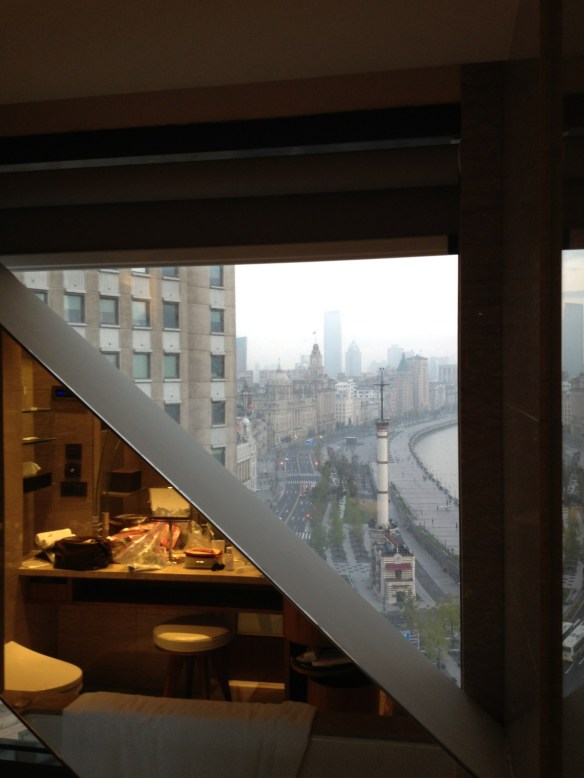
A not so great picture of the Bund as seen through our hotel window….amazingly beautiful!
I love this picture! Photo taken out of hotel bathroom looking down at the Bund.
The best way to explore the sharp contrast between old versus new in China is to visit Beijing and Shanghai in the first week. While Beijing is old, historical and brimming with culture, Shanghai is ultra modern, cosmopolitan and chic.
One of the country’s most vibrant and modern cities, Shanghai, meaning “by the sea” is going places that China as a whole dreams of heading. Given Shanghai’s strategic location as a gateway to the Yangzi River, it was first established as a small port town and eventually grew to a population of 50,000 in the late 17th century. The real future and fate of Shanghai occurred after the opening of the British concession in 1842 which lead to a period of dramatic growth, splendor and decadence.
Shortly after the British arrived, the Americans and French followed and Shanghai became an economic powerhouse financed by opium, silk and tea trade. As the city blossomed and grew, large finance houses set up shop leading Shanghai into a period of robust growth and economic supremacy. There was a long period of vice and decadence as the city became filled with whorehouses, opium dens and gambling parlours which eventually were cleaned up only to lead the city into a long period of malaise and decay.
Shanghai was revitalized in the early 1990s when the decision was made to develop a swampy, vacant farmland on the eastern side of the Huangpy River. This area, today known as Pudong, is one of the most ultra-modern, brilliantly colorful skylines in all of China save for Hong Kong. Being in Pudong, it is unbelievable to see this modern, dazzling supersized city that was all built within the last 20 years mirroring the sensational growth of China herself.
To me, Shanghai is a fascinating, complex city beaming with lights, color, vibrancy and of course good old contradictions. While The Bund represents the prestigious, old-world charm of the past, Pudong represents the dramatic future of China, the number two economic country in the world. Shanghai perfectly brought the old and the new all together in one big, luminous city full of paradoxes for the perceptive traveler. I fell in love with its complexity, beauty, modernity and historic charm. It is a place that summoned up so much of my feelings about China, and a fabulous way to end the trip.
Stay tuned..My next post series will be all about Shanghai and all this phenomenal city has to offer. I will cover the Bund, Pudong, The French Concession, Old Town, Shanghai Shopping, Chinese Street Smarts and more….plus I will probably throw in some Tucson posts since I’ve never blogged about lovely Tucson, Arizona before and it is a cool place. Thanks for reading!
Leaving Beijing, we had our first taste of heavy traffic and wet rain. We were ready to leave the dreary weather (or so we hoped) and head south to Shanghai known as Beijing’s decadent little sister. Although I truly enjoyed Beijing’s majestic Forbidden City, ancient hutongs and scattered parks, I really was getting tired of the smoggy, cold weather. Plus the food options were becoming limiting (that happens when you don’t especially like Chinese food) and I knew that I would find much more variety and international fare in cosmopolitan Shanghai. It was time to leave.
Photo below taken during our hour-long taxi ride to Beijing South Railway Station. The further we got out off town and along the Ring Road, the more of these ugly Soviet-era apartment complexes there were. It made me realize just how insanely big Beijing is and how densely the people live. This represents one of hundreds if not thousands of these kinds of living complexes.
In my opinion, there is no better way to see some of the countryside and what is really going on in China than to travel by train. There is something nostalgic about train travel. You can sit back, relax and watch the world go by or in the case of China’s high-speed G trains, watch the world scream by.
The Beijing-Shanghai G Train is one of the longest and highest quality high-speed railways in the world with a designed speed of 350 km per hour. It makes the 1,318 km/819 mile long journey between Beijing and Shanghai take a mere 4 hours and 48 minutes with a brief stop at Nanjing. Launched in June of 2011, the railway was the first one designed for speeds up to 380 km/hour (236 miles/hour), making it the fastest train in the world. The journey from Beijing to Shanghai took 3 hours and 58 minutes compared to 9 hours and 49 minutes on parallel railways with conventional trains. However, after a few mishaps shortly after its launch, the train was slowed down to its current rate averaging 300 km per hour/186 miles per hour.
Photo below: Pulling up into the Beijing train station I am amazed by its modernity and vastness. There are railways everywhere.
Entering Beijing’s train station which is extremely modern (except for the bathrooms: Squat toilets of course). Security was tight and the place was packed.
An up close look at a G Train. Impressive!
There are rows and rows of G Trains waiting for its passengers to board. Each train has a “sightseeing” class with only four luxurious seats, one section of first-class seats (with about twenty-four seats) and 16 trains of regular coach seats.
Leaving Beijing there are tons of buildings in the midst of construction. We made a joke that the national bird of China is the “Crane”.
Per GMO (9/2011), “over 200 skyscrapers are under construction in China today. This is equivalent to the total number of skyscrapers in the U.S. today”.
As the train slowly rolls out of Beijing, passing by one new building conglomerate after the other, it becomes evident what is really going on in China.
“A giant smog of unreality hangs over Chinese property. SocGen calculates that over the last decade, China has completed 16 billion square meters of floor space. This is equivalent to building Rome every two weeks” (SocGen, June 23, 2011)”.
As we would soon witness during our five hour train ride, this construction boom has resulted in vast “Ghost cities” across China in which there are no inhabitants and the cranes cease to be working. The China National Bureau of Statistics and GMO estimate that there will be up to 75 million new homes built this year.
Per the Financial Times*:
“After a decade of soaring prices, signs are that the world’s most populous nation faces its first real estate crash. That would be dire for other countries that rely on China to fuel their own economic growth”.
Some scary trends:
Home prices in Beijing have risen by about 150 percent in the past four years.
Residential transactions are down 11.6 percent from last year, all across China.
Analysts say an urban apartment costs 8-10 times the average annual income nationwide. In Beijing and Shanghai the multiple is closer to 30.
Construction accounts for 13 percent of the economy, one-quarter of all investment and 40 percent of steel use.
*Source:Financial Times “A lofty ceiling reached” (12/14/2011 by Jamil Anderlini).
As we head out of Beijing, passing by all the look-a-like buildings and apartment complexes, the G Train finally starts to pick up speed reaching of dizzying 306 km/hr or 190 miles/hour. It is the fastest speed I’ve ever traveled by train and my stomach felt it.
Finally we had left Beijing and were in the countryside and it was beautiful ….but not for long.
Ghost cities appeared in the distant horizon and it freaked me out….they were everywhere!
This photo below spooked me the most. We were in the middle of nowhere and in the distance there was a gigantic “Ghost City” where everything had stopped in time, uncompleted. The initial belief of the Chinese government and real estate tycoons was “we will build and they will follow”. Not so sure if it is true.
After almost five hours of passing ghost town after ghost town, I was fascinated and in shock. I have never seen such massive construction and building anywhere before. It is phenomenal. In a country where property construction accounts for an estimated 13% of GDP in the world’s second largest economy, what will happen when the real estate bubble comes to a half? The economic ramifications for China, its people and the world are frightening. Let’s hope for a soft landing.
Arrival at Shanghai’s Rail Station…..and on to the next adventure.
When you think of China’s city lights. your mind often rests on Shanghai and Hong Kong: Big cities, amazing skyscrapers and incredible lighting at night. These cities sometimes feel like Disneyland or Vegas, captivating your souls and imagination. There is an odd resemblance to Christmas, as the city lays aglow in uncanny lights.
After visiting Shanghai I admit that the city’s evening lights are unbelievable and mesmerizing. I instantly fell in love with the city at night, and felt that Shanghai was almost right up there with Paris, the City of Lights (yet I prefer the older city atmosphere of Paris over the newly built, ultra modern Shanghai). I could have sat there all night admiring the lights over the Bund and Pudong in Shanghai. I had never seen anything quite like it before and I realized that the night in Shanghai was by far more beautiful than the day time when the city was awash in pollution, traffic and noise.
For as much as Shanghai’s lights beckon, I believe that Beijing’s city lights are highly under-rated and definitely worth admiring. Maybe it is the old-world architecture that I fancy or perhaps the initial belief that Beijing would be uneventful. One night in Beijing proved that my assumptions were wrong. It was not a gray, dull, boring city. Instead, it is an ancient city beaming with life as soon as the sun sets.
The beauty of Beijing at night can’t be denied. It is a place worth exploring with your eyes wide open….
The Forbidden City at night is unbelievably spectacular. My only regret is that I’m not a better photographer as I was unable to truly capture the dreamlike nature of this place at night.
View from the cab. I love this photo. I feel that it captures the true energy of Beijing at night. I took it from our cab window obviously while we were moving.
Picture of Ghost Street, the renowned street with any kind of Chinese food that your heart desires.
Right outside of our hotel was one of the largest street food venues I’d seen. It was bustling with activity as soon as the sun set. Hungry customers lined up and ordered their meals on a stick to go (of course cooked fresh right in front of their eyes).
The main pedestrian street at night was filled with colors and entertainment. There were enormous flat screened TVs built into the sides of buildings. Kind of reminded me again of Vegas or New York.
Restaurants awaited hungry customers….
My only regret was that I was too tired from jet lag and walking eight hours throughout the day to stay up later and enjoy the sensational beauty of Beijing at night. For the city’s secrets are often revealed at night when it is quite, more peaceful and full of a different kind of life.
Before visiting China, I had the amazing opportunity to hike the Annapurna Circuit trek in Nepal. As I’ve said time and time again in my blog and to family and friends, this was the one trip in my life that really touched my soul. It inspired me. It changed me. And most of all, it encouraged me to continue exploring as many far off destinations that I can possibly visit.
My trip to Nepal was my first exposure to the Buddhist religion. Sharing a border with India, Nepal, a tiny mountainous kingdom, was exposed to two main religions: Hinduism and Buddhism, that grew and developed to become the two prominent religions in Nepal. During my trek through rural mountains villages in Nepal, I was blessed with one Buddhist village after another. Temples, colorful prayer flags, gigantic prayer wheels and burning juniper incense infiltrated my heart and soul. The monks dressed in maroon robes and praying softly was a pleasant, peaceful experience. I instantly purchased the Dalai Lama’s famous autobiography when I got home. I felt inspired by this magical religion and wanted to learn more.
I read his book, appropriately titled “Freedom in Exile: The Autobiography of the Dalai Lama“, and felt an anger and shock burning inside my soul that drove me mad. I could not believe what the Chinese government had done. It was tragic, sad and terrible. Yet, it was a story that had been repeated all too frequently in our world’s history. America and the injustice done to the Native Americans. The “colonization” of South America. The tearing apart of Africa. And the list goes on.
What I had a hard time coming to terms with after reading this book was my feelings on traveling to China. I understood that human rights were far from being achieved by the Tibetans as well as most of the population of China. Would I be ok with that?
Driving around town in the Twin Cities (the local term here for Minneapolis and St. Paul area) I grew accustomed to seeing “FreeTibet” bumper sticks on many cars. I knew that the Dalai Lama had recently come here to speak with his people, the local Tibetans who have come here in exile to start a new life.What do they think of the Chinese government?I wondered but felt like I knew.
I wouldn’t find my answer of course until I was in China, looking around, visiting Buddhist temples and talking to people. The first stop in my quest to understand Buddhism in Beijing was the most revered Buddhist temple outside of Tibet: The Lama Temple. Originally built in 1694 during the Qing dynasty it was used as a palace and later changed to lamasery in 1744 by Emperor Qianlong. Today it is the largest, most well-preserved lamasery outside of Tibet and is a renowned place of worship, pilgrimage and importance in the heart of China’s capital.
We set off on our last afternoon, walking, to the Lama Temple. After reading the Dalai Lama’s tragic account of events, I wasn’t sure what kind of religion I’d find in China. I understood that the Communist Party of China had no official religion yet tolerated religious practice to some degree. Yet it was hard to get a sense of how religious the Chinese are overall since many prefer to keep their religion private. Some estimates state that there are approximately 100 million Buddhists in China. It is the most prevalent religion, followed by 18 million Muslims, 10 million Protestants, and 4 million Catholics (Facts from “Culture Smart China: The Essential Guide to Customs and Culture” 2010 edition). Yet in a land of 1.3 billion people, these numbers lead me to believe that there are a lot of people who do not practice a religion or chose not to tell anyone that they do. Like most statistics in China, it is hard to get a clear picture.
Regardless, Buddhism has a strong cultural importance in China as it has been inside the country for thousands of years since its introduction from India via the Silk Road. I was keen to visit the Lama Temple and see what it was all about. After visiting this lovely place, I was even more confused than ever. For it was simply serene and the devoutness of the practicing Chinese Buddhists was deeply touching. It didn’t make sense to me what had happened and why Tibet cannot be free. Like most of my trip to China, it proved that it is a land of paradoxes and contradictions that a foreigner may never fully understand. There are many questions in life that will remain forever unanswered. Perhaps this is one of them.
Here are my pictures and commentary from my visit.
The walk from our hotel near the Forbidden City took us over an hour passing through main thoroughfares, small streets and plenty of interesting things to take pictures of. We knew that we were finally getting closer to the Lama Temple when we reached this street packed full of Tibetan shops.
Suddenly gray dull Beijing came to life with color, smell and sounds as we entered the Buddhist district near the Lama Temple.
The majestic archway leading into the Lama Temple.
The walkway to the temple was beautifully adorned with shade trees that cast a peaceful glow on the area.
There were plenty of monks dressed in brilliant orange.
Some monks had obviously come from far to pray and also be like a tourist and snap some photos.
When you were done with your incense, you placed them in the fire pit to burn.
As always, there were lions protecting the temple. This one is a male with its location on the east side of the building and grasping a ball.
The breathtaking architecture of the temple reminded me of the palaces in the Forbidden City. Yet the smoke-filled air from the burning incense gave the Lama Temple a much more mystical feel.
Perhaps there was too much smoke in the air to take this picture but I still enjoy the close-ups of the incredible art and detail of the buildings.
I left the Lama Temple feeling relaxed and peaceful. It was such a special place and I was relieved to see so many ordinary Chinese there practicing their religion openly. It is estimated that hundreds of Buddhist temples were destroyed after the revolution in China in 1949. It is a pity that they no longer exist.
Stay tuned..Next stop is “Everyday life in Beijing”. It is my last post on Beijing and a compilation of tons of great photos I haven’t shown yet. Thanks for reading !
Throughout my stay in urban China, I was bemused, amazed, surprised and continually fascinated by the resourcefulness of the Chinese in regards to modes of transportation. Here is a photo blog of what inspired me.
When getting around or transporting goods, anything works, especially bicycles!
These were the “party bikes” located in the bar zone of the Hutongs. I loved seeing all the young Chinese gals cruise around on these fun bikes for bar hopping.
One of many bike parks. I loved the electric bikes. They were sleek and quiet. You hardly knew they were there.
I especially loved these little bicycles. Not sure if they have a special name or not. But they sure are cute!
With such heavy traffic and high costs for cars and trucks, it is no wonder the bicycle is the number one mode of transportation for both people and goods.
Sidewalks, streets and highways…no matter! If you are a pedestrian, you just had to watch out for passing motorcycles and bikes!
Meals on Wheels! Hungry anyone?
The Daily Commute: Beijing. (Look at all the smog!).
I loved these little “tin cars”. There was no way I was ever going to step foot in one of them though. I don’t think you’d come out alive if you got in an accident in one of these little cars. I even saw them on the highways! Scary.
Thankfully Beijing had their own devoted “Bike and Motorbike” lane. This made things far safer except of course at the intersections where it was a free for all between bikes, motorcycles, pedestrians and cars!
There are plenty of buses in China which is a cheap and affordable way to travel.
A motorcycle park. Genius idea!
Driving is the most dangerous mode of transportation in all of China. Per Lonely Planet China, “China’s roads kill without mercy. Traffic accidents are the major cause of death for people aged 15 and 45, and the World Health Organization estimates there are 600 traffic death a day!”. After spending ten days in China, I completely understood these facts. Driving is crazy there (like many big cities in the world) and it was even more scary being a pedestrian in Beijing. Vehicles do not think twice about driving right towards pedestrians even if there is a walk sign in the cross walk. You have to really be careful and use a 360 view when crossing the street (if you want to make it safely across!).
I had heard about these graphic displays of “Traffic accidents and resulting deaths” before and was thus forewarned that they are disturbing. Here is a display set up in the heart of Beijing. The police were passing out flyers with pictures in case these warning signs weren’t enough.
After seeing these graphic displays of fear, I was a bit weary getting in taxis (especially in Shanghai where our hired cab driver drove over 100 mph on the highways, passing on the shoulder. I finally told him to slow down as the pictures continually returned to my mind).
Stay tuned…more China coming up soon! I may even sneak in a few posts about Minnesota!
Finding the Hutongs at night were hard but fun! At least we had a sign to guide us in. Yet once inside the Hutongs, it was anyone’s bet on which direction to go. There were no maps nor streetlights to lead your way. In some Hutongs, a flashlight would have really come in handy!
My last post on China was by far one of my favorites: In Search of Beijing’s Hidden Hutongs. As I mentioned in the post, the Hutongs, or narrow alleyways, are the true heart and soul of Beijing’s past. They are magical maze-like places which instantly transport you back in time, to thousands of years ago. The rooftops were by far my favorite thing to capture on film. They were so detailed and so lovely. I could have spent hours just taking picture after picture of each and every one. I also truly loved the sense of adventure and discovery while wandering around the hutongs. The narrow alleyways snaked around in mysterious ways and you had to decide whether or not to go left or right or continue on straight. It reminded me of the Dr. Seuss Book “Oh the places you’ll go“.
After our second day in Beijing, we finally discovered a fabulous hutong near Qianhai lake which was loaded with restaurant after restaurant. We decided that day that we would have to return at night for a meal and if we had the energy, hit the bar section further down where the generation X and Y’s of Beijing let off some steam.
The main difficulty for returning to the Hutongs at night was once again finding them! As I mentioned in my earlier post, they are marked yet still difficult to find on a map and cars are not allowed inside them. Thus if you took a cab to a Hutong, they typically would drop you off outside of the entrance on one of the main drags and you’d have to weave your way back inside the serpentine maze of the Hutong to try to find your destination. It wasn’t easy to find in the day time and the night time was even harder as the hutungs are not very well-lite thus you are often found wandering around in complete darkness.
This was right up my alley in terms of adventure and “getting lost”! I loved it and best of all, we did finally find our way around some of the Hutongs thus were able to enjoy them at night as well.
Finally we found the main entrance to one of the best Hutongs in town! Now who would imagine it would be located back here, behind this construction area? Yet it was our way of finding it again at night! We followed the main drag and looked for the crane above. Then we wove around the side of the construction and voila! There it was, an enormous maze-like Hutong loaded with boutiques, restaurants and bars!
Finally we found international restaurants! We found Italian, British, Indian and more! I could hardly contain my excitement since I was not enjoying Chinese food so much. This area was only about a 40 minute walk from our hotel. Yes, a bit far but worth the walk and it felt great to get exercise after a big meal.
Once you entered the Hutongs, there were many parts like this one above that were almost pitch black! I could have really used a flashlight there!
We had dinner at a fabulous little Indian restaurant that we found in Lonely Planet and actually had searched for during the day and found it that night. I loved having my favorite Indian foods in the heart of Beijing. It felt kind of strange but then again, I love Indian food so why not?
We didn’t make it to the wild and crazy bar Hutong (never quite figured out what the name of it was). When we had passed it during the late afternoon, things were already picking up. There were three-person bikes to rent, rooftop bars with sofas on top and lots of loud music. It felt vibrant, fun and not at all like most parts of gray, old, stiff Beijing. I really wished I had the chance to hang out there for a few hours and learn about the young, rebellious youth think of it all. Beijing, China, Communism and the future.
Stay tuned….more China coming soon! I still haven’t finished Beijing and Shanghai will be a delight as well. Thanks for reading!
While waiting in the American Airlines lounge at Chicago O’Hare to catch our international flight to Beijing, we found ourselves talking to a China “travel warrior”, one of those successful American businessmen who had either the luxury or the headache (depending on how you view things) of traveling overseas constantly to Asia. Since I never got his name, I’ll call him the Chinese Travel Warrior as it seemed to fit. He’d been to China at least 40 times and was well versed in the ins and outs of traveling and doing business there. He’d informed me gleefully about the preparation of Peking duck as well as showed me a picture on his cell phone of what you’d get in China if you ordered Chicken Soup (yes, a real dead chicken foot sprouting out of the top). He told me the good and the bad, the nice and the dirty and helped get me excited about the adventure ahead.
Probably the best piece of advice that the Chinese Travel Warrior gave me, however, had to do with sightseeing. He told me that I had to spend some time in Beijing’s infamous Hutongs or “narrow alleyways” that mysteriously thread through the heart of old Beijing. He told me that the Hutongs are where the history, culture and life of old China can be seen, if that is, you can find them.
Not knowing or understanding at all what the Hutong are, I opted to search my beloved Lonely Planet China and here is what I found about Beijing’s Hutongs:
The spirit and soul of the city lives and breathes among these charming and ragged lanes where a warm sense of community and hospitality survives. Criss-crossing chunks of Beijing within the Second Ring Road, the hutong link up into a huge and enchanting warren of one-story dwellings and historic courtyard homes. Hundreds of hutong survive but many have been swept aside in Beijing’s race to build a modern city.
The description of the hutongs obviously grabbed my attention and lead my father and I on a three-day search in finding the best and the most colorful hutongs in all of Beijing. Here is a collection of my photos taken during our explorations of Beijing’s Hidden Hutongs.
Finding the Hutongs was half the battle and half the fun. Our first day in Beijing, I was on a mission to find them. We walked until we dropped, for over eight hours, pounding the pavement of Beijing. I had read in Lonely Planet that all the Hutongs are marked with a historic sign. Yet finding them on a map was another challenge all together. We realized that the best way to find these hidden treasures was to walk without a map and explore.
Eventually after lunch we found our first section of Hutongs located directly behind the Forbidden City. Before I saw the red sign (photo below), I noticed a dramatic change in the architecture of the buildings and most notably the roofs (photo above). They looked old.…could these be part of the Hutongs I was searching for? I wondered.
This sign confirmed it: Our first Hutong spotting!
Yet this Hutong wasn’t too inviting. Perhaps it was being renovated? We decided not to walk down and explore it much further than this picture. I knew there would be more. Many more. We would just have to find them!
We continued our walk down Beichang Jie, one of the main drags located behind the Forbidden City, in search of more Hutongs. We saw lots of interesting photo shots like the one above which I adore. I love the old bicycles and the cool buildings.
We walked a little further and came across this lovely Hutong. I found a splendid alleyway but there was not much else back there but quiet courtyard homes.
I was fascinated by the Hutongs and could have explored them all day long! Here is my dad going under the electrical boxes that provide electricity to these ancient homes.
The Hutongs are narrow thus all bicycles are normally parked outside the entrance. I love this picture. For some reason, it is one of my favorites from the trip.
During our second day in Beijing, we discovered an entirely new area of Hutongs located by Qianhai Lake in North Dongcheng. These Hutongs were more than residential and had stores, bars, restaurants and even chic boutique designer shops. Here is a more lively Hutong that we found the second day which snaked around in many different directions.
I found it hard to not get lost. Yet getting lost was probably the best aspect of our search for the hidden Hutongs. That meant you discovered new things that you probably would have missed. Sometimes traveling without a map is the best way to travel.
If you did get lost or not want to get lost, you always had the option of hiring a rickshaw to show you the way. We found this line up of eager rickshaw guides in a more touristy section of Hutongs (now what it was called still remains a mystery to me! Again, it is a hutong that we managed to stumble upon and never found it again!).
Comparing notes and trying to work a deal.
After hours of walking and exploring, we finally came across this trendy Hutong that had tons of cool bars, restaurants and shops. This time we made a note on how to get there and find it again!
Some of the beautiful boutique shops found in the Hutong.
By lunch time, we were ready to take a rest and found the perfect place, The Passby Bar, located on Nanluogu Xiang, which was a great place to eat and watch the world go by.
Above is a picture of all the restaurant’s Lonely Planets! Apparently the owner is an avid world traveler!
As we entered the Passby, it felt like entered some kind of English pub.
I LOVED their motto: BETTER TRAVEL THAN DEAD! It seems like it was written for me!
After a delightful lunch with of course a glass of wine, it was back to it. I was determined to find more of Beijing’s hidden Hutongs and the more we walked, the more we discovered.
The architecture was a photographers dream.
We left the Hutongs feeling excited about what we’d seen and looking even more forward to coming back to experience them at night, when they come to life with people, lights and mystery.
The Chinese Travel Warrior was right….you can’t possibly see Beijing without finding the hidden Hutongs which are the true heart and soul of the city and its magical past.
Stay tuned…next post will be on Beijing’s Hutongs at night!
If you have ever traveled anywhere in Asia then you have certainly experienced the “curse of the Asian Toilet” before. Otherwise known as the squat toilet, it can be a brutal and stinky affair, especially for women who do not have the biological convenience that men do (yes, God must truly be a man!).
I, myself, am well past any issues with the squat toilet. After traveling for three weeks in Nepal (in which over half of it was in remote villages in the Himalayas) I got broken in rather quickly to the “do’s” and “don’ts” of squat toilet etiquette. For example, Do carry toilet paper. Do always have hand sanitizer available (since there is seldom anywhere to wash hands let alone find running water). Do carry a flashlight. And most important: Do cover your noise (don’t you dare breathe in through your nose! Mouth breathing only) and Do, and I mean Do, try your best to not look down or spill. This is tricky for a female who isn’t equip like a male. But it is a reality that we must face especially when using a squat toilet! You definitely don’t want any accidents when you are traveling all day long wearing the same pair of pants!
For me, going to China and dealing with the lack of the “western toilet” (as my beloved Nepali guide called it) was going to be nothing after three weeks of roughing it in Nepal. I’d seen plenty of bad, cold, smelly toilets. After awhile it was determined that sometimes mother nature was best.
So, I thought amused that it was no big deal dealing with the Asian toilet situation during my travels. I’d done it, I’d mastered it and best of all, the hotel would most likely have a western toilet (unlike in Nepal where I went three weeks without one).
What I found so incredibly fascinating in China was the controversy regarding the Asian toilet (especially before Beijing hosted the Olympics in 2008), the resulting growth of the public toilets (over 5,333 were added to prepare for the Olympics), the new rating star-standards of toilets, and last but not least, the hilarious commentary I saw about the wonder of the porcelain gods. I couldn’t get enough of toilets during my trip!
Strolling along Beijing’s Chang’an Avenue in May, Kevin Born was drawn to an ancient Chinese-style building with delicate wooden carvings and wash paintings — only to find it was a public toilet.
Inside, he found a granite floor, remote-sensor flushing, automatic hand drier and piped music. He found it difficult to believe that only three years ago when he first came to China, answering nature’s call was an experience not for the faint-hearted.
“You had to take a deep breath and dash into the toilet. You held your breath and your head high, and never looked down. Then you’d dash out quickly for another gasp of fresh air. All within 30 seconds,” recalls Kevin, 30, an engineer from Germany.
The city launched a three-year campaign — with a 400-million-yuan (57 million U.S. dollars) investment — to modernize its public toilets in 2005 as part of its effort to prepare for the 2008 Olympic Games.
With 1,000 new public toilets being built and renovated each year, the fetid back-street privies are being replaced with clean, well-maintained flush toilets.
Now, Beijing is flushed with pride that all the 5,333 public toilets, boasting standardized white male and female figure signs, are available within a five-minute walk of any downtown location. In addition, there will be 700 toilets in Olympic venues by the time the Beijing Games start and an additional 800 nearby.
Now it is time for a few of my best toilet shots (no worries….they are all flushed) as well as another interesting article I found regarding the history of toilets in China (including the introduction of the star rating system) and the push of the Chinese Government to vamp up the number of public toilets in preparation for the Olympics. Happy reading! (And please….don’t read this post on the toilet!).
Inside our hotel lobby, we had nice clean western toilets. Yet I could not stop laughing over this “lost in translation”!
One of thousands of new, convenient public toilets made available throughout Beijing in preparation for the 2008 Olympics. It was fabulous having so many public toilets available! Most were all the traditional squat toilet, however, they were clean, not sticky and readily available everywhere. It made a day of sightseeing or an evening of drinking beer easy. (Don’t you hate it when you are traveling and desperately need to use the bathroom but can’t find one anywhere?! Not possible in Beijing, thanks to the thousands of newly minted public toilets).
More public toilets located in the famous Hutongs. They even had sinks with working running water! Some had toilet paper too….bonus!
See, they are now nice and clean! Not the old nasty ones that left people ready to pass out. Locals and tourists alike embraced the availability and cleanliness of the new toilets.
Different styles of public toilets that were “stand-alones” and much nicer than our “Port-a-Pottys” back at home.
I could not resist grabbing my camera and taking this picture of the sign in the bathroom at one of the restaurants we ate at in Beijing. Too funny!
It was not posted once but twice! Guess they meant business!
In Shanghai, I nearly fell off my (toilet) seat when I realized that (a) it was heated! (b) it had a “rear cleansing” option and (c) it had a dryer! Now that is a little disturbing, isn’t it. (No, I did not try any of these services).
The toilet was constantly heated to a warm 90 degrees F. Guess they want you to stay seated for a while and enjoy! Ha!
Stay tuned…enough silly business. I’m starting to remind myself of my kids and their non-stop adoration of “potty talk”! Next post will be on Beijing’s fabulous Hutongs! Thanks for reading!
There is something divine about a good massage. As someone who has suffered a bad neck and upper back for over three-fourths of my life (see post: Dealing with Chronic Pain) you can imagine how much better an excellent massage is to my poor, sore muscles. I am like a new person after a massage. I don’t have a darting, throbbing pain in my neck and my soul seems to finally find some sort of peace.
Unfortunately, like most luxuries in life massages are not cheap. In fact, I find it difficult to find anywhere decent to get a massage for under $120 per hour. In my book, as a stay-at-home mom with no income to call my own, I just can’t stomach dishing out that kind of money, even if my back hurts like hell. Thus I end up getting probably only one to two massages a year, usually as a gift from my loving husband or understanding mother who also suffers chronic neck pain.
Before heading over to China, my neck and back were really causing me grief. After a ten-year hiatus, I had to start physical therapy sessions again to try to manage the pain and strengthen my back muscles. It found it so incredibly frustrating to have to deal with this “pain in the neck”. I am an incredibly active person who can’t let a persistent pesky pain stand in my way.
Looking back, I am convinced that my 20 mile plus bike rides over the summer pulling my four-year-old daughter were the main culprit in ruining my back again. (I suppose I can also add in “getting older” although I try not to dwell on it). Stress and spending more time at the computer were also causing problems (hmmm….could it be all that extra time I’ve been spending blogging?). I was determined to go on my trip and relax a bit, and pray my back wouldn’t go into complete spasms on the flight. Having a good seat helped significantly, but passing out after four glasses of wine and falling asleep at a strange angle did not help.
Needless to say, when I landed in Beijing after a fifteen hour flight I could barely turn my head. I knew that it wasn’t a good sign but I had hope. For I had heard about the art of the Chinese Massage and I knew that the price would be right.
Chinese medicine has been practiced for centuries. Per Massage Today:
Traditional Chinese medicine is one of the oldest continuous systems of medicine in history, with recorded instances dating as far back as two thousand years before the birth of Christ. This is in sharp contrast to American or Western forms of health care, which have been in existence for a much shorter time span.
Traditional Chinese medicine is based, at least in part, on the Daoist belief that we live in a universe in which everything is interconnected. What happens to one part of the body affects every other part of the body. The mind and body are not viewed separately, but as part of an energetic system. Similarly, organs and organ systems are viewed as interconnected structures that work together to keep the body functioning.
Massage known as “an mo” or “tui na” in Chinese and Acupuncture have been integral parts of Chinese medicine for thousands of years and has gained worldwide attention and practice for many years. Chinese doctors believe that a network in the human body called “‘jing luo” serves as a passageway for vital energy and blood to reach all the parts of the body. The use of acupuncture and massage on pressure points and injured muscles can greatly relieve pain and maintain overall health.
As soon as I landed, I could hardly wait to explore and experience the art of the Chinese massage. My body was desperately waiting and begging. Yet, unfortunately other things got in the way such as the more important excitement of exploring a new place. Who wants to waste two hours trying to get a massage when I can walk until I drop and see as much of Beijing as possible? I reasoned.
Stubborn, defiant me waited until the very last minute; until I was at the “point of no return” in level and severity of pain and discomfort. I had walked for over eight hours long on our first day in Beijing, on hard concrete, constantly stopping to rub my back or do a quick neck stretch. I even laid on my “tension release” racket balls for an hour, drank several glasses of wine, took a pain reliever…. yet there was no relief. It wasn’t looking good.
The climb up to the Great Wall was amazing while I was doing it. Exciting, fun and pure adventure. Yet when I woke up the next morning I had hell to pay. I was in dire straits. I could barely move my shoulders let alone turn my head from side to side (I cursed myself and wondered how I ever managed to hike over 100 miles last year in the Himalayas! Could my body really have aged that much in a single year?!).
It wasn’t the way I imagined my vacation, suffering and wallowing away in pain. I had to do something. It was time to discover the art of the Chinese Massage, and fortunately the best place in town was right outside my doorstep.
The Dragonfly Spa, located only four buildings down from my hotel, is known as one of the top spas in Beijing. Knowing that made me initially hesitate, thinking that it would be pricey and snooty. But silly old me forgot the number one thing about China: The low-cost of labor.
When I walked into the Spa to check out the prices, I was instantly drawn in. The entire waiting room and spa smelled of roses, real fresh, fragrant roses. Hundreds. Thousands. A room aloft in roses. It instantly put me in a trance. The friendly, pretty receptionist handed me over a neatly printed price list. I swallowed before opening it and then to my shock and disbelief, the prices were insanely cheap. An hour-long aromatherapy massage with hot oils was only $35. The lesser hour-long “Chinese Massage” was a mere $16. They even had a neck and shoulder massage for an hour for $15. I could not believe my eyes or my luck. I was in the perfect place! I was in Heaven!
I desperately asked the receptionist if it was possible to get a massage that moment. It didn’t look too busy. I was the only one there. But I wasn’t sure because at home you have to typically book a massage at least a week in advance.
The pretty, young receptionist smiled reassuringly and told me, “One moment, please“, in perfect, beautiful english. She picked up the phone, dialed, and spoke rapidly in Chinese to whoever answered. “Please have a seat“, she said kindly. Within five minutes a small, petite woman walked in, smiled at me and lead me back to Heaven.
As I left the pleasant waiting room and entered the spa, I was instantly greeted by the healing, peaceful smell of lavender. The entire room was dark except for little candles that lined the stairs leading up to the massage rooms. It was the most incredible, pleasing synthetic flowery smell I’d ever experienced. It was enough to make my knees weak.
I lied down on my stomach in almost complete darkness and silence and let each ache and pain in my poor, overworked body relax. Sometimes I think it is best if the masseuse does not speak english. I tend to talk too much, even during a massage. That makes it harder to relax and simply enjoy the experience. Since I didn’t know Chinese and my masseuse knew little english, there was no conversation whatsoever. Just silence and total relaxation; something I think everybody in this world needs.
For someone so small, I was amazed by the strength of her touch. The hot, scented oils melted into my skin and sunk into my rock-like muscles relieving the tension that had been stored up for months. I closed my eyes and relaxed, enjoying each and every moment of Heaven. I didn’t want it to ever end. It was so wonderful.
Of course, all good things must come to an end. The sixty minutes were up, and I could barely move. My body felt like butter and my muscles melted into the massage table. I took my time getting up and was sad to leave. But I knew that it would not be my last time at the Dragonfly. For how could I resist the art of the Chinese massage?
For the next day I was going to indulge in the $15 one-hour neck and shoulder massage. And, little did I know there was a Dragonfly in Shanghai too where I would get a send-off massage before leaving China. Heaven comes in threes.
Stay tuned…there are more China posts to come. Not sure yet if it will be the post on “The Curse of the Asian Toilet” or one on the fascinating Hutongs, or old alleyways of Beijing.
One of the top highlights of any visit to Beijing is a visit to the infamous Forbidden City, one of imperial China’s most exquisite displays of traditional Chinese palatial architecture and grandeur. Built in 1406 to 1420 and used as the imperial palace during the Ming dynasty to the end of the Qing Dynasty, the Forbidden City is one of the best preserved complexes of ancient cities in the world, containing over 980 buildings and 9,999 1/2 rooms in the heart of Beijing.
What makes the Forbidden City so fascinating and mystifying is that it was forbidden to the general public for over 500 years. Only the emperors (there were 24 in total from the Ming and Qing dynasties who lived there), their families, and their crew of eunuchs and servants were able to live there, from its onset until 1911, when the Qing dynasty was ousted and the Imperial era ended. The Forbidden City was not opened to the general public until 1925, over 500 years since its construction. (For more historical information and facts on the Forbidden City, click here.)
Our hotel was in a prime location – at the heart of Beijing – within blocks of Tiananmen Square and the Forbidden City. We couldn’t have selected a better location as our base. We knew that the Forbidden City was huge thus agreed to devote at least a half a day for exploring the world’s largest surviving palace complex (The Forbidden City was built in the center of the ancient, walled imperial city of Beijing and covers over 178 acres in a rectangular shape. From north to south it measures 961 metres (3,153 ft) and 753 metres (2,470 ft) from east to west).
As we ate our lovely American breakfast, we could see the packs of provincial Chinese tourists march by our window, all wearing identical hats in order to identify them with their respective tour group. Guides wearing headsets, microphones and sporting a similar matching hat, lead the way. We were glad we weren’t part of the mob.
My dad and I, of course, had a different plan in mind for touring the Forbidden City. We would simply walk to Tiananmen Square, look “American” and wait for our sales pitch. We would go with the best, most informative Chinese (yet English-speaking) tour guide at the most competitive price for a two-hour tour. We knew we could spend an entire day there and that most guides were happy to spend the whole day with you. But we knew what we wanted: A brief, yet comprehensive basic tour of the Forbidden City, all crammed into two hours time.
We headed around the gigantic 52-metre wide moat that surrounds the impressive Forbidden City walls towards Tiananmen Square, one of the main entrances to the Forbidden City. We were lucky that it was still relatively early, only 8:30 am, thus the massive crowds we saw yesterday afternoon were presumably still riding into central Beijing on the tour bus.
We didn’t think it would be hard to find a guide. Just the day before we got accosted by plenty of tour guides looking for potential clients while we strolled through Tiananmen Square. Yet this morning they all seemed to be in bed, sleeping. We waited patiently, glancing around and trying our best to look like we needed help. Within five minutes, we met “Jack” (not related to our previous tour guide Jackie who brought us to the Great Wall. Must be a popular “western” name!).
Jack was tall, lean and intense. He dove right into his sales pitch with wanting eyes and seemed slightly offended as we tried to negotiate down the price and make a time limit on our tour. He informed us that he was one of the best Chinese tour guides for the Forbidden City. We knew within seconds after meeting him that he was the one.
Jack proved to be an excellent guide albeit an extremely high-strung, driven individual. My father had realized that he had met his match. Jack possessed even more of these qualities than my sometimes impatient, yet highly energetic father! Me, on the otherhand, was rather excited to have such a high-strung, chatty guide. I took plenty of notes!
Here are the photos from our intense, high-speed visit to the Forbidden City. Hope you enjoy them as much as I do! Warning: I had an awful hard time cutting them down. So I decided to include almost all of them!
The entire Forbidden City, which overs 178 acres, is surrounded by a 52-foot-wide, two-meter-deep moat and a 30-foot-high red wall. I loved this picture of the backs of the buildings reflecting in the grimy waters of the moat.
Looking the other direction.
This picture is definitely one of my favorite “third-eye” moments! The locals catching their dinner!
As we approached the Forbidden City, once again I had hoped for better weather than your typical smoggy Beijing day. It finally dawned on me that this was a “normal” day in Beijing and I’d have to get used to it. Too bad….as I would have loved to see the Forbidden City behind the smog.
When I first saw the Forbidden City, my first thought was how intimidating it looked. It went as far as the eye could see and was all done in imperial red, the color of China.
There are four entrances (gates) to the Forbidden CIty. We entered through the gate outside of Tiananmen Square, right next to the ticket/admission office. This is the main gate that leads you through the Forbidden City’s main sights. The above picture illustrates the crumbling, 30-foot high red wall that surrounds the Forbidden City.
There is also this high grayish-colored wall that is on the far outside of the Forbidden City. You could see plants creeping their way through the cracks.
Here is the main ticket counter. We were lucky to not have a big line. It was still early (only 9 am) and the Forbidden City had just opened.
Above is a picture of the main entrance to the Forbidden City. This is where we met Jack, our tour guide for the morning. The lines and groups of tourists were already forming as we entered into the Forbidden CIty. Our timing was perfect!
Jack was an eager teacher and couldn’t wait to tell us all about the amazing history of the Forbidden City. All in all, there are 9,999 1/2 rooms. Why the 1/2 room? Because there are 10,000 rooms in Heaven thus there is a half-less room in the Forbidden City.
The line above is called the “Dragon Line” or “Middle Line” and was reserved and only used by the emperor. The only other person able to walk on this line was the emperor’s wife, on their wedding day. The line leads to the emperor’s office and house.
The inside of the Forbidden City was enormous and kept going on and on through different archways and gates. It is a beautiful place and I found this picture to be among my favorites.
The first building we came to is the most important and largest palace in the entire Forbidden City, the emperor’s office. The Dragon’s Line leads straight towards it.
All of the 980 buildings in the Forbidden City are the same exact color scheme and architectural design. The color red is the most prominent color on all the buildings followed by the yellow roofs.
Each building is flanked by a male and female lion. The male lion is on the east (closest to the rising sun) and the female lion is on the west. The lion is symbolic of power and protection of the emperor.
Above is a picture of me in front of a female lion. You can tell due to her location (west side of building) and also underneath her right foot is a baby lion.
The intricate painting on the woodwork of each building is unbelievable. I could not stop taking pictures of the colorful design that remain bright hundreds of years later.
A group of provincial Chinese tourists in the “white cap” tour group.
We walked past building after building trying to take it all in.
This giant vat is one of several that is used for burning incense.
A building’s importance is measured by the number of animals on top of the roof. This is the top of the emperor’s office, the most important building in the Forbidden City. It has the highest number of animals, ten. The emperor’s home (his wife had her own as she had to share him at night with his concubines) had nine animals on top, which is considered a lucky number in China.
The crane symbolizes long life in China. We found it ironic that it is the national bird. There are so many (building) cranes up in China due to the intense construction boom, that we laughed at this irony.
The turtle is also an important animal in China. It symbolizes long, happy life and good luck.
An up close shot of the beautiful, yellow-tiled rooftops seen throughout the Forbidden City.
This is how fires were put out in the Forbidden City. There are over 308 giant copper and iron vats that used to be filled with water in case of a fire.
The vibrant red and gold colors can be seen throughout the Forbidden City.
A picture of my dad and I in front of one of the many buildings (now weeks later, I can’t seem to remember exactly what building this is. I guess that is one of the problems when there are over 900 and they all look identical, except in size!)
I love the shapes of the yellow tiled rooftops.
There are plenty of impressive stone carvings and statues as well.
Yet another building.
Unfortunately the smog started to really set in, decreasing visibility greatly. Yet I still really love this photo of the rows and rows of buildings. Many are not even open to the public. Just the main buildings are as it would take weeks to see them all and some have not been restored.
Above is the “Large Stone Carving” made out of one piece of stone. (Below is a sign that gives the details).
Last but not least is a picture of the last emperor (only 6-years-olds when he became emperor. His name was Puyi) who was finally booted off the grounds in 1924 (he lived here from 1911 after the failed revolution that ended the dynasties until 1924 when he was escorted off the grounds by the army).
After he left in 1925, the Forbidden CIty was finally opened to the public, over 500 years later. Now it is the “unforbidden” city!
Stay tuned…more posts on China coming up soon! I will be discussing “The Art of the Chinese massage”, “Asian toilets”, Beijing’s Hutongs, and more.
We arrived on top of the Great Wall of China at Jiankou, after two and a half hours of hard climbing up, to see one of the most impressive, spectacular man-made phenomenons I’d ever seen. I’d been to Machu Picchu, the ancient ruins of Rome and Ephesus in Turkey, and spent six months living in Paris. All were amazing. Yet for some reason, the shere magnitude and length of the wall just blew me away. It snaked up and down and around the ridge of the mountains for as far as the eye could see. For almost 4,000 miles in total, from east to west, across the Middle Kingdom. How the ancient Chinese indentured servants built this massive wall of rock and stone was a mystery to me. At first sight, it took my breath away.
After paying a few yuan to climb the last steps of a make-shift ladder, we finally stepped on the 2,000-year-old Wall. I took so many pictures it was impossible for me to edit them. So, I decided to put them all in the post. The good and the bad. Unfortunately the smog had not lifted and covered the Wall like a suffocating blanket. I wanted to cry at the “what if’s“. But I didn’t let myself go there for today was not the time to dwell on the poor visibility of the Wall. It was the time to cherish and marvel at one of mankind’s greatest creations.
After my first steps walking along the wall, I understood why it is called the “Great” Wall of China. It did not disappoint and proved my convictions that no matter how I felt about the rest of the trip, this one moment in time would make it all worth the journey.
Here are my photos, the good and the bad, as I entered and walked along the Wall. Come take a walk with me!
The end of the trail. Here is the last tower at Jiankou. You cannot go further in this direction past the tower as the trail is dangerous. (I am sure some adventurous souls do so, despite the absence of the Wall and a trail!).
The wall in the fog, headed towards Mutianyu, a fully restored and easily accessible part of the Wall.
Thirdeyemom (aka “me”) gets accosted by the Chinese paparazzi! These hikers nearly fell over when they saw me. A almost-forty-year-old-American-blue-eyed-blond! I couldn’t pass the hiking group and had to get my picture taken with at least ten people! It was hysterical! I realized that I would never ever want to be famous. What a drag!
I am laughing so much in this picture! As someone who is used to always “fitting” in, it felt strange to stand out in a crowd and capture so much attention.
This is inside one of many towers. The bottom level is where the military slept and the top level is where they kept lookout. It was cramped accommodations, as they had 20-30 men in each chamber. Luckily, the men would stay here for only a few months at a time and then return to the village for a month off while another group took over watch. This went on for many years.
My dad hiking the precarious unrestored section of the Wall.
View back towards the direction we came at Jiantou.
Our guide, Jackie, crossing over a bridge. The photo doesn’t do it justice. The Wall is relatively steep and high. The right side was for the invading Mongolians and the left side for the Chinese Empire. Per Jackie, one person died per meter of Wall built. The servants or slaves had to carry one of these large stones up hand by hand, the same route we came. Jackie told us that the first part of the Wall as built in only nine years time by over three million Chinese. It is an astounding 5,000 km long.
This cut-out was where the early Chinese militants would throw things at their prey. As time went by, they used guns to kill their enemies.
There are parts of the unrestored section that you have to get off the Wall and follow a trail. This picture was taken to show you the size of the stones that were carried on the servants backs to build the Wall, as well as the sheer size and height of the Wall. This goes for almost 4,000 miles!
The Jiantou section of the Wall has never been restored and dates back 600 years to the Ming Dynasty.
The Chinese had a rather intuitive system of alerts. They took advantage of the mountains and valleys that carried the sound. Thus, they used a call system to warn the army against a Mongolian invasion. During the daytime, they used smoke. At night, they used fire. During bad weather, they used sound. Per our guide extraordinaire, Jackie, here was the call system:
One stream of smoke meant 100 troops. Two streams of smoke meant 500 troops. Three meant 1000. Four meant 5,000. And, 5 meant 10,000+ troops or a massive invasion!
After walking across the unrestored section for a couple of hours, we finally entered the restored section of the Wall at Mutianyu. Mutianyu is a popular route for tourists as it has a gondola that whisks you up to the Wall. Clinton came here during his Presidency which the Chinese like to boast. Once on the Wall here, though, it is no walk in the park. It is still quite steep and at times, dangerously steep on the vertical stairwells leading up and down from the towers. Yet, the path is easier as you don’t have to manoeuver through shrubs and misplaced stones.
This section of the Wall is the restored area called Mutianyu. It is really too bad that the sun didn’t come up as I am certain the fall colors and the grandeur and scope of the Wall would have been sensational. Per Jackie, the Great Wall of China passes through nine provinces! If only I could see that far!
As we entered Mutianyu, along with the restored wall came more people. Obviously it is much easier to get here than at Jiantou! The crowds still dull in comparison to Badaling. Thank goodness I didn’t go there!
If only my pictures turned out and it was clear! You can vaguely see the lines of the Wall stretching up around the ridges of the mountains.
Along with the tourists, came the Chinese brides who took the gondola up dressed in white for their pre-wedding photos.
We Americans are superstitious and generally don’t get our photos until after the wedding. Normally it is considered bad luck to see the bride before you are married. I know this tradition is changing but I was pretty adamant on this tradition.
After five and a half long hours and aching knees along the Great Wall of China, it was time to be like a tourist and take the lazy way down. We rode the gondola and it was great!
As we left Mutianyu, we were swarmed by eager Chinese vendors trying to sell us a t-shirt or trinket for less than a dollar. It was three or four blocks of tourist hell. And this was Mutianyu! I can only imagine what the big touristy Badaling must be like! No wonder they call it the Badaling Blues!
We arrived in the car park at Mutianyu, thrilled to see our driver awaiting our weary feet. We were tired, dirty and hungry yet elated to have walked the Great Wall of China. It was the highlight of the trip and a day that I’ll never forget. For days like these are why I travel. To marvel and be amazed at our big, brilliant world!
Stay tuned…much more China to come, sprinkled in with some other interesting posts about life, culture and giving back! Thanks for reading!