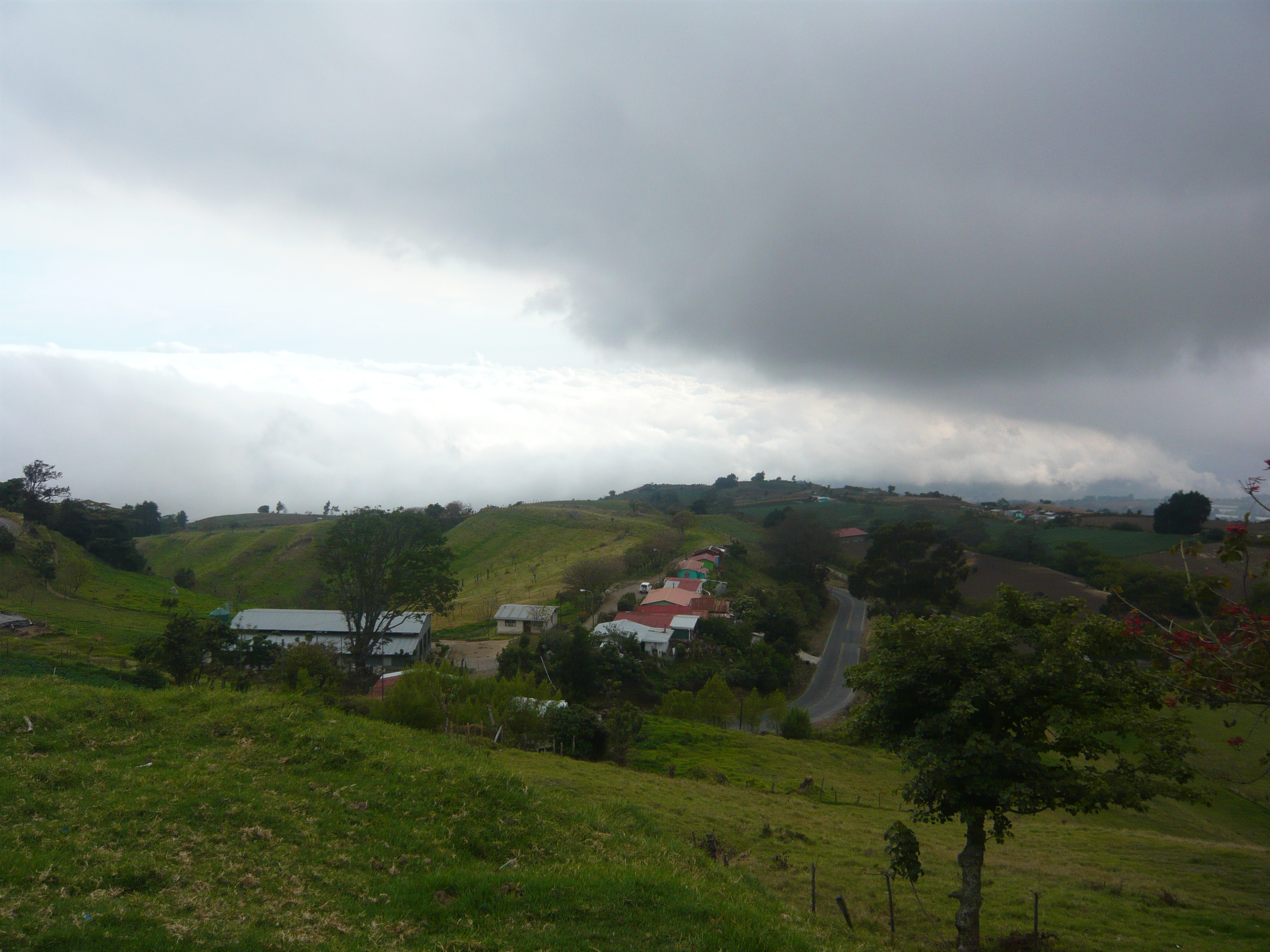
The flight began it’s approach into San Jose International Airport and my palms began to sweat in anticipation. Instead of seeing the lush vibrant green landscape that I had heard so much about before coming, the sky was dark save the thousand twinkling lights of the city below. I couldn’t wait to be on the ground! I was utterly exhausted from my cold and the pressure of the descent wreaked havoc on my eardrums. But despite it all, I was excited to finally be here in Costa Rica, a place I’ve wanted to visit for a long time.
I gathered my belongings, headed through customs and entered into the Arrivals lounge into a sea of black heads holding hundreds of white signs listing names of the passengers whom they’ve come to greet. I also find the Arrivals area in another country to be quite a stressful, disorderly place. You walk through the glass doors and there you are, voila, surrounded by hundreds of smiling, shouting people waving big white signs in your face. It is overwhelming to say the least. Especially when you are tired or jet-lagged (which I was not given only a two hour time change and a relatively short flight from Minneapolis).
I searched the eager faces, desperately hoping he was there. Then I found him, smiling and holding a sign that said Mrs. Melancon (so formal!) and was relieved that my driver had come. You never know for sure when corresponding and organizing all your travel details via email. Especially when there is a language barrier involved. Yet I was glad he was there to take me to my hotel. The last thing I wanted to do was have to haggle with an unknown driver in a language I wasn’t all that red hot at. Furthermore, it was almost nine o’clock and I was ready to relax.
The driver grabbed my bags, packed them inside the small, old sedan and sped off towards downtown San Jose. It was Saturday night and the city was incredibly alive. People were out, everywhere, walking down the streets, driving in cars, and going out to eat. I could feel the energy pull me in and instantly felt happy. It had been such a long cold winter!
My driver didn’t speak a lick of English yet that didn’t seem to faze him one bit. He talked boisterously and rapidly to me the entire ride, and was delighted by my second grade level Spanish. In fact, he encouraged it which was a relief and helped me let down my guard so I wasn’t so afraid of making my many mistakes. Somehow, like magic we managed to communicate and before I knew it, we were at my hotel, El Presidente, located right on the main drag. Gracias, I said cheerfully, glad that he got me there safe and sound and also put up with my terrible Spanish. I secretly cursed myself for majoring in French! The Ticos, as Costa Rican people are called, seemed extremely cool, gregarious people that I definitely wanted to get to know. It would have helped if I could communicate better in Spanish but I hoped that after a week long immersion, I would somehow become more proficient.
The hotel was large and quite modern. I had no idea at all what to expect so I was quite pleased to be in a clean, comfortable, safe place. The staff was overwhelmingly friendly and welcomed me with smiles. Despite my pounding sinus headache and sore throat, I had to get a drink before bed. I knew there was no way I could sleep so soon after arriving into a new country. Fortunately the hotel has a nice gringo bar that opens up onto the street, which enabled me, a blond American woman traveling solo, to have herself a glass of ice cold Sav Blanc and watch the world go by on a Saturday night. I was amazed by the people out on the streets. I had heard several times that San Jose can be dangerous, especially for foreign women and especially at night. The hotel staff reminded me gently to not leave the hotel at night alone. Period. Of course I didn’t. Thus finding the gringo bar was the perfect opportunity to explore my surroundings all under the comforts and safety of the hotel. Tomorrow I had the entire day to explore the city and I would talk with the front desk about where to go. I couldn’t wait to see for myself what all the fuss and fascination is about with Costa Rica. And, tomorrow was the day!
It was finally nearing the end of Minnesota’s infamous brutally cold, never-ending winters. Winter has never been my cup of tea. It is two things: Too cold and too long. Sometimes winter can last almost six full months making it hard to believe that anyone would ever choose to live here. Yet, somehow, like other hearty Midwesterners, I manage to survive.
Spring does not arrive until late April or early May. Usually we would get a few teaser days when the temperature is well above average, and everyone is out and about enjoying the weather. The lakes start to thaw, the birds reappear, and the snow slowly begins to melt making messy, splashy puddles everywhere. But before you know it, winter magically reappears and people return to their long, lonely hibernation. The winter-spring dance normally goes on for weeks until the ice on the lakes finally breaks free, the vibrant green buds burst into leaves and people actually come out of their homes. It feels like some kind of strange, yet predictable rebirth as life once again returns to Minnesota.
It is usually around this time of year, in mid-to-late March, that every sane Minnesotan is beyond stir crazy and is desperately seeking sun and sand. Airplanes become packed with pasty, white, hearty Minnesotans heading south. Schools close. Homes become empty and there is no one around. Many prefer to vacation in Florida or some other tropical paradise far away from anything white and cold. Others prefer heading south of the border to some luxurious or cheap beachfront hotel in Mexico.
For me, it was something similar yet different as well. Like many others, I was also headed south, too, where I would happily be wearing my sandals and t-shirts that had been tucked away for months. I was going to Costa Rica, but not to sit a beautiful beach and drink every worry in my life away. I was going on a different kind of vacation. A volunteer vacation.
Volunteer vacation? What in the heck is that? friends asked, wondering how on earth the two words could go hand and hand. Was it some kind of mid-life crisis? friends secretly wondered. Or some kind of “desperate housewife” kind of deal?Was she going mad? Although they didn’t exactly ask me these questions, their confused, bewildered faces clearly indicated what they were thinking. They didn’t understand me. They didn’t travel. Well, at least they didn’t travel to the places I wanted to go. And, that was the problem. Even my own mother found the idea strange.
So, why did I decide to leave my husband and two young children behind for a week and volunteer in Costa Rica? Perhaps it was a little of all the above….mid-life crisis, desperate housewife, mad or so on. But the real reason behind my decision was simply because I wanted to. I had always wanted to.
Ten years ago I saw the article on global volunteering and read it with high hopes that someday I’d be able to do the same. The stories all sounded amazing: Working in orphanages in Romania, teaching English in Tanzania, building a school in Peru. Experiences that would last a lifetime, and would make you feel like you were doing something great in the world, not just earning a meager paycheck or climbing the corporate ladder. I dreamed of someday volunteering abroad but I knew that it was impossible at that point in my life. I clipped the article, kept it in my file cabinet, hidden away for years, hoping someday I’d be able to do it. The path I was following in my life was typical for a young, college-educated American girl: Work, building a career, marriage, and then finally kids. I continued to travel internationally throughout the years with my boyfriend, then fiancé, then husband, but due to the pure lack of American vacation, I never did a volunteer trip (vacation was only two weeks per year given at start of a job and taking more than a week off at once was highly frowned upon—those lucky Europeans!). It was only when I had my children, they grew a little bit older (well, 3 and 5) and more manageable, that somehow or another I was able to pursue my dream of volunteering abroad. My husband knew how badly I wanted to do it so he miraculously gave me the green light. He would take the kids to see his parents in Virginia over spring break allowing me to travel to Costa Rica to volunteer.
So, after ten long years of hoping and waiting, I finally found myself seated in coach on an American Airlines flight headed off to Costa Rica. It was the last week of March which was the perfect time to leave. All my love for Minnesota had dried up long ago and I was looking forward to seeing the color green once again, which had been absent for months. I had never been past Mexico so Central America would be an entirely new place for me to visit. I was extremely excited albeit a little nervous as well. I was traveling alone and would be staying with seven other volunteers (strangers) for the next week, working together. Who were they? What would they be like? What if I hated the experience?Worse yet, what if I never got over my miserable cold and remain sick in bed the whole time? All these questions racked my brain, making me feel even more anxious than before.
The one thing I kept reminding myself was the last words I heard before leaving the States: Go with an Open Mind. That was the one final piece of advice our program manager from Cross-Cultural Solutions (CCS) said before ending our volunteer conference call. Those were also the words I kept reminding myself of over and over again when I learned what our volunteer experience would be. Keep an Open Mind. There are several volunteer opportunities planned at each site, however, due to the short length of our trip, volunteers going on the one-week “Insight” volunteer program typically do not find out what they are going to be doing until two weeks before departure. This way CCS can ensure that the project or work can be completed in a week making the experience more worthwhile. Thus when you sign up for a program with CCS, you are taking a leap of faith not knowing exactly what you will be doing but having an idea that it may involve one of the following opportunities: Working with kids at an orphanage, teaching English to children or adults, working at a hospital or place for disabled children, or working at a nursing home.
I was fine with all the potential volunteer opportunities except one: Working at a nursing home. I didn’t want to admit it but working at a nursing home seemed like the most depressing experience possible. In fact, it scared me. I didn’t like being around elderly people in wheelchairs, watching them wither away and revert to their infancy. I’m not a religious person either so death scared me. My only experiences with nursing homes had been negative. When I was a girl, I was on a dance team who used to perform on Saturdays at the local nursing homes, trying to cheer the white-haired residents up. It was horrifying. Then, in my twenties I watched both of my grandparents die in dark, lonely nursing homes. The experience was always the same. Depressing. So I secretly hoped that I would get any other assignment than that.
Our program manager at CCS must have known that working at the nursing home was probably at the bottom of most volunteers list. So she spent time setting it all up, emphasizing that before she told us what our volunteer work was going to be, that she wanted us to keep an open mind. (Third eye, right?). Those words sent chills through my bones because before she even said it, I knew. We were getting the nursing home.
When I told my family and friends that I had received my placement and would be working at a local nursing home for abandoned abuelas and abuelos (Grandmothers and Grandfathers), I tried to sound as upbeat as possible. It would be great, I said a little too enthusiastically. But I had my doubts.
When I arrived in Costa Rica, one of the first and most important things I learned was the importance of the words: Pura Vida, which literally means “pure life” or “full of life”. However, the words have a much deeper meaning and can be used to describe a peaceful, tranquil life free from impurities.
For the Costa Ricans, pura vida means everything and is truly their raison d’être. At first I was surprised to learn how frequently pura vida is used in every day conversation. It is used for both a greeting and a farewell, to express joie de vivre or simple satisfaction, to offer a difference of opinion or an agreement, or just to say “cool”. How could one simple phrase mean so much and so many different things? I wondered in awe and mystery. During a week long stint volunteering and living with the locals in Costa Rica, I was about to find out.
As our jet plane took off and climbed five thousand, ten thousand and then eighteen thousand feet, I realized in awe that only a few days ago I had been at almost the same altitude as the plane. It was a wild thought. Almost a little frightening.
As I looked down, out the airplane windows, I finally was able to conceptualize how high 18,000 feet truly is. The buildings became smaller and smaller, the cars like ants lining the roads. The vastness of the green, voluptuous rice fields stacked one on top of the other, bursting in color and life. Then, for the last time, I saw the godlike, mighty Himalayas, strikingly beautiful, like a mirage of flying towers soaring upwards into the heavens of the sky. I had to pinch myself to believe that I was really here and had really been there. It was all like a dream.
Months before I left for Nepal, I made a decision that I no longer wanted to be simply a tourist that visited a country, enriched myself in all its culture and beauty, and left nothing in return, no gift behind. My new way of thinking all began on a recent trip I made which was different from anything else I’d ever done: A volunteer trip to work in Costa Rica. Although I was only there for one week, the impact volunteering made on my life and the people I helped during that short time led me to believe strongly that you must give back. You receive a gift when you travel, and it is important to give one back.
I wracked my brain for different ways I could raise money. I knew that I wanted to donate money to a non-profit organization that focuses on education in Nepal. After reading several inspirational books on education in poverty-stricken lands (Two Cups of Tea, Stones into Schools, Half the Sky), I knew that this was the area to attack. I searched Lonely Planet who has an excellent listing of non-profit organizations as well as volunteer opportunities, and found just the organization I was looking for: READ Nepal.
READ Global pioneered the concept of sustainability as an international development organization dedicated to combining education and private enterprise to make rural communities viable places to learn, build, and prosper. READ partners with rural communities to create, sustain and grow projects in a manner that is politically and culturally appropriate. READ has helped establish forty nine Community Library and Resource Centers paired with for-profit enterprises throughout Nepal and India that serve over a half million people annually and has also recently opened up a center in Bhutan.
Finding the right organization was the easy part. The hard part was figuring out how a “thirdeyemom” could raise the money. A mom, who had voluntarily left the workplace to raise her two young children (aka a mom with no income). Of course we could just write a check out of our own money but that didn’t feel right. I wanted to earn the money. Furthermore, I wanted to involve my children in the process so they could learn the importance of giving back.
That was where my creative thinking came into play. It was summer in Minnesota—-a time to be outdoors, out of our long winter’s hibernation, and back into the world again enjoying our 10,000+ lakes, beautiful parks and nature. There was no school for the children. Thus opportunities lurked. Why not host a “babysitting extravaganza” all in the name of charity, at my house? I sent out the email to my group of trusted friends with small children. Parents who knew what I was doing and who also wanted a break. I set up three Friday morning playgroups with ten children each ages 5 and under (yes I’m crazy), with a suggested donation of $10 per child. A pretty good deal when you consider it usually costs at least $10 per hour for a sitter. It worked great (except for the huge mess I had to clean up afterwards). I was able to raise almost $300, which was only $200 shy of my initial goal of raising $500 for READ Nepal. Hurrah!
After the initial joy of raising the money, I realized that I still had to figure out how I would earn the rest. That was when I came up with the idea of having a “lemonade sale” on the corner of our street. This may sound funny to people who don’t live in the United States but it is one of the trademark events of childhood. Every American child at some time in their life have a lemonade stand in which passing people stop to purchase an ice-cold glass of lemonade on a hot summer day. It is a tradition. So why not do one for charity? I made four pitchers of ice cold lemonade, some handmade signs and we set up shop on the corner of our street with hopes of staying until we sold it all. Unfortunately sales were very slow despite the singing, shouting and jumping up and down of my 4 year-old blond-haired daughter. My six-year-old son quickly became bored. After making a disappointing $25 we closed the stand and drank the remainder of the lemonade. Not such a great idea after all.
Summer was quickly ending and my trip to Nepal was rapidly approaching. I was well short of my goal but didn’t give up. My last ditch effort was the all-American yard sale. Again, for those not familiar with the American “Garage Sale” or “yard sale”, let me explain. Basically you go through all your closets, boxes, and drawers and gather up all the stuff you don’t need or use anymore, and place it in a pile. You meticulously go through each item, one by one and put a ridiculously low price on the item. Then you haul all the items outside either to your garage or your yard, place up a few advertisements (aka homemade signs) around town, and wait. Believe it or not, people go absolutely NUTS about garage sales. They are out at the crack of dawn, sneaking around like cats trying to get the best deal they possibly can. Before I had even set up all my tables of stuff, they were knocking on my door trying to get a deal. It was pathetic in a sense. My large sign said “all proceeds are being donated to charity” yet people still tried to weasel down the price. Go figure! After three hours, the sales piled in and my old “junk” was packed away in other people’s cars, to be used or stored in their house. The garage sale wound up being a huge success and brought my total up to $550, well past my goal!
Exhausted, I cleaned up the remaining items and my husband packed everything up to donate to a local charity. I had met my goal and felt proud. But little did I know there were others (friends, family, neighbors, etc) who noticed my effort and contributed to the cause. The money raised eventually made it to $2,000 which was matched by my husband’s employer, bringing the total donation to READ Nepal up to $4,000! Wow, just like that a small idea ended up being a big help. The funds were donated a week before I boarded the plane to Kathmandu. READ Nepal was delighted with the donation and informed me that the money would be more than enough to open up an entire library and reading center in rural Nepal. The gift was given and I realized that it is the things you do for others in life that make you feel the best.
The beautiful smile of a young child in rural Nepal:
The president of Earthbound Expeditions, Rajan Simkhada, is an amazingly talented, impressive and humble man. He has worked in Nepal’s tourism industry for years, was raised in the villages and now resides in Kathmandu where he runs his travel agency.
Earthbound Expeditions was created over 14 years ago, and is a leading adventure tourism agency that leads the traveler “off the beaten path” on trekking trips throughout the Himalayan darlings, Nepal, India, Tibet, and Bhutan. Over the years, as Earthbound gained raving reviews and more and more customers came, the company branched out into philanthropy work focusing on responsible, sustainable (social and environmental) travel. His company promotes rural development by giving back 10% of their profits each year in these areas. Per Earthbound, “responsible travel is a new way of travelling and trekking for those who’ve had enough of mass tourism. It’s about respecting and benefiting local people and the environment-but it’s far more than that”. It involves respect for the local culture, minimal environmental impact and giving back to the community. In an increasingly global world, social responsibility and tourism go hand and hand and it is refreshing to find a company dedicated to working with and for their people.
Besides running the trekking company, Rajan is also very busy in his philanthropic work. He is the founder of Mamata Volunteers a non-profit organization that matches US volunteers with customized volunteer programs within Nepal. Below is information on the scope of Mamata Volunteers, written on their website, www.mamatavolunteers.org:
Mamata Volunteer’s mission is to provide volunteers with a customized program that will enable them to make an important contribution to the people of Nepal, while also gaining an in-depth experience of Nepal’s language and culture that will stay with the volunteers for the rest of their lives. Join us and experience this unique Cultural Immersion and Responsible Travel Program in Nepal one of the most beautiful countries in the world.
Mamata Volunteers is a non-profit organization stationed both in Nepal and in the United States. As a part of our Volunteer Program, Mamata first provides instructional training on local language and culture and only then do we place our trained volunteers in schools, hospitals, orphanage and communities across the region. Volunteers will have the chance to teach English, stay with children in local care houses, and help with community based programs like health camps, environment cleaning, empowerment of women and more. Come join us for a truly life changing experience at the Top of the World, Nepal.
Rajan also serves as National Director of HANDS IN NEPAL, a grassroots non-profit organization founded by a young, highly talented American man, Danny Sprague Chaffin, that focuses on building schools in rural Nepal. Their first school (a four-room schoolhouse made of stone and cement with a tin roof) was recently completed for the cost of around $6,000 and provides education to over 80 children in the village of Dharka. To learn and heard more about his story, you can visit the website at: http://www.handsinnepal.blogspot.com/
You can also see an amazing documentary of Danny’s experience on YouTube. Here is the link and it is definitely worth a view and incredibly inspirational:
Finally, Rajan and Earthbound is the leading patron and sponsor of the Buddhist Bal Griha Orphanage in Kathmandu, Nepal. The Orphanage provides a home for over fifty children who come from disadvantaged rural communities. In many cases, the families simply cannot afford to keep their children so they are abandoned.
It is amazing people like Rajan and Danny (and all the others out there in the world) who are making positive change in Nepali people’s lives. Something that should inspire each one of us travelers to follow in their path and make a difference in the world, whether it be a financial donation, volunteer work or simply a smile. I believe that sharing our unique cultures, respecting and learning from other cultures, and helping others, all go hand in hand to make the world a better place!
————————————————————————————————————————————–
To learn more about Earthbound Expeditions and their work please see their website: