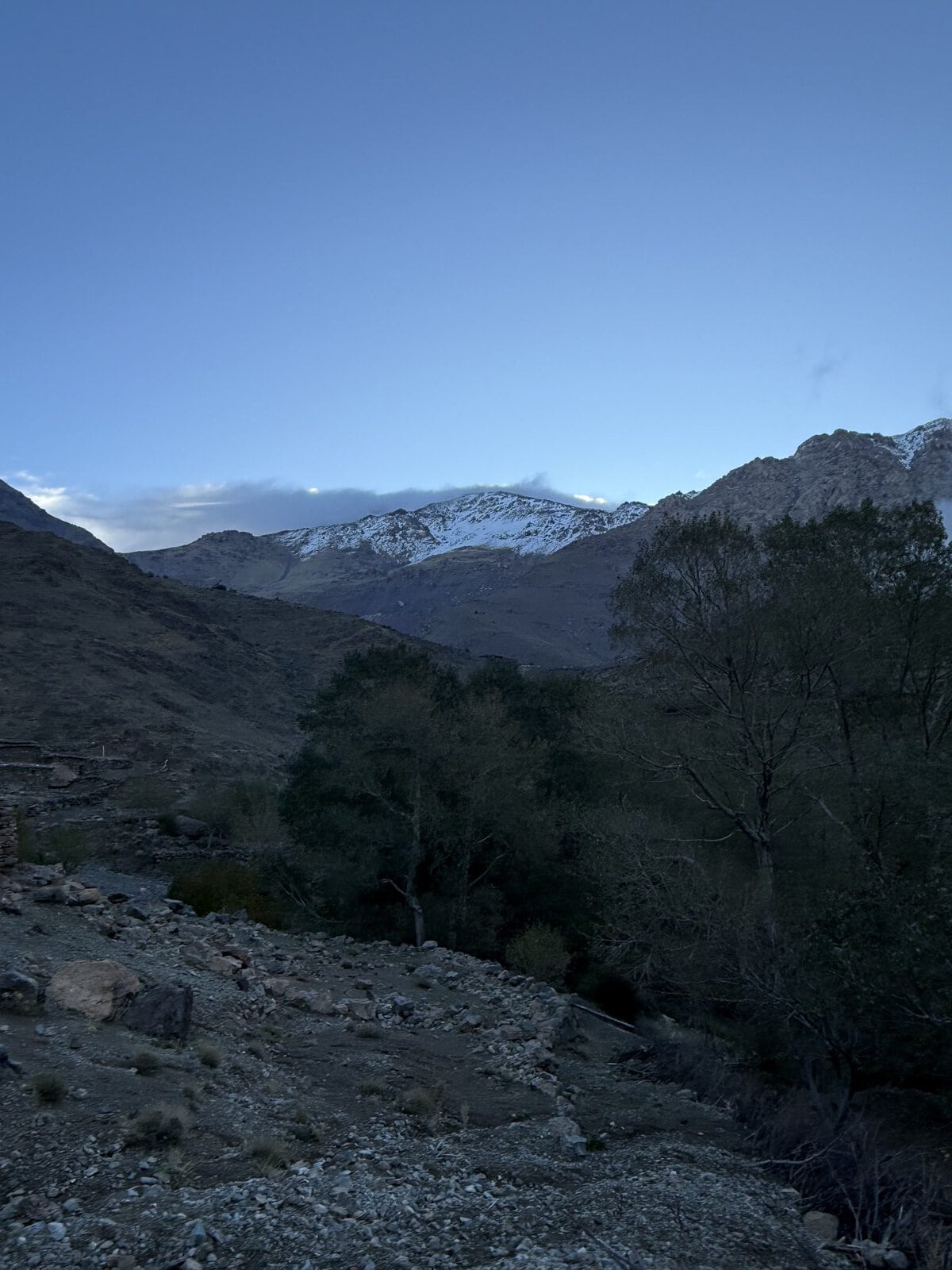
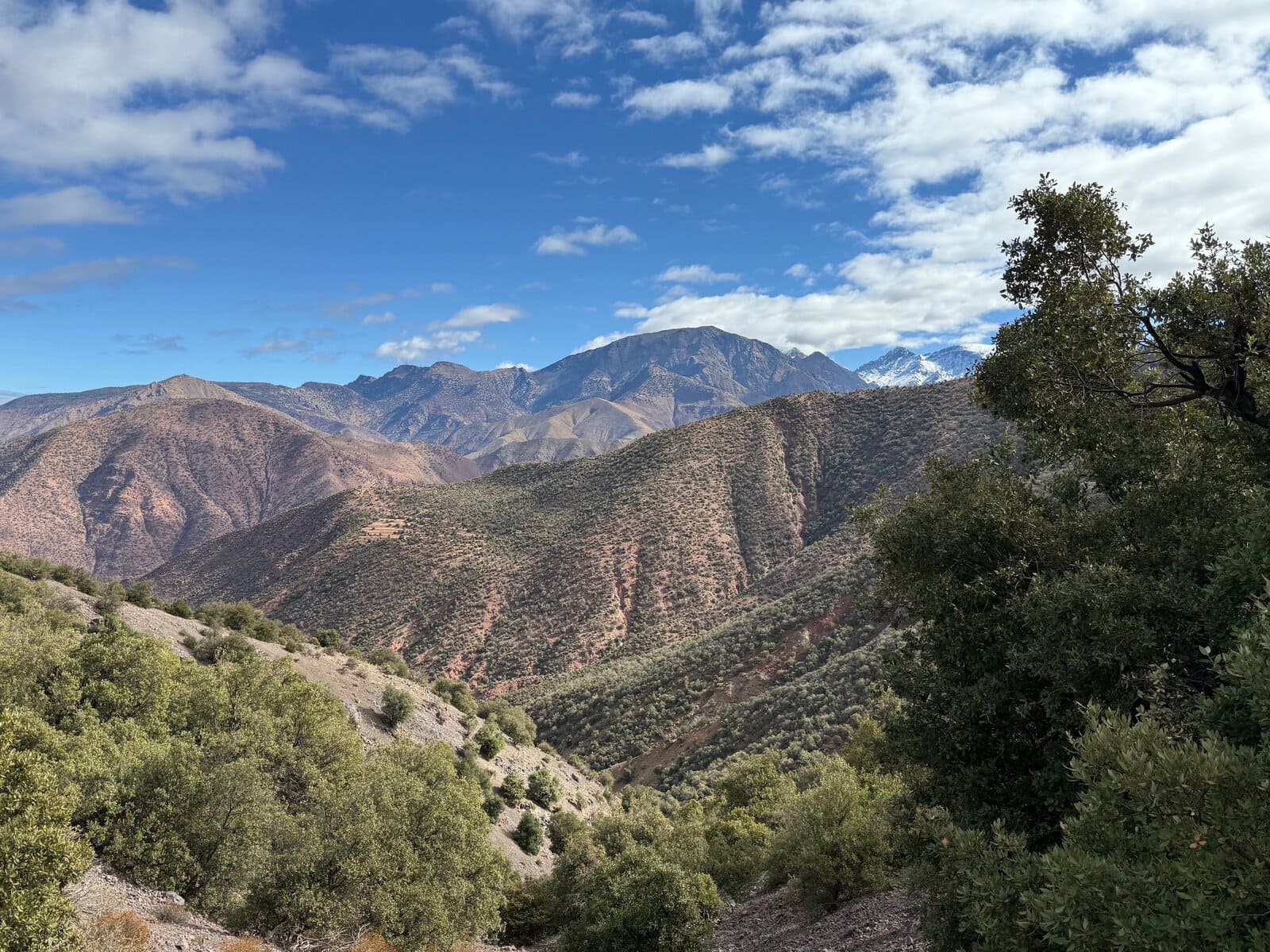
The last leg: Hiking the Atlas Mountains to the stunning village of Imlil , Morocco

After a hot Moroccan breakfast with sweet Berber tea, we set off on our last day of hiking in the Atlas Mountains. Today, we would complete our hike from Tizi Oussem to the beautiful village of Imlil, a village easily reachable from Marrakesh making it a popular day trip for those who want to experience the Atlas Mountains and Berber hospitably.

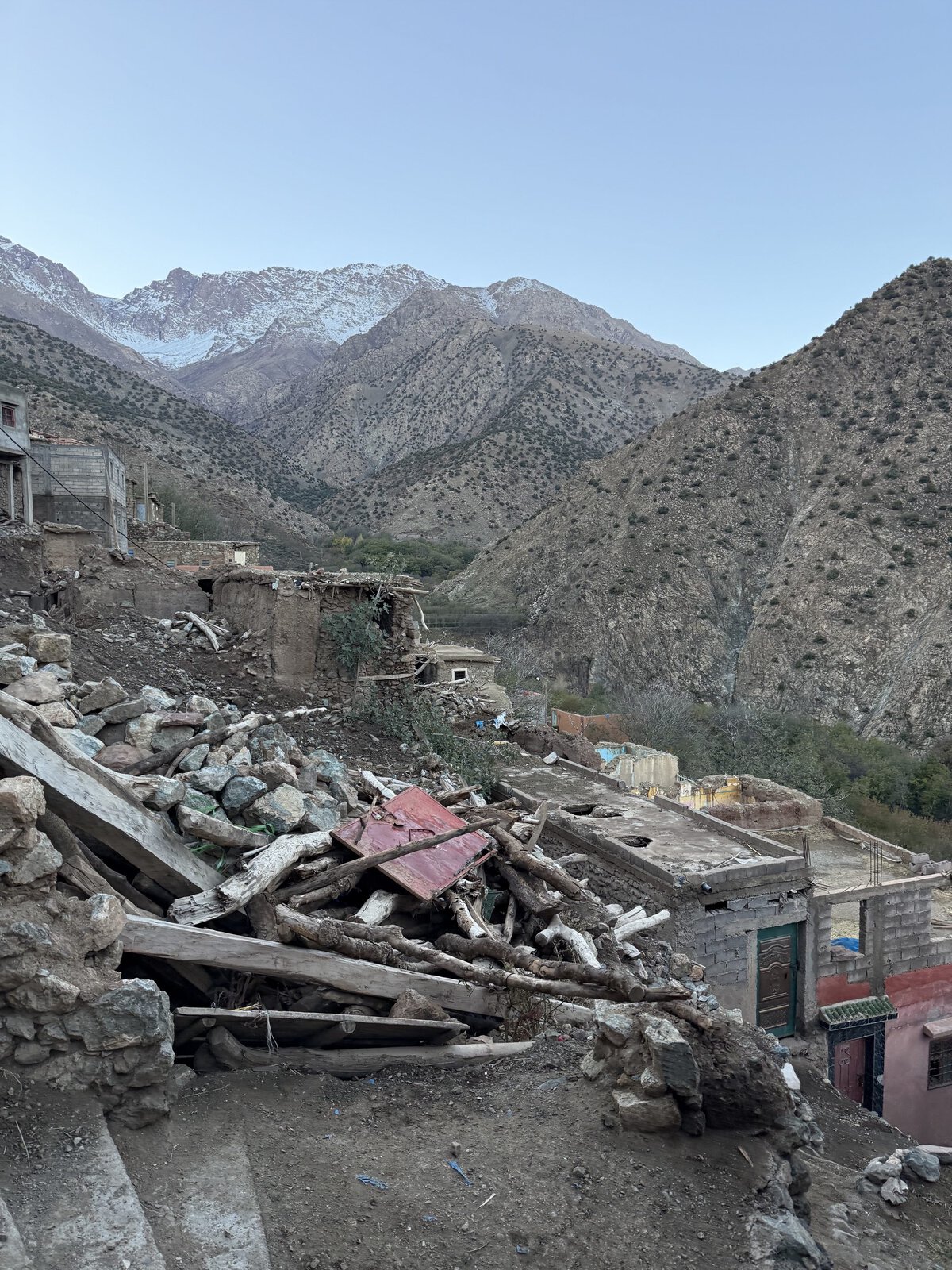
As we left Tizi Oussem, our guide Mohamed showed us some of the leftover destruction from the earthquake a few years back. It had hit this community really hard and they were still trying to rebuild years later. Many Berber homes were built the traditional way using stone to keep the heat in during the winter and hot sun during the summer. Since Berbers are mostly farmers and goat herders, livestock would often live on the bottom floor of the home using their feces to heat the house in the winter months. While a practical style of home, many did not survive a major earthquake so the new homes built by the government and NGOs were made of concrete to last the weather and survive future earthquakes.

Tizi Oussem, Atlas Mountains, Morocco

Older homes on the left and a newer concrete home pictured on the right. 

Adventure Travel Africa Morocco TRAVEL TRAVEL BY REGION Trekking/Hiking
Hiking the Atlas Mountains in Morrocco

Day 3 of the Atlas Mountains trek from Imgdal to Tizi Oussem, Morocco

Our third day trekking in the Atlas Mountains in Morocco was one of the longest days, hiking from the remote village of Imgdal to the even more remote community, Tizi Oussem.

We rose early to the sound of the call to prayer echoing melodically through the valley and the sun was beginning to rise above the village. By day three, I was finally accustomed to sleeping in an unheated gite on a somewhat uncomfortable futon on the floor in a room with six others. It had been quite some time since I traveled this basic and while I would have preferred a warm, cozy bed and a hot shower, the camaraderie of it all made the trip the more memorable.

Setting off into the mountains

Adventure Travel Africa Morocco TRAVEL TRAVEL BY REGION Trekking/Hiking
Day 2 of the Atlas Mountains trek from Tiziane to Imgdal, Morocco 

Day 2 of the Atlas Mountains trek from Tiziane to Imgdal, Morocco 

The second day of trekking the Atlas Mountains ended up being one of my favorites for its sheer wow factor and beauty. Day two took us from the lovely village of Tiziane to the remote Imgdal, a lovely Berber village in the heart of the Atlas Mountains. The five-hour hike would take us up along the Assif n’ait Oussaden valley, passing through walnut groves, climbing up via switchbacks through the clouds until our descent into the village of Imgdal.

After an early morning breakfast, we packed our gear and set off to the rising sun and the echoes of the call to prayer.  As we left the village, school children were already up and ready for their walk to school while farmers were heading out to the fields for their day of work. Just like the day before, we did not see another tourist and had the entire trail to ourselves.

Heading out for our hike a little after seven am from the lovely village of Tiziane

Adventure Travel Africa Morocco TRAVEL TRAVEL BY REGION Trekking/Hiking
Enjoying the breathtaking views on the first day's hike in the Atlas Mountains

Hiking the Atlas Mountains: Day 1 Trek from Imi-oughlad to Tiziane, Morocco 

Few treks in the world feel as timeless and captivating as the four-day journey through Morocco’s Atlas Mountains. Hailed as one of the world’s great hikes, the trail winds through dramatic mountain scenery and centuries-old Berber villages hidden deep within the valleys, places so untouched that it often feels like stepping back in time. Stone homes cling to steep hillsides layered like a wedding cake, while lush terraced fields snake up the mountains, irrigated by ancient systems still used by farmers today. Life here moves slowly, to rhythms that have endured for generations.

Morocco’s cultural identity is deeply rooted in the heritage of the Berbers  (also known as the Amazigh people), who are the Indigenous tribes of North Africa, and the country’s oldest inhabitants. For centuries,  the Amazigh have called the Atlas Mountains home, building villages in remote valleys and forging a way of life inseparable from the rugged landscape around them. Intrepid travelers can witness the Berber way of life on foot, hiking through the ancient mule trails that connect these mountain communities.

The trails weaving through the high peaks and valleys of the Atlas Mountains were once vital mule tracks used by Amazigh traders, shepherds, and families to travel between villages. Walking these same routes offers far more than a hike; it is a journey through living history. Around every bend are sweeping mountain vistas, terraced hillsides carved by hand, and villages where traditions and daily life remain deeply connected to the land.

Imi-oughlad, Morocco Atlas Mountains

Adventure Travel Africa Morocco TRAVEL TRAVEL BY REGION Trekking/Hiking

Two Crazy Days in Marrakesh

Marrakesh is one of those cities that takes you by surprise. I had been to Morocco before visiting its capital city of Rabat and also Casablanca. Yet once I arrived in Marrakesh, I realized that I hadn’t been to the real Morocco.

Marrakesh, the fourth-largest city in Morocco, located at the foothills of the High Atlas Mountains and one of the country’s four imperial cities, is a place that requires the use of all five senses. From its elaborate, colorful, and endless souqs to its eye-popping architectural treasures, and the plethora of smells, sounds, and oddities of its main square, Jemaa El-Fnaa, Marrakesh is a city that will inspire you, overwhelm you, and keep you exploring its endless serpentine streets until your feet ache.

Lovely view from my riad

Africa CULTURE Morocco TRAVEL TRAVEL BY REGION

Becoming a global volunteer

“If you can’t feed a hundred people, then feed just one.” – Mother Teresa

IMG_2502

Two lovely Garifuna girls in Roatan, Honduras.

Four years ago, I was finally at the point in my life in which I was able to set a new goal for myself. I made the decision that I would spend one week a year abroad as a global volunteer, giving back to a host community. After years of traveling around the world, I realized how incredibly fortunate I am to be able to see places that most people will never see. Furthermore, I understood how much we truly have in the western world compared to to everyone else who are not so fortunate. Spending time in developing countries opened my eyes even more and I became even more thankful for the fact that I had a more than adequate roof over my head, plenty of food on the table, a loving family, the ability to stay at home with my children and pursue my dreams. All in all, I realized that I had a really great life and that millions of people around the world were just struggling to survive.

IMG_4489_Snapseed

Central America Costa Rica Guatemala Honduras Morocco SOCIAL GOOD TRAVEL BY REGION Volunteering Abroad

Morocco Today: A Land of Complexity and Contradiction


A Moroccan stop sign

An afternoon tour through the ancient Roman ruins (AD 40) and Merenid necropolis of Chellah (built in the 14th century by the Merenid sultan Abou al-Hassan) reminded me just how much history and change has passed through Morocco.

Here are some photos of the ancient city of Sala Colonia and Chella:

The overgrown ancient city is filled with towers and crumbling defensive walls that once protected the powerful Merenid sultan:

Per Lonely Planet Morocco (9th edition), “Making out the structures takes a bit of imagination, but the mystery is part of the magic of this place”.

Now the towers and trees are home to the hordes of migrating storks which are in the process of mating in the spring (I was wondering what that loud, obnoxious sound was! Apparently they clack their bills in order to attract a mate). That was almost as impressive a sight as the ruins!:

Note in this picture there are three levels of nests!

Up close and personal with a stork:

Here is a photo of the remains of a beautiful Islamic complex (note the colors are green and white, the sacred colors of Islam):

The gorgeous, lush Moroccan countryside and farmland offers the visitor a glimpse of what the countryside is like:

————————————————————

Today Morocco remains a country full of complexity and contradictions. It’s rich cultural heritage starting with the Amazigh (Morocco’s “free people” or natives also known as the Berbers) then subsequent invasions by the Romans, the Arabs, the Spanish and the French (Morocco gained independence only in 1956) have made it the complex, mystical place that it is today.

As a bridge between both the Western and Arab worlds, Morocco is loaded with complexity and contradictions. While it is an Islamic kingdom with over 99% of the population being Muslim, Morocco is widely regarded as one of the most modern, liberal-thinking Islamic countries in the Arab and North African world. Traditions remain sacred in Morocco yet some are changing, especially with the younger generation. Veils can be seen worn by young and old women side-by-side other women wearing their hair down freely and uncovered. Praying is done five times a day, yet if it is missed, that is accepted as long as it is made up over the course of the day. Restaurants, cafes and discos are opening among the main city centers while the majestic medinas and world-famous souqs remain the main shopping area of town.

As many people would like to believe, camels cannot be seen walking down the street (like in India!) but are seen in the sahara desert. And, believe it or not, goats can be seen in the trees (in Agadir, goats climb the trees to eat the Argan nuts which is passed through the goats feces and made into the world famous Argan oil. This is a fact!).

Thus times are changing for Morocco as it advances towards modernization and globalization. Yet with these unprecedented changes, tensions arise in a deeply traditional and highly religious society. Morocco has not been untouched by the recent wave of revolutions touching it’s Middle Eastern and North African neighbors. Although King Mohammed VI has implemented some dramatic changes in Morocco (most notably in regards to social, economic, and political laws), Morocco is still a constitutional democracy in which power filters down from the throne. In 2007, only one out of three Moroccans bothered to vote thus there is some discontent and disillusionment with the government despite the King’s high level of respect and regard among his people. Protests and strikes are a daily occurrence in Morocco. I witnessed them every single day during my stay. Yet, the main difference is that the protests and demonstrations are peaceful. They are well-organized, with hand-out flyers, brightly colored t-shirts, sectioned off streets and an ample supply of police. This is the Morocco that may very well be able to make headways and change for the people and their future. It will be very interesting to see how everything plays out in Morocco. Only time will tell what path it will follow.

Like many nations around the world, Morocco has been significantly effected by the global recession and its economy is slowly picking up. Tourism plays a huge role in Morocco’s economy and Morocco was fortunate to pick up the tourists from its neighbors such as Tunisia and Egypt after the uprisings in each country. However, the recent bombing on April 28th of a trendy cafe in the tourist haven Marrakech which killed 15 people, will most likely have negative repercussions on Morocco’s tourism industry. Terrorism has not really been as huge of an issue in Morocco as it has in other Arab and African countries. There have been two terrorist attacks both in Casablanca since 9/11 (one in 2003 which targeted hotels and restaurants that killed 45 people, and another one in 2007 which occurred outside the U.S. Consulate General and the private American Language Center). Other than that, Morocco has remained relatively safe and even with the recent attacks, I still feel that Morocco is very safe, perhaps even safer than my own country.

Of course there are still concerns that the safety of Morocco may change and become unstable. One issue involves Morocco’s growing population of youth. In a country of 34 million people, 30% of the population is under 15. That could lead to an increase in problems with unemployment (Morocco already has a high level of unemployment, especially among the youth and newly college-degreed), strains on the educational system, and the desire for young, technologically-savvy (yes, they all have access to the internet and satellite TV) to start demanding more freedoms and more opportunities in which the government is not providing. Morocco is plagued by massive social injustices and a large gap continues to grow between the rich and the bare-bones poor. If the King can implement changes soon then perhaps this young, volatile population will be satisfied. If not, well then we know what could happen down the road.

Now that I’ve been back at home in the States for a little over a week, I’ve had some time to reflect on Morocco. I must say that I was completely surprised and taken aback by what a wonderful, amazing country Morocco is and what warm, generous, kind-hearted people the Moroccans are. I was welcomed with open-arms and accepted into their culture and world. Throughout my stay, I always felt safe and never once felt threatened. I realized that part of this feeling of security has to do with the Moroccan culture and spirituality. The Islam religion places God at the top of their lives and everything falls down after that. Violence is rare. Stealing not as common. And, capitalism is not important which was a refreshing concept given how materialistic and consumeristic American society and culture has become.

By going in to Morocco with the “third eye” approach, I was able to experience all the wonders and joys of a phenomenal culture and religion. I am truly thankful that on our first day at CCS Home Base in Rabat, Mohammed, the Country Director, told us some words of wisdom. He said, “the experience in Morocco should teach us how different we are yet to remember that nothing is right or wrong. Just different”. Thus in order to have a successful volunteer experience in Morocco, you have to remember to keep an open-mind and heart. This will help you learn about Morocco and share our culture with them.

Mohammed is 100% correct. My stay in Morocco further confirmed my view that there are a lot of misperceptions about the Islamic religion and that part of the world. Not all Muslims are a bunch of terrorists! In fact, only a very small few are terrorists and if these people are terrorists, are they truly Muslims? Correct me if I’m wrong, but the Prophet Mohammed does not condone violence. Killing another human being is against the Qur’an. Thus terrorists (many, by the way, are illiterate and cannot even read the actual Qur’an) are not even following the Muslim religion.

I think as Americans we have to rethink our viewpoints and perceptions on the Islamic world and take it for all the wonderful things it has to offer. It is only by traveling and learning about the world, we can make ourselves better as well. I feel extremely blessed to have been one of the 800 people who have volunteered with CCS Morocco since it’s opening in 2007. Now my hope is that someday I’ll be able to go back…

Morocco TRAVEL BY REGION Volunteering Abroad

Moroccan cooking 101: How to make tagine

Anyone who has ever traveled to Southern Spain, Turkey, North Africa or Middle East knows that the food is quite magical. Food from these regions generally contain an array of fresh spices abound in flavor such as saffron, cumin, ginger, paprika, black pepper, cinnamon, mint and garlic. Mouthwatering fresh fruits such figs, dates, oranges and pomegranates can often be found added to freshly prepared tagines and couscous. Delectable olives, delightful almonds and mouth-burning harissa (a capsicum-pepper sauce which I adore) make any meal legendary.

The warm, gentle climate of Morocco provides an abundance of fresh vegetables as well (such as pepper, beans, tomatoes, artichokes, eggplants, onions, beets and pumpkins) which are common side and main dishes throughout Morocco. Being a world cuisine lover, I found Morocco to be a culinary paradise and was not once the slightest bit disappointed in the fantastic, fresh, exciting and worldly food I found.

My first night in Morocco was spent at a gorgeous Riad (see earlier posts) which served my first true Moroccan tagine, the famous Moroccan stews containing chicken or lamb with an assortment of fresh vegetables and spices that are cooked in a conical earthenware pot creating a lovely, tender and moist stew. I chose the chicken tagine with almonds and lemon over my beloved couscous (a type of semolina, small circular rice that is also served usually with a stew). After eating detestable plane food for the last twenty-four hours, my first Moroccan meal felt like heaven. I was also surprised to learn that Morocco, an Islamic country (over 99% Muslim) produces fantastic local wine. I ordered a half-bottle of Moroccan red which was delicious: Full-bodied, bright, with a smooth finish. I went to sleep after hours of travel feeling happy and full, anxiously anticipating my next Moroccan meal.

My visit through the local souq showed me exactly where these fresh, delightful ingredients come from. Vendor after vendor sold spices in all colors and flavors by the bag, and olives, nuts, figs, dates and fresh vegetables were at each and every corner of the market. I could have spent hours and dirhams passing through the souq and sampling up everything they had to offer. No wonder why Moroccans are such good cooks! In fact, each region and every city is known for its unique dishes and influences. This is probably not a surprise given that the distinctive flavors of Moroccan cooking come from a variety of origins such as Portuguese, Jewish, Spain, Persia, Senegal, France, Berber North Africa, Italy and Turkey—all countries that have ties to Morocco.

Some of my favorite market delights:

The couscous:

The dates and figs:

My week-long stay at the CCS Home Base in Hay Riad, Rabat, was another week of culinary delight. For an entire week, we had breakfast, lunch and dinner prepared by two native Berber cooks and we ate like kings and queens. Here are some pictures of our meals:

Lunch:

This gorgeous dish is called a bastilla. It is a multilayered pastry made out of phyllo dough and filled with a crushed mixture of toasted almonds, ground chicken, cheese and spices. Finally, it is topped with a dollop of cinnamon to give it a dessert like taste and appearance. It takes hours to prepare and looks were by no means deceiving….It was incredible!!!!

Here is a photo of the nummy inside:

Another favorite meal we had was the long-awaited Moroccan couscous, a quasi-religious experience in Morocco and what also just so happened to be one of my all time favorite meals thanks to that year spent living in France. Apparently the preparation of couscous takes an entire day and usually is made to feed an army thus it was usually made for the volunteers on the last day of the week’s stay: Friday. Here are some pictures of this amazing meal:

Our fantastic chefs preparing the couscous:

A close-up view of the finished product;

Ready to eat!

One of the highlights of my week stay in Morocco was our two-hour cooking class held by CCS at the Home Base. We learned how to make two main staples of Moroccan life: Moroccan Mint Teat and Chicken Tagine.

Throughout Morocco, mint tea is a way and tradition of life. Moroccans, like many others around Asia and parts of Africa, love their tea and tea time is a sacred time in Morocco that cannot be denied. Usually tea time happens in the late afternoon from 4-6 PM however tea time can happen anytime in Morocco, and to be invited to tea is a big honor.

Throughout the day, we could see Moroccans have traditional tea in the medina, in the souq, in the CCS Home Base and at our volunteer placements. Outdoor cafes serve tea as well however it usually isn’t the labor and love-intensive home-made Moroccan Green Mint Tea.

One afternoon at CCS, we learned how to make this Moroccan treasure. Here is how it is done:

Traditional Moroccan Mint Tea

preparation time: 20-30 minutes

Boil Water on the stove

When boiling, pour the hot water into the tea pot, rinse and dump out. This warms up the pot.

Add two tablespoons of Green tea into the hot pot.

Pour a cup of hot water into the pot and let stand for one to two minutes.

Don’t shake the mixture, and pour it out into a cup. This is the soul of the tea.

Add another cup of hot water to the tea pot and shake.

Pour the contents into another cup. You will notice that the tea is a different color (this is because the tea leaves open and may have some dust or dirt on them, so you shake the leaves to get rid of the “bad stuff”). You take all the poured cup(s) of this tea and dump it out into the sink.

Next, you go back to “the soul of the tea” which is the spare, original tea that was not mixed and poured into a reserve cup. You pour the cup of tea into the teapot and fill with more water, leaving some space on top for the fresh mint and basil. Bring to a boil.

After boiling, you add a handful of fresh mint and basil, then add a lot (Moroccans like their mint tea very sweet!) of sugar, perhaps 4-5 larges tablespoons.

To mix, pour the cups into tea glasses and then pour the contents once again back into the tea pot. You do this 4-5 times (no joke!).

Finally, the tea is ready to serve. You pour the finished product into glasses (not mugs) as the Moroccans prefer and get ready to sweeten up your mouth! Enjoy!

Voila!

———————–

Chicken Tagine with lemon

Preparation time: 1-1.5 hours

Note: It is best to have a traditional tagine earthenware pot to make this but I am sure you can improvise with a large saucepan and tight-fitting lid (yet may want to leave a crack open while it is cooking).

Here is a picture of a tagine:

Heat the tagine on the stove (i.e. the clay pot or else a large saucepan)
Add 4 tablespoons of oil and heat
Add 1/2 teaspoon of salt along with 8 pieces of chicken parts (@ a whole chicken).
Cook on medium high

Chop a fist-full of fresh cilantro along with two to three cloves of fresh garlic.

Flip the meat (continue on medium high)

Chop one white onion.

Add the below ingredients to the tagine and the after adding, flip the meat:
1 heaping teaspoon of fresh grated ginger
1 heaping teaspoon of cumin
1/4 teaspoon of black pepper
1 teaspoon of saffron
1 tablespoon of the cilantro/garlic mix
1/2 of the chopped onion

Flip the food and then add the other half of chopped onion on top of the tagine ingredients (you want one half of the onion to cook underneath the meat).

Add one preserved lemon*.

Add another heaping tablespoon of the cilantro and garlic mix.

Last step: Add one cup of water to the mixture; cover the tagine and let boil. Then turn to low heat and simmer for 45 minutes. ENJOY!!!!!

*You can either buy preserved lemon or make it yourself. To make it yourself: Cut one lemon into fourths. Add salt into each lemon section. Preserve pieces of lemon in a closed jar for two weeks at room temperature and shake every other day. When ready, take seeds out and place small pieces with rinds inside the tagine.

The finished product:

———————————————

I was so impressed with my newfound knowledge and with the delicious taste of the tagine, that I actually went on a mission to buy a real clay tagine the day before leaving Morocco. I have no idea what on earth I was thinking. Tagines are fragile and cumbersome. Not something you want to try to carry back on multiple international flights. But I was a woman on a mission. I had to have one!

With little time left in Morocco, I opted to hit the nearest shopping mall, a place called Margene, which unbelievably enough contained what I call a Moroccan version of Costco warehouse. I walked in and the place was packed with local Moroccans going about their shopping. There I was, of course the only blond-haired woman, searching for deals and salivating once I found them. I found my tagine, for $15 as well as a boatload of Moroccan spices such as cumin, ginger, saffron, etc. All for the meager price of $1 per enormous year-long-lasting bag! I stocked up knowing that even Target charges the outrageous price of $10 for a tiny bottle of two-use saffron. If I could have filled my entire suitcase with spices, I’m sure I would have done it (yet I probably also would have (a) smelled up my suitcase to beyond repair (b) got busted at customs for it.

Anyway, I had loads of fun at the Moroccan Costco and successfully managed to get all my beloved spices and the tagine home safe and sound. Now, if I can only find the time to actually make a tagine or even more so, one that is edible! I’m sure my husband and friends would be impressed! 🙂

Here is a photo of my Moroccan Costco:

The cumbersome to carry purchase:

Our final Moroccan Cooking 101 experiment was to make those delicious deadly pastries: Phyllo dough, filled with either the crushed almond, cheese, chicken mixture OR carrots, garlic and cheese, OR feta cheese and spinach mixture.

Here are some pictures of our group learning the drill:

Preparing the “stuff’ to stuff the phyllo. Here is the carrot mixture sautéing in oil and butter of course:

More ingredients to stuff your phyllo (the crushed almond, cheese and chicken mix):

Stuffing and rolling the phyllo before it is either baked or fried:

In the meantime, for those readers who I’ve made really hungry, here are some recommended Moroccan Cooking sites found in my copy of Lonely Planet Morocco:

This site offers a compilation of different recipes and sites. It also has great information on Morocco:

http://www.al-bab.com/maroc/food.htm

Here is another one with over 370 recipes….alas…if only I had the time!

http://www.astray.com/recipes/?search=moroccan

Finally, if all else fails….find a good local Moroccan restaurant and eat without the work!


Coming Next…..I want to wrap up my week in Morocco with a post on my visit to the ruins and one on Morocco today. Stay posted!

Morocco SOCIAL GOOD TRAVEL BY REGION Volunteering Abroad

Women in Morocco

One thing I was extremely curious about was the role of women in Islamic Morocco. Before going on my trip, I did my homework and read an excellent book by a well-known author and sociologist, Fatima Mernissi called “Dreams of Trespass: Tales of a Harem Girlhood”. The book is a memoir depicting in beautiful, poetic detail Fatima’s early childhood and life in a Moroccan harem during the 1940s up until the independence from France in 1956.

In those days, most Moroccan households were traditional harems or enclosed households in which extended families lived together under one roof and practiced the tradition of women’s seclusion meaning women stayed and lived in the harem and rarely left. Mernissi describes harem life in exquisite detail from her point of view as a prepubescent girl. Harem life to her and especially to her mother and the older generation is like living in a prison. A women can not leave the harem without a male’s permission and it is completely enclosed by a large wall so no one can see in or out. The harem is kept by a gate keeper who protects the women and makes sure no one gets in or out without permission. There is a strict code of behavioral conduct and practices that must be followed inside the harem. For instance, all family meals must be taken together and women must dress and behave a certain way. The men had the power, especially the older ones and there was a strong hierarchy among the women themselves based on age, importance and status. Married women were treated better than divorced women who were looked down upon. Women spent their days inside the harem splitting up the household chores and also doing various activities such as traditional embroidery and crafts. They were let out only to go to Koranic school (where they studied only the Qur’an and not other subjects) and go to the hammam once a week (a traditional Moroccan bathhouse). Some harems involved multiple wives for the men such as the harem of Fatima Mernissi’s grandmother, however, the traditional of many wives began to subside during the 1940s. The 1950s brought huge change to Morocco with its emancipation from France in 1956 and harems slowly but steadily began to die out. Today harems are a thing of the past yet they continue to have a lot of allure and mysticism for the tourists who could only imagine in their heads what such a place would have been like.

During my stay in Morocco, we were fortunate to have an hour long discussion on women’s rights and the role of women in Morocco by the CCS Home Base Manager, Khadja, a native Moroccan from Agadir (a small town south of Rabat which is famous for Argan Oil). Khadja is a thirtysomething women who encompasses both traditional and modern Morocco. She was a past Peace Corps volunteer and is fortunate to be the only women in her family to have continued her education past middle school. She is a highly educated women which is striking in a country that has only a 56% literacy rate overall and and illiteracy rate among women of 64% (much higher rate in the countryside). Thus to be from a small village and to finish her degree at a university represents an amazing accomplishment for Khadja. Obviously she is very bright as well as very lucky that her traditional parents allowed her to move away from the village and continue her education.

A photo of me and Khadja, an educated, modern Moroccan woman wearing her traditional hijab and floppy sun hat, just like me!

Morocco is one of the most complex places in the world. It represents an intricate, complicated melange of both the Western and Arab worlds that is often hard for a foreigner to understand. Being only eight miles off the coast of Spain and having centuries of invasions from the Romans, the Spanish, and the French, Morocco provides an amazing mixture of cultures from Mediterranean countries and the Arab world. Combine this past with the present day changes in the world due to technology (i.e. the Internet) and access to the good old satellite TV, and Morocco is faced with immense pressure to move forward into more western, modern culture.

Of course the traditions remain. Islam is THE most important influence in a Moroccans life and dictates more or less how a Muslim Moroccan should live and behave (for example, premarital sex is forbidden, drinking if forbidden, a man can still legally have up to four wives, etc). Yet, things are changing in Morocco, especially among the youth. and especially for the young, modern Moroccan woman.

When you walk along the street nowadays, you can find the entire gamut of attire starting from the full-fledge burka (which is very rare), to the more traditional jelaba and caftan (long robes), to the more western clothing (jeans, sweater, blouses) either with or without the hijab (veil or head scarf). Some Moroccan women, especially in Casablanca, would even wearing high-spiked heels and skinny jeans with a color-coordinated hijab. The contrasts in apparel were striking and very confusing, especially for a western woman like me. It is a known fact that the Qur’an states it is obligatory for a woman to wear a hijab. However, nowadays it is becoming more of a personal choice rather than a religious obligation. I would say that overall, most (perhaps 75%) of the women wear the hijab however it is truly beginning to change and it is not necessarily worn for religious reasons anymore. Sometimes it is worn as a fashion statement.

As you leave Rabat (the country capital) and cosmopolitan Casablanca and enter the countryside and the small villages, every woman wears the hijab and almost all wear traditional dress. As with any place, change in rural areas takes long thus the countryside is much more traditional.

Here is a brief history of Women in Morocco:

Before the arrival of Islam, women lived by Aljahilia or “The Period of Ignorance”. Women had no role in society except for men’s desires or as a slave. The arrival of Islam in 622 AC, marked a drastic change for women’s lives. Women received three basic rights dictated by the Islam religion: (1) The Right to live (2) The Right to be honored and respected as a mother, and (3) The right to own a business and work. These rights enormously effected women’s lives and their treatment in society by men. Women were gradually enabled to rise their status remarkably yet of course they still weren’t and still aren’t equal.

The independence of Morocco from France in 1956 also represented a significant change for women and women’s rights. One of the biggest changes was the ability of women to go to school and receive an education. Before 1956, women were only allowed to attend Koranic schools which taught them mostly about religion and did not learn sciences, math, arts, history, politics, etc. However, still today there is lot that needs to be done in regards to women’s education as only 64% of women are literate and in the countryside nearly 90% of women are illiterate, with the biggest issue being that most girls stop their education by eleven or twelve years old.

Changes are happening in Morocco, especially since the change of power to the current king, Mohammed VI, who succeeded his father Hassan II upon his death in 1999. Hassan II was known as to rule with an iron fist and all dissent on his power was repressed. Thus deep resentment of the monarchy grew up until his death and the takeover of his son, Mohammed VI, who quickly vowed to right the wrongs of the era known as the Years of Lead. In 2004, Mohammed VI instituted the much anticipated Mudawana, a legal code that dramatically changed women’s rights by protecting and guaranteeing women crucial rights to divorce, custody, property and inheritance rights, and child support. Before this law, there was no limited marriage age (meaning women could be passed over to marry before puberty), and women needed their father’s permission to marry. Also, women had no choice whatsoever when in comes to divorce. Only a man could initiate the divorce. Since this law, the following changes have happened which dramatically improves a woman’s life in Morocco:

1. The legal age for marriage starts at 18 years old.
2. Women can sign their own marriage contract without their father’s approval.
3. Men can still marry up to four wives, however, the law states that each wife must be provided with her own residence. Also, if a man wants to take on a second wife, then he must obtain the approval from his first wife.
4. Divorce is now a choice for both a man and a woman. Now women can initiate a divorce yet she still needs her husband to sign the divorce paperwork unless it is a case of domestic abuse.
5. A husband now has to pay child support and if there is a divorce, the inheritance must be split in half.

Obviously these changes has greatly enhanced a women’s life in Morocco, yet there is still quite a bit of work to be done. A woman still cannot freely go into a cafe without getting uncomfortable, negative glares by men. The cafe is a man’s world in Morocco. A woman who has a child out of wedlock, is sent to the city to have the baby where the baby is abandoned to an orphanage because premarital sex is considered a sin in Islam. Women cannot wear a swimsuit on the beach. Instead, she must wear either a jelaba into the water or the more modern ones wear a shirt and pants.

However, there is hope that change is coming. Women are more likely than men to use the Internet and Moroccan women have become the most avid Internet users in the Arab world. Also, in 2007 there were 34 women elected to the Parliament, representing 10.4% of all seats, which is just slightly behind the 12.5% of women in the US government.

As expected, the new family law (the Mudawana) has also brought about many social changes in Morocco as well. The rate of divorce has increased with leaps and bounds, and the average age of marriage has gone from early twenties to 28 or 29 years old. Only time can tell whether these changes are good or bad but overall it can only be better for women to have more choice.

Probably the biggest challenges to women and to men overall in Morocco is the high levels of unemployment (13% and growing), the high level of illiteracy, and the large population of people that are living below the poverty level (19% per the World Bank). In a country where the average salary is only a meager US$1677 per year, there are going to be some challenges going forward if things do not get better. Even the highly educated Moroccans are not able to find a job so there is a general sense of restlessness in the air.

However, Morocco is unlike its fellow Arab countries and the people have great respect and admiration for their King. Most demonstrations and protests have been extremely peaceful and well-organized, and are a daily occurrence in Morocco. Whether the masses gets fed up and demands change, only time can tell. At least the King seems to be on top of things and is doing what he can to please the crowd. It will be interesting to see what the next decade brings to Morocco. Who knows, maybe the hijab will be a distant memory of the past in 2020 or then again, in Morocco, where tradition, culture and religion are the center point of life, maybe the hijab will remain a crucial part of a woman’s wardrobe.

Morocco TRAVEL BY REGION