Shanghai ‘hoods: The French Concession

One of my favorite ‘hoods in Shanghai is the fashionable, serene French Concession.  Although you won’t find the name “French Concession” written on any Chinese maps, it is easily identified by the dramatic change in scenery as the city landscape changes from traffic-heavy, congested streets full of a mismatch of style into the elegant tree-lined streets awash in art deco and old-world residential charm.  It practically feels like you are stepping into France except for of course the constant reminders that you are in China.

See what I mean?

The French Concession was once home to a lot of Shanghai’s decadence.  Gangsters, revolutionaries, writers, pimps and prostitutes filled the neighborhoods’ notorious venues and residences making it a rather troublesome albeit enticing place.  Today, the graceful tree-lined streets encompassing the districts of Luwan, Xuhui, Changning and Jin’an are bursting with life representing the new, modern Chinese consumers who like to shop at the fancy designer boutiques and eat at the new western restaurants and cafes of the French Concession.

I could have spent hours in the French Concession wandering aimlessly among the gorgeous streets and window-shopping at the lavish boutiques.  It was the first place in all of Shanghai where I didn’t feel stressed and could actually relax a bit.  The streets were lovely and narrower.  The horns weren’t constantly honking.  You weren’t walking against a swarm of people.  In fact, the French Concession felt relatively empty in parts.  It made me start to wonder where all those new Chinese capitalists were hiding.

Getting to the French Concession from our hotel on the Bund required a bit of effort.  Against the recommendations of the hotel staff who politely insisted that we take a cab, we walked.  (For some reason, the hotel staff always recommended that we took a cab wherever we went in Shanghai.  After walking there, I understood why.  The traffic was crazy and it is not very pedestrian friendly except in the parts of town where they constructed the above ground sidewalks.  See earlier post:  Chinese Street Survival 101).

Entering the French Concession, traffic was still heavy and starting to dwindle down.  But it was still a constant struggle until we got deeper inside the hidden streets and away from all the chaos and confusion of a huge, urban jungle. 

The walk was long (well over an hour), confusing (trying to read a Chinese map and figure out where you were going was challenging) and stressful (loads of traffic, honking and congested sidewalks).  But, all in all I’m glad we did it because getting lost and finding your way around is half the fun.  Plus you sure see more on your feet than in a cab.

Like this lovely tree-lined park full of parents and their children (or shall I say child since most Chinese are allowed to have only one child since the “One Child Policy” was implemented by the regime in 1978.  

Needless to say, we were tired and slightly overwhelmed when we finally reached the start of the French Concession.  It was time to take a breather, have a cup of coffee and figure out of plan of attack.  Luckily there were plenty of French-styled cafes to choose from.

As a French lover and someone who spent a fair amount of my idyllic youth in France, The French Concession had its fair share of French cafes where you could get a good, real cappuccino french-style. 

As I mentioned before in my post called Shanghai Shopping, the French Concession is packed with row after row of designer boutiques and shops.  I had never seen so many upscale, hip boutiques in all of China.  It was amazing.  Yet, there was not a single shopper inside.  That struck me as very strange and perhaps a sign of the economy slowing.  

Finding your way around the French Concession was anyone’s guess.  The streets wove around like a snake and were poorly marked.  You just had to follow the tree-lined streets to know you were still in this unique part of town.

The architecture was simply divine!  It is the place that I would want to live if I ever lived in Shanghai.  

Although the French Concession is much quieter and perhaps a bit more tame, there are still the constant reminders that you are indeed still in China and not Paris! 

Of course there still was a fair share of interesting transportation methods even in the French Concession.  I saw bicycles loaded with presents, boxes, merchandise, produce  and even hay.  

Pedestrians still had to be careful and pay attention to oncoming interference!  

But if all else failed, and you needed a break from it all, there are plenty of places in the French Concession to sit down, relax and unwind.  Such as this little wine bar that I would have loved to pass the rest of the afternoon at….

Yet with an hour walk back to the Bund, drinking till I was silly was not an option.  For you have to take walking in urban China just as serious as driving.  If you want to end up back home in one piece, then it is best to be one hundred percent with it!  

Stay tuned…my next ‘hood for review will be the ultra modern, skyscraper concrete jungle known as Pudong.  

China TRAVEL BY REGION

Giving back: How a trip to a third-world country changed my life

I started my blog thirdeyemom back in February with modest expectations.  I have always loved to write and I have been a wanderlust since birth.  I wanted to share my experiences of seeing the world with others.  I wanted to have some kind of voice besides my leather-bound journal.

I felt a little nervous about writing a blog.  Many thoughts crossed my mind.  What if no one ever read it?  What if no one liked it?  What if I was disappointed?  

But excitement and anticipation took over all my doubts and I said “What the hell“, you only live once.  By using a pen name, thirdeyemom, no one will even really know who I am!  I can be somewhat anonymous. (Yeah…right).

Nepal TRAVEL BY REGION

Shanghai ‘hoods: Old Town

The cosmopolitan city of Shanghai is one of those bewitching places that casts a spell over the freshly minted Chinese tourist.  It is city that perfectly displays the contradictions and paradoxes of China itself.  Like a jigsaw puzzle of mismatched pieces, Shanghai’s distinct and unique neighborhoods continue to fascinate and confuse the unexpected tourist who had initially thought they understood what China is all about.  From the old-world European charm of the Bund to the ultra-modern over-the-top skyscrapers of Pudong, never has one city offered such extreme representations of old versus new.

For one trip to Shanghai’s unique ‘hoods and the virgin tourist is proven wrong and thrown into even more confusion and fascination with the Middle Kingdom.  

This next series of posts is going to continue on the journey through the unique and distinct ‘hoods of Shanghai.  I’ve already written about the Bund and a little about Pudong at night.  The next few posts will move on to some of Shanghai’s other noteworthy ‘hoods:  Old Town, Pudong (during the day) and the French Concession.

Old Town is perhaps the best representation of Old China found in Shanghai.  Known to the locals as Nan Shi or “Southern City”, Old Town is a beautiful area of traditional Chinese buildings, bazaars, gardens, temples and shops.  Although a large part of Old Town has been sadly bulldozed away to make room for modernization, there is still a large area remaining of these gorgeous traditional Chinese buildings, some of which date back to the 16th century.    This part of town was originally built in a circular format protected by ancient, city walls to keep the malicious Japanese pirates away.  Now, it has become a tourist mecca and unfortunately this once pristine area is now almost intolerable due to the swarms and swarms of camera-clod tourists.

My dad and I actually stumbled upon Old Town one afternoon as the sun was setting and I was able to capture some pictures of it before the herds of tourists invaded.  Here are some of my favorites.

Old Town is only a few blocks away from the Bund, where we were staying.  We had a map of the general vicinity and pretty much stumbled upon it by noticing a significant change in the architecture around us.  Here is one such building that marks the opening of Old Town and its lovely buildings, shops and gardens.  

The buildings were unlike any I had seen in China.  Nothing like the colorfully painted ones in Beijing that sprinkled throughout the city (especially in the Forbidden City).  These buildings were mostly white with black lacquered woodwork across the rooftops.  

Before entering into the labyrinth of Old Town’s buildings through the pedestrian only passageways, we passed a preview of what was in store along the main drag.  The whimsical black woodwork was indeed a lovely contrast against Pudong’s ultra modern skyline.  

We made a left turn into this bazaar and voila, we found Old Town!  It was filled with every kind of touristy shop imaginable.  Some were outrageously annoying stocked high with knickknacks and trinkets while others were quite nice (such as the department store where I bought a few silk scarves).  

As we wandered back inside, the narrow passageways did not allow for the swarms of people.  It was late afternoon on our first visit to Old Town and a weekday.  Thus thankfully it wasn’t that crowded…..yet. 

There were hundreds of gorgeously ornate buildings such as this one.  I loved the juxtaposition of the red against the black and white woodwork.  Simply spectacular. 

Unfortunately it was getting dark thus none of my next pictures turned out.  It was a pity as we found a lot of serene ponds filled with goldfish, one of the Chinese people’s favorite luck charm.   Hunger and thirst overpowered us (it was five o’clock, cocktail time!) so we decided to leave and come back the next morning.

Although the weather was ok and not as smoggy, we forgot that Saturday meant a lot more people.  Despite the crowds, at least the conditions were better for taking more pictures of the gorgeous buildings, a work of art in their own right.

As we headed further into Old Town, the crowds of people became overpowering.

Excuse me, excuse me….but I can’t even seem to move!  

Before I knew it, my head was screaming inside…”Get me out of here!”

As we walked out, I noticed two more buildings that were worthy of representing the “old”.  The one in the photo above and below.  

And I learned a valuable lesson:  Never go to a tourist attraction in China on a Saturday!

Stay tuned..next Shanghai ‘hood featured will be the glorious French Concession.

China TRAVEL BY REGION

The Daily Run: Strategizing for the new year

Photo above taken last Monday, January 1st in Tucson, Arizona. A family walk through Sabino Canyon with Grandma, Grandpa, me and the kids.

After nine days in sunny, warm Arizona and two weeks off of school, we are back in balmy Minnesota (it has been record highs lately making me wonder what month it truly is) and off to another new year.  The kids are back in school.  My son started today and my daughter will resume preschool tomorrow.  The weather has been uncanny and odd.  It reached 50 degrees today, we have absolutely no snow and for the first time I can ever remember, the lake is not frozen solid.  Either we are in for some serious payback in February or global warming has landed hard.

Today was unseasonably warm, a high of 50 degrees (normally it is in the teens and that is considered warm).  My daughter and I went down to the lake where she rode her scooter, unbelievable for January!  There is no snow (last year we had a few feet by now and 82 inches by the end of the season).  And, as you can see on the picture below, the lake is not completely frozen!  There is a huge hole in the middle!  

Normally Lake Harriet and the other metro lakes are frozen solid by early December.  The ice is so thick that cars, yes that is correct, can drive across them and ice fisherman drill their holes into the ice and set up their ice homes across Minnesota lakes.  There are skaters, nordic skiers and snowshoers galore.  Not this year!  At least not yet.  

The odd weather has left me confused and thinking that the Gods Must be Crazy!  But as I know, having lived in Minnesota and the Midwest for almost all of my life, that I don’t have to worry one bit.  Winter will come, and when it does decide to show up, it will be long, brutal and cold.  For Minnesota is notorious for harsh, long winters.  That is what makes us Minnesotans such hearty souls.

As I get back into my daily routines, it is time for me to start focusing on 2012 and all the exciting things coming ahead.  Tomorrow, my post on my upcoming involvement with the UN Foundation’s pilot program, Shot@Life will be posted on World Mom’s Blog (I will add a link tomorrow on my blog).  At the end of the month, I’m headed to DC to be trained as a grassroots advocate for this exciting program that focuses on providing immunizations to millions of children in developing countries.  After that, the fun begins with blogging and hosting events to raise awareness of the dire straits of children around the world who don’t have access to life-saving vaccines.

In February, my daughter and I are going on a big ski trip out west to Taos, New Mexico to meet up with my dad.  Both of my children have been learning how to ski this winter and we’ve spent every weekend at the ski hill (except of course when we were in Arizona).  It has been a wonderful way to be together as a family and to see my children learn to ski.  I grew up skiing and love the sport.  Thank goodness they have the equipment to make snow on the hills here!  The balmy weather has been ideal for weekend skiing.

In March, I am off on another adventure to volunteer and learn Spanish in Quetzaltenango, Guatemala.  I’ve been dusting off my old spanish grammar books and have started my evening lessons at home reviewing, memorizing and praying that I will be able to communicate with the locals when I’m there!  I have no idea what to expect but that is what will make the experience so fun.

Other than that, who knows?  I find that life is always an adventure and I look forward to what 2012 will bring. 

Stay tuned..my next series on China will be about the different neighborhoods of Shanghai.  Then, I will take you on a trip to a nearby water village dating back hundreds of years.  Thanks for reading and comments welcome! 

Adventure Travel Arizona Minnesota TRAVEL BY REGION United States

Shop til you drop: Shanghai shopping

Before going to Shanghai, I had heard the dreamy term Shanghai Shopping.  I knew that Shanghai was known as the Paris of the East and had some of the best fashion out there in all of China.  For most women, Shanghai is a shopper lover’s paradise where you can literally shop til you drop, all day long.

Although I must admit that I am not the most enthusiastic shopper (I only have ten pairs of shoes compared to the dozens that most women have), I did enjoy strolling Shanghai’s infamous fashion scene and admiring the huge variety of offerings.   After only a few days, I determined that there are more shores than the eye can see.  There are stores everywhere and quite honestly most of them, especially the designer boutiques and high-end shops, were empty.  Perhaps this is a sign of the economy. But it did make you wonder how the stores can stay in business when there is literally not a single soul inside except for a bored shopkeeper chatting on the internet!

In Shanghai, you can find anything the heart desires whether it be ribbon shops, button stores, chic up and coming boutiques or high-end retailers only for the ultra wealthy.  You can find it all in Shanghai if you have the energy, patience and perseverance to walk the crazy, congested streets of Shanghai to hunt and gather.

Here are some of my favorite shops I found along the way. Hope you enjoy!

For the locals or those inclined to do-it-yourself and make your own clothes….

I saw ribbon shop after ribbon shop…everywhere! 

Even shops dedicated to lace so you can make your own lingerie. 

There are also loads of yarn and fabric stores like the one above and below.  The fabrics were gorgeous (if only I knew how to sew!).  There are also lots of tailor shops in Shanghai where you can get your own suits tailor-made for cheap.  Too bad my husband wasn’t along. 

For the locals, affordable shopping…

Crazy, neon lights “junk” shops like these ones above…

Anything you can possibly fit and sell in a store….

Food markets were everywhere.  Street Food is a huge way of life as most Chinese eat breakfast and lunch out.  It saves time and is very cheap. 

Some of the streets had open market styled shops like these ones above.  I even saw live product demos right out in the street.  

For the fashionistas, the somewhat affordable new, chic boutiques of the French Concession…

There were rows and rows of these boutique shops…but not a soul inside….

For the rich…upscale shopping in places like the at the start of the French Concession and Pudong….outrageous designer boutiques that only the ultra wealthy can afford…

And finally…whatever you want…

I saw every kind of instrument shop imaginable.  Instead of all being together in one store, each kind of instrument had their own shop. 

I left Shanghai without buying one fashionable thing.  Perhaps I was overwhelmed, too cheap or just plain old tired and ready to get back home.  I wonder if I go back again someday, if all these shops will still be around or it will be one big strip mall? 

Stay tuned…more posts coming soon. 

China TRAVEL BY REGION

Street Survival 101: How to get around urban China without getting flattened

For anyone who has ever traveled in Asia, then you understand exactly what the title of this post is about.  Walking anywhere in any big Asian city – whether it be Beijing, Shanghai, Kathmandu, Bangkok or Delhi – requires a certain kind of expertise, guts and street smarts.  In these large urban jungles, traffic comes in all shapes and sizes and is massive, loud, aggressive and sometimes uncaring about human life.  You make a mistake once by stepping out into the street without looking and you could be dead.

The intimidating street:  Crossing the street in Shanghai can be a dangerous thing.

I discovered this frightening fact the first time I was in Kathmandu and New Delhi.  I had read about it before so was thankfully somewhat prepared and aware that there are real dangers involved in crossing the street and even walking down the sidewalk.  I grimaced when I heard the tales of the unexpected tourist who looked the wrong way and got smashed by oncoming traffic.  I was prepared, or so I thought.

I was shocked and horrified once I actually stepped onto these very streets for the first time and realized that you’ve got to truly pay attention whenever you are walking anywhere in a large Asian City.  For human life is not always valued the same in a big city where there are millions of people fighting to survive and get around (ok, this is a little harsh but sometimes I really did feel this way, especially when the cars, trucks and buses came right at me in the middle of an intersection during a green walk sign!).

Never before had I felt so threatened when walking the streets than when I first arrived in Beijing.  There were many close calls, especially when we first got there and were so jet lagged.  Yet, after a few days we figured it out and here are the main things we discovered.

Street Survival 101:  How to get around urban China without getting flattened.

First of all, there is no regard whatsoever for the “green” walk signs.  Cars, trucks, mopeds, buses, you name it, all come charging through the intersection honking their horn in warning as the pedestrians scurry across.  There were many times when I feared either I or someone else would be struck dead.  I especially got nervous when the elderly were wobbling across.  There were many close calls.

I probably shouldn’t have taken this photo and have been more concerned about my safety and my dad’s, yet this just shows how cars really don’t care if you are in their path.  You’ve got to get out of the way fast or else, well….

Second of all, vehicles love to run red lights.   It is extremely important that before you step out into the street you look ALL ways.  Do a 360 degree look around before moving forward no matter what color the street light or walk sign indicates.  Four times out of five, there will be something coming.  I found the bike lane to be the worst offender.  Many times bikes, mopeds, electric scooters and carts hardly stopped at all and kept going regardless of the red light.

Intersections in China can be a free for all—cars, bikes, motorcycles, trucks and people included!  Beware!

Third of all, whenever you cross a street you just have to keep looking and do your best to get safely across as fast as possible.  Vehicles can come out of nowhere and of course they won’t slow down or stop if you are in its path.

Getting around is a free for all.

I witnessed many “almost accidents” such as this one between the bicyclist and the moped.  

Hurry….hurry….hurry!

Finally, just because you are walking on a sidewalk does not mean you are safe.  I’ve seen motorcycles, bicycles and even small cars driving either behind or right at you on the sidewalk.  It would really hurt to get your foot run over!

This guy passed me from behind…thankfully the sidewalk wasn’t too crowded.  

The good news is that the Chinese are aware of the dangers of crossing the street and have done some things to make it safer for pedestrians.  In Shanghai, one of the most difficult places to cross the street, I found huge above ground walkways over some of the major intersections such as this one (Note:  In Beijing, these above ground sidewalks did not exist and I sure wish they had!  It was insane trying to cross some of the busy intersections there and I’m happy that there were no incidents!).

Climbing up out of harms way (thank you, Chinese Government!). 

I am much happier here than there down below! 

When Shanghai built this new highway a few years back, it was a welcome gift not only to the drivers but also to the walkers who received the above ground sidewalks. 

Because it sure beats trying to walk down there and be battling against that line of traffic. 

Shanghai also adopted the use of crossing guards on some of the busy streets near the high-end French Concession.  I had never seen these in other highly congested parts of Shanghai and certainly not in Beijing, which is notorious for having extremely dangerous crosswalks.

Finally there was some help for the pedestrians!  The crossing guard even blew here whistle loudly at aggressive drivers and stopped them from driving through the green walk signs.  Phew! 

Rest assured….after a few days of walking like a local you’ll be fine!  You will learn how to zigzag across traffic at extreme speed and expertise.  You’ll remember to take a 360 degree look before stepping out into the street.  And most of all, you’ll appreciate your streets back at home even more!

Stay tuned…more China coming soon!  Thanks for reading and comments are always welcome and appreciated!  

China TRAVEL BY REGION
Arizona -Sonoran Desert Museum

An afternoon at the Arizona-Sonora Desert Museum

The mission of the Arizona-Sonora Desert Museum is to inspire people to live in harmony with the natural world by fostering love, appreciation, and understanding of the Sonoran Desert.

One of my favorite places to spend an afternoon in Tucson is at the fantastic Arizona-Sonoran Desert Museum. Located in the heart of Saguaro National Park in the outskirts of Tucson, the Arizona-Sonora Desert Museum is part living museum, part botanical gardens and part zoo all combined in one great outdoor venue.

You can spend an entire day at the Desert Museum, however, an afternoon works out just fine as well. The Desert Museum is a wonderful way to explore and see all of the Sonoran deserts’ diverse flora and fauna.  There are several exhibits featuring Arizona wildlife in its prime, spreading across over 21 acres of beautiful desert and two miles of walking paths.  You can see Javalinas, coatis, mountain lions, bobcats, coyotes, ocelots, wildcats and brown bears, all native species to the Southwest.

You can also go inside and peek into the dimly lit caverns of the bats, many different species of snakes, scorpions, Gila monsters, tarantulas, black widows and more. It actually kind of creeps you out a bit to know that all these creatures live in the desert right beside human beings (especially the ones that are poisonous such as the black widows, scorpions and rattlesnakes).  Best be ignored, though, otherwise you’d never leave your house!  (Fact: I have almost stepped on a hairy tarantula the size of a small plate. My parents have to spray their home for scorpions as they both have accidentally stepped on one before which causes your entire leg to go numb).

What amazes me is how the wildlife in Tucson lives right next door to civilization.  There are a series of washes (dry riverbeds) that run throughout Tucson and act as a reservoir to handle the rainfall and snow melt in case of floods or monsoons. This is also the home of many of the animals mentioned above so it is best to be careful!

The Desert Museum is a lovely place for all ages and kids love it as well.At the entrance, for one dollar you can buy a Desert Museum Stamping book in which kids can run around the museum collecting different paw prints or “stamps” of the animals and learn some fun facts along the way. It is a great way to keep them engaged in the museum!

20120104-085011.jpg

Max and Sophia at the entrance of the Desert Museum, sitting on a Javalina, Arizona’s notorious troublemaker.  

20120104-085018.jpg

As you can see, the Desert Museum is truly in the heart of the desert! 

Getting there is half the fun.  Once you pass through Tucson, you will climb upward towards Gates Pass, a dramatic view of the flat desert landscape below. Some have said that you can actually see the curvature of the earth from the vantage point but honestly it all just looks flat to me.   As you drive up towards the pass, there is a great place to stop and take a short hike up and see for yourself.  I have done this before however since I was with young kids, we decided to “pass on the pass” and get right to the museum.

20120104-085029.jpg

Max and his cousin Hanna listening to a volunteer docent tell them about snake skeletons and skins.  

20120104-085035.jpg

Rattlesnake skin.  

20120104-085044.jpg

20120104-085051.jpg

Some of the beautiful cacti along the outdoor paths of the museum.  

20120104-085102.jpg

The museum boasts over 300 different animal species and 1200 kinds of plants on display, all alive in their natural desert setting.  

20120104-085124.jpg

In back is a mountain lion.  It is very rare to see them (thank God!) however sometimes they do end up in contact with humans which isn’t a good thing as they can be quite dangerous.  

20120104-085132.jpg

My son Max getting his first stamp in his animal booklet.  

20120104-085138.jpg

My niece Hanna and nephew Brody watching the prairie dogs in action.

20120104-085147.jpg

The infamous jumping cactus.  They do jump and they do hurt if you happen to run into one! 

20120104-085154.jpg

20120104-085202.jpg

20120104-085211.jpg

20120104-085219.jpg

20120104-085227.jpg

Here is a coati out to play.  

20120104-085237.jpg

My daughter Sophia found the special viewing window! 

20120104-085349.jpg

20120104-085358.jpg

The birds adore hanging out on the Saguaro cactus.  

20120104-085405.jpg

A saguaro cactus skeleton. 

20120104-085415.jpg

20120104-085426.jpg

20120104-085436.jpg

The cousins having fun and filling up their stamp books.  

20120104-085443.jpg

20120104-085500.jpg

A pipe organ cactus…aren’t they cool?

Adventure Travel Arizona TRAVEL BY REGION United States
Phoneline Trail, Sabino Canyon, Tucson, Arizona

Discovering the raw beauty of Sabino Canyon

As I always say, there is no better way to experience the raw beauty of nature than to do it by a good hike.  Sabino Canyon is just one of those places. It is achingly beautiful and perhaps one of the most stunning places in all of southwestern Arizona.

Nestled in the southeastern foothills of Tucson, Arizona in the Santa Catalina  mountains, Sabino Canyon is a true gem. The formation of these mountains began over 12 million years ago, long before the first sign of man.  Over time, a significant canyon formed that would eventually turn into a lush, verdant desert oasis deep inside the canyon.

A massive earthquake in 1887 centered in Northern Mexico caused even more change to the canyon.  Massive boulders dislodged and crashed down thousands of miles below creating an even more dramatic landscape.  In 1905, the U.S. Forest Service was created and took over the administration of Sabino Canyon.  Nothing much happened to the area until the 1930s.  The onset of the Great Depression prompted the US Government to put people to work by building infrastructure and one of the places that benefited was Sabino Canyon.  The Sabino Dam as well as over nine bridges were built during this time, creating a 4.5 mile paved road up through the canyon.  Plans had been made to continue the road all the way up the canyon up to Mount Lemmon but fortunately they ran out of money and the project was dropped.  Had the road been built, the entire beauty of Sabino Canyon would have been destroyed and lost.

Sabino Canyon officially opened as a State Park and recreational area in 1978.  Today, it ranks one of the top tourist destinations in all of Tucson and is a haven for hikers, walkers, bikers and anyone else who wants to enjoy its raw beauty.

A tram service runs daily every half an hour up the canyon and back.  For only a few dollars, you can ride along and listen to an informative narration on the history, geology and flora and fauna of Sabino Canyon.   This is a great thing to do as a family and of course we have done it many times.  However, the best thing to do in Sabino Canyon is to get out there and experience it firsthand with a hike.

There are several hikes in Sabino Canyon and over the years I’ve done many of them.  However, my most favorite hike of all is called The Phoneline Trail, which is about an eight mile round trip hike, located about two-thirds of the way up the canyon, giving you a bird’s eye view of this spectacular place.

The start of the trail is flat but not for long. 

 There are many types of cacti found throughout Sabino Canyon.  The Saguaro Cactus is perhaps the most well-known.  It takes on average 65-70 years for this cactus to grow an arm.  They also can live for over 200 years!  What also is amazing about the Saguaro cactus is its root system.  Saguaro’s roots only go down about twenty inches deep, however, the roots spread out as wide as they are high.  Pretty unbelievable!

After a mile or so of flat walking, it is time to climb up!  It is best to be prepared with tons of water, hiking polls, lots of sunscreen and of course extra stamina.  It is not uncommon to see college aged kids running up the trail!  I even saw some people running barefoot.  Crazy given all the rocks and obstacles. 

Soon the hike leads you gradually and then steeply up the side of the canyon walls. 

My favorite barrel cactus which bloosom beautifully in the springtime.

Finally after a couple of hours hiking we are nearing the top of the hike where the Phoneline Trail flattens out and you basicaly walk along the edge of the canyon.

Down below is the paved trail which is another option for seeing the canyon.  But I prefer to view from up top!

At the end of the canyon in back is Mount Lemmon, a beautiful area that hosts many pine trees as well as a ski resort. 

Sabino Canyon is home to a wide variety of wild life including the elusive mountain lion, bobcats, ocelots, skunks, foxes, deer, javalinas, raccoons and coyotes.  They also have lots of different kind of venomous and non-venomous snakes (I’ve seen a rattlesnack but not on the trail) as well as scorpions and tarantulas (yes, unfortunately I’ve seen these two things yet at my parents house!  Not on the trail!).


I only wished this photo could have turned out better but we were hiking right into the sun.  I have never seen the canyon as verdant as this in December.  It was simply spectacular.  Who would have ever imagined a desert could be so green?  It is even better in March and April when the brilliant desert flowers are in bloom and the green is a vibrant lime-color that almost hurts your eyes.

There has been a ton of rainfall and snow in the upper mountains causing the streams to flow with force. 

The Canyon also has an ample and diverse supply of beautiful trees such as the Cottomwood (in this picture, which still has its golden leaves on from the fall), the white-barked sycamore trees, and the dark-wooded mesquite trees.  Another favorite is the Palo Verde tree which means “Green Stick” and has green bark and green leaves. 

The white-barked tree in back is an Arizona Sycamore.  The bark is lovely. 

This is a mesquite tree which proves great firewood as well as a food source for many animals within the canyon.  The tree produces bean pods which are enjoyed by many small canyon critters. 

After an eight mile strenous hike through record-high heat (who would have believed it was December?), I was exhilared and fatigued.  It was a great hike and I can’t wait to do it again!  

Stay tuned…I am headed back to a wintery Minnesota tomorrow.  I’ve heard that we finally have a few inches of snow and am looking forward to it!  I am not looking forward to the cold January weather, though. 

Adventure Travel Arizona TRAVEL BY REGION Trekking/Hiking United States

Shanghai Surprise

There is something special about Shanghai at night.  On the west of the river is the stunning, old world grandeur of The Bund.  On the east, you see the magnificent light show of ultra-modern Pudong.  I could have spent hours walking along the waterfront boardwalk and admiring Shanghai’s greatest surprise:  It’s spectacular beauty at night.   Here are a few of my favorite views.

(Note:  I apologize in advance for the quality of these photos.  Unfortunately I used my iPhone camera.  I hope to learn the art of photography at night.  A photography course is on my goal list for 2012.  I still thought these photos were worth sharing.  Enjoy!)

Stay tuned…

China TRAVEL BY REGION

A walk in the desert

I love to hike.  For me, hiking combines some of my greatest passions in life:  Being outside and being active.  Tucson is surrounded by mountains and offers ample opportunity to hike until your hearts desire.  There are some peaks such as Mount Wrightson, that reach almost 10,000 feet and there are many national and state parks loaded with trails.  

Every time I come to Tucson, I try to fit in some hikes.  My parents live in the foothills and are close to several of my favorite trails and hiking spots such as the lovely Sabino Canyon (which has countless trails) and Ventana Canyon.   Some of my favorite trails include the hike to Seven Falls which guides you along diverse desert landscape bringing you to a large canyon with seven waterfalls (this hike is exceptionally beautiful in March or April when the water has melted off Mount Lemmon above and creates huge, rushing falls and beautiful, fragrant desert flowers).  I also love to hike the Phoneline trail that wraps around Sabino Canyon affording a spectacular view below.   Finally, the Ventana Trailhead is another great hike which combines some steep, zigzag trails giving you a fabulous workout and a rewarding view at the top of Tucson valley.  All three of these hikes can take anywhere from 3-4 hours depending on how fast you move and how few breaks you take.  It is a perfect way to let off steam, burn some calories and enjoy the stunning fresh air and views of the Arizona desert.

Yesterday we opted to take a new trail and ventured over to Pima Canyon, about ten minutes away from my parents home.  We chose a trail leading up along the Catalina Mountains which was uniquely beautiful and very peaceful.  It was the first time for years that I hiked with my siblings as well as my father, so it was a great time with good company.  

Here are some shots along the way.  

My dad and sister setting off.

Going up…this hike had a lot of climb involved and was rocky so you had to keep your eyes in front of you! I was relieved that my dad went first. I always get paranoid of encountering a rattlesnake. I’ve seen them before in the distance but never (knock on wood) had one jump out in front of me before.

The trail system goes on forever, way up high into the mountains in the background. You can hike for days back in the wilderness as long as you bring a pack. There is also plenty of wildlife such as mountain lions, bighorn sheep, deer, ocelots and wildcats. Sadly a lot of their habitat has disappeared and these animals have come down to the foothills and valley in search of food and water only to be a nuisance to the human population below. I’ve seen an ocelot, javelina pigs, coyote and wildcat outside of my parents home. Not a good thing to see, though.

A skeleton of a saguaro cactus, Tucson’s most dominant variety of cacti.

The trail map…we took the Pontatoc Canyon Trail.

Photos of the many different varieties of cacti.

These are the notorious and deadly jumping cacti.

And the stunning view behind us…


Then we reached the top and took a sibling photo—-our first in years of the three of us.

And fabulous views of Finger Rock and the surrounding Pima Canyon.

Mount Wrightson beckons in the background….one of my most favorite hikes of all! It is a whole day affair that I’ll have to save for another day.

Adventure Travel TRAVEL BY REGION Trekking/Hiking

The Bund at night

There is something seriously sexy about The Bund.  Lovely, grand, historic buildings line the decedent waterfront of the Huangpu River affording an old-world charm, albeit European, to the “Paris of the Orient“.

Built around the start of the first Opium War and the consequent concessions, the lovely historical buildings of The Bund were constructed over a period of years starting in 1840 until 1930.  The “Bund” which translates into the “embankment” or “embanked quay” reflects a multitude of architectural influences signifying the international flavor of Shanghai at the time. The old historic buildings that once housed large banking and trading companies, businesses and foreign consuls, represent a bouquet of different architectural styles.  One can find Gothic, Baroque, Rome, Renaissance, Classic, as well as both Eastern and Western influences among the buildings.  It is truly a delightful place, especially at night when the city lights aluminate this spectacular strip of buildings.

The Bund is particularly sensual at night.  When the lights are beaming up onto the building’s arches and splendor, it is a magical place that is definitely worth an evening stroll.

Here are the highlights of the Bund at night.  Enjoy!

A not so great picture of the Bund as seen through our hotel window….amazingly beautiful!

China TRAVEL BY REGION

Shanghai: The Decadent Little Sister

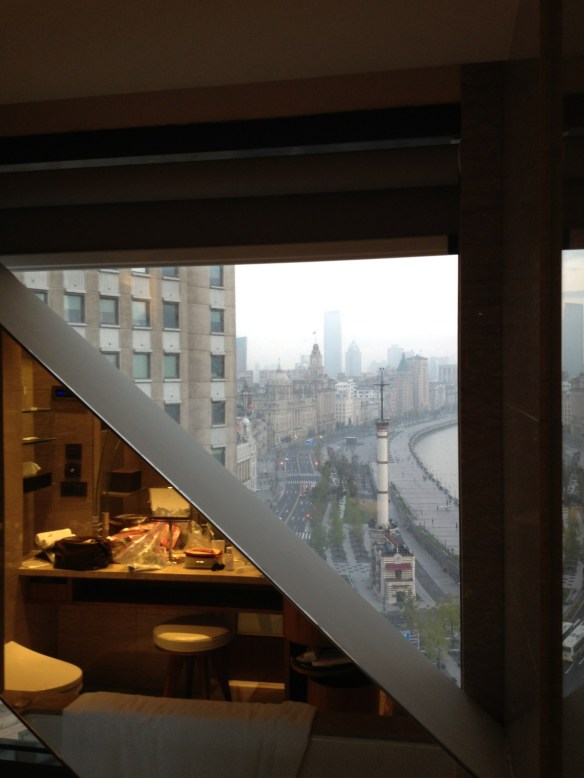
I love this picture! Photo taken out of hotel bathroom looking down at the Bund.

The best way to explore the sharp contrast between old versus new in China is to visit Beijing and Shanghai in the first week.  While Beijing is old, historical and brimming with culture, Shanghai is ultra modern, cosmopolitan and chic.

One of the country’s most vibrant and modern cities, Shanghai, meaning “by the sea” is going places that China as a whole dreams of heading.  Given Shanghai’s strategic location as a gateway to the Yangzi River, it was first established as a small port town and eventually grew to a population of 50,000 in the late 17th century.  The real future and fate of Shanghai occurred after the opening of the British concession in 1842 which lead to a period of dramatic growth, splendor and decadence.

Shortly after the British arrived, the Americans and French followed and Shanghai became an economic powerhouse financed by opium, silk and tea trade.  As the city blossomed and grew, large finance houses set up shop leading Shanghai into a period of robust growth and economic supremacy.  There was a long period of vice and decadence as the city became filled with whorehouses, opium dens and gambling parlours which eventually were cleaned up only to lead the city into a long period of malaise and decay.

Shanghai was revitalized in the early 1990s when the decision was made to develop a swampy, vacant farmland on the eastern side of the Huangpy River.  This area, today known as Pudong, is one of the most ultra-modern, brilliantly colorful skylines in all of China save for Hong Kong.  Being in Pudong, it is unbelievable to see this modern, dazzling supersized city that was all built within the last 20 years mirroring the sensational growth of China herself.

To me, Shanghai is a fascinating, complex city beaming with lights, color, vibrancy and of course good old contradictions.  While The Bund represents the prestigious, old-world charm of the past, Pudong represents the dramatic future of China, the number two economic country in the world.  Shanghai perfectly brought the old and the new all together in one big, luminous city full of paradoxes for the perceptive traveler.  I fell in love with its complexity, beauty, modernity and historic charm.  It is a place that summoned up so much of my feelings about China, and a fabulous way to end the trip.

Stay tuned..My next post series will be all about Shanghai and all this phenomenal city has to offer. I will cover the Bund, Pudong, The French Concession, Old Town, Shanghai Shopping, Chinese Street Smarts and more….plus I will probably throw in some Tucson posts since I’ve never blogged about lovely Tucson, Arizona before and it is a cool place.  Thanks for reading!

China TRAVEL BY REGION