We arrived at the airport in Delhi, utterly exhausted, around 8:30 PM. The supposedly two hour drive from Agra to Delhi, wound up taking over five long, brutal hours. I wasn’t surprised. Nothing surprised me anymore about India.
We paid our driver, and then entered the fortress-like Delhi airport, guarded at all entrances by machine-gun clod soldiers. Security was extremely tight in India; like nothing I’d ever seen or experienced before. You aren’t even allowed to enter through the airport doors without a valid airplane ticket, boarding pass and passport. A printed out receipt from American Airlines didn’t cut it. So we had to go to another window and get the right documents to be let inside.
We waited in the long line to check in, went through security which involved full-body pat downs and careful inspection of our hand bags. Then we sighed in relief. Finally we were here, safe and sound, and ravishingly hungry after that scrawny, malnourished chicken curry and questionable chicken sandwich. I found the first recognizable and somewhat trustworthy fast food chain I could: Dominos Pizza. It’s pretty hard to mess that up, right? It’s just pizza. My dad opted to eat at the American Airlines sponsored lounge and despite my protests, ordered a green salad. I told him over and over again that it was a mistake. We made it 17 days without eating a salad or any kind of uncooked vegetable, so why was he taking the chance now? I don’t know if it was exhaustion, hunger, lack of vitamins or just not using his head but all my warnings landed on deaf ears. He didn’t listen and greedily consumed not one but two fresh, green salads with relish and delight. It was eleven pm and we still had two more hours until our flight left. So next we moved on to our long awaited glass of red wine.
We grumpily boarded the plane a little after midnight, feeling filthy and beyond tired. As soon as the plane took off, I was out cold and so was my dad. Fifteen hours later, the plane began the descent into overcast skies at Chicago O’Hare International Airport. Home, almost, at last! I was overjoyed!
We gathered our stuff and headed to the business lounge, one of my dad’s perks with being a frequent flier, and we were delighted to find out that they had freshly remodeled showers! Wow….talk about heaven! The showers were the nicest, cleanest example of plumbing I’d seen in weeks and I took my time indulging.
Not long after the shower, however, it hit me. The infamous, terrifyingly, much-dreaded Delhi Belly! I was practically on the floor, hunched over and in tears, in the wonderfully clean, modern American bathroom. And all I could do was thank god it didn’t happen in Delhi! With no remotely clean or public bathrooms available, it would have been beyond my worst nightmare and humiliation possible. Unfortunately getting stomach ailments is all too common in India and Nepal. The food is not prepared to the same levels of standards and hygiene as found in the States. There were many unfortunate souls on the Annapurna Trek who succumbed to a miserably bad case of the runs. I can’t even imagine how terrible that would have been! You definitely lose all your modesty that is for sure.
Fortunately, I was prepared. I had a stash of antibiotics in my bag which I took immediately and was cured within 24 hours. My father, however, wasn’t so lucky. He did not go to the Travel Clinic before our departure and relied mostly on me for advice. He has traveled the world, way more than me, and has never been sick. This time he was not so lucky. After arriving home in Arizona, he awoke to find himself sopping wet and delirious with fever. My Mom frantically grabbed the one thermometer in the house and took his temperature. It was 104.5 degrees Fahrenheit, an incredibly dangerously high fever. She grabbed her purse, pulled him out of bed and rushed him to the local emergency room. Then his Delhi belly began and lasted for four long, miserable weeks. The fever ebbed and flowed, his stomach killed, and he lost a lot of weight (which he didn’t need to lose!). Test after test was run to no avail. Finally after a month of the runs, it magically stopped. The next day he received a call from the doctor. One of many tests came back yet this one was positive. Apparently he had some sort of nasty parasite living inside his intestines but luckily it must have passed. His lesson was learned the hard way: No more green salads in third-world countries!
We awoke early Monday morning, our last full day of the trip, to the usual sounds of life in Delhi: non-stop honking, car wheel screeching, shouting, yelling, and godknowswhat noises. I peered out the window of our hotel room and was not surprised to see a fire already burning. Yep. They were still there. The tarp community who live on the dirty, loud street right across from the hotel. The sky was the same gray-blue color. The thin blanket had not lifted. I had a feeling that it never lifts.
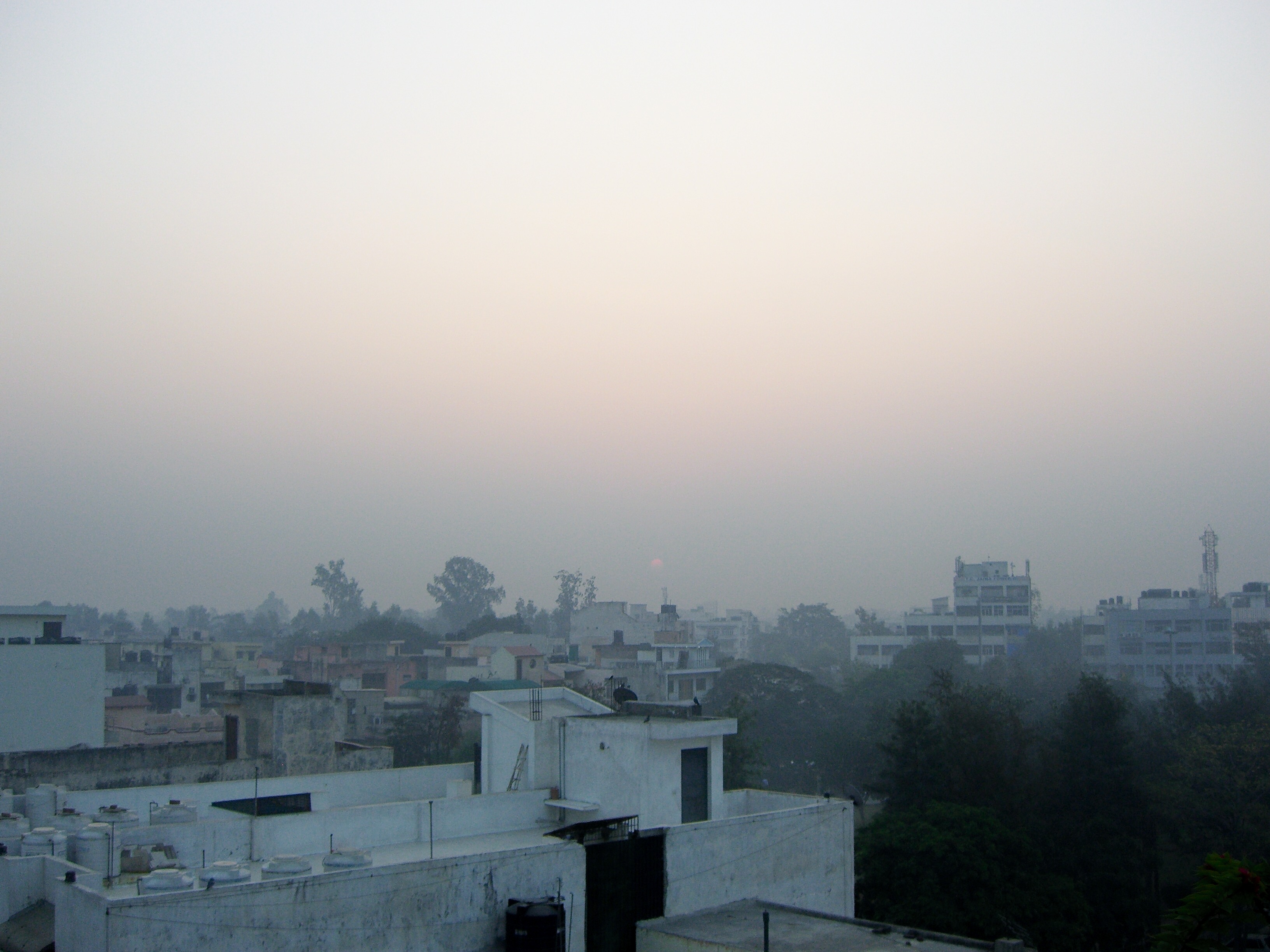
We had a brief breakfast of rolls, jam, fruit juice and tea on the rooftop terrace which affords a 360 degree view of smog-infested Delhi. The orange-pink sun was beginning to rise, slowly, hesitantly above the great masses of people and buildings which make up this immense, chaotic city.
“Come on, hurry up, Dad!” I told him impatiently. Our driver for the day was waiting downstairs and we had to try to get out of Delhi as soon as possible, if that is even possible. We had big plans for our last day of driving to Agra, the home of one of the most beloved, sought after sites in the world: The Taj Mahal. I couldn’t wait to go. I’d always dreamed of seeing it in person and here was our chance. Our flight didn’t leave from Delhi until one in the morning so we had the entire day. We were told that Agra is about 124 miles south of Delhi so if traffic is alright, the drive usually takes around 2-3 hours, or 4 hours tops. That was doable in one day, right, I reassured myself. The flight attendants do it, or at least that is what they told me on the flight over from Chicago. It is easy. A no-brainer. We had all day, right. No worries.
We set off at ten past eight into the throngs of traffic and all the craziness that driving in India has to offer. We had an excellent driver, I reminded myself. One of the best assured the hotel. I marveled once again at how on earth people get around in such madness. Cars, trucks, motorbikes, people, buses were all clogging the road well past capacity. I sat back in my vinyl seat with my seatbelt buckled tightly and watched the world go by. Entire families on motorbikes, with the sari-wearing women sitting precariously sideways on the bike, while holding her infant to her chest. Twenty or more people crammed in like sardines into those funny looking three-wheeled carts that acted as a sort of taxi system throughout India. People stacked inside, on top of and holding on to the sides, of over-packed ancient looking, pollution-infested buses. Cows and water buffalos lounging in the middle or side of the street, munching on garbage. Camels pulling huge wagons stacked high and bursting out the sides with some kind of enormous leaves. Then, the people….EVERYWHERE. A sea of black hair and brightly colored saris in glimmering gold, magnetic red, and pumpkin-colored orange. The problem was how did it all work? How were not hundreds of people killed daily on these roads? I clung tightly to the door handle at every turn, worried we were about to take some unknown Indian out. It was frightening as hell. No wonder you must have a driver in India! You would have to be completely insane to drive in such a place!
The driver informed us that there were three things that made a good driver in India:
The Horn: Is used non-stop the entire way. Talk about a major headache.
The Lights: Used to flash people to warn them to get the “f” out of the way!
Luck: Probably the most important thing of all in a city of over 14 million in which traffic has no rhyme or reason whatsoever.
After an hour or so of this crazy, chaotic driving I casually asked the driver when we would get out of the city and on the highway. He looked at me with a bemused look on his face and said, “What do you mean, Miss? This is the highway”. I nearly died. How silly I felt. I had been picturing a nice, relaxing peaceful drive into the countryside, where I could see the real India. That was when I corrected myself. This is the real India.
It took me awhile to calm down and try to enjoy the ride as best as I could. The problem was I had to use the restroom which although is a basic human need, there seems to be a real problem in India and Nepal in finding any public toilets. I told the driver that I needed to find a bathroom and asked how far. He said sincerely, “Things are different here in India. It will take me at least another hour to find a place that is acceptable to you. Can you wait that long”? I had no choice. I had to wait. I secretly cursed myself for drinking so much coffee and juice before I left.
Uncomfortable, I sat back and tried once again to relax but this time with an incredibly full bladder. Given the high volume of traffic on the road and the constant stopping and waiting due to congestion, I noticed that there was not a lot of space between other vehicles. If my window was down, I could touch the person next to me. This lack of personal space was something I was not accustomed to. But even worse than my violation of space were the hard, unblinking stares that invaded the depths of my soul. I tried to figure out why they were staring. Not a few but all of them. Children, Men, Women, Young, Old, them all. Why were they staring at us? Then, like a sudden surprise, I realized they weren’t staring at the driver or my dad. They were staring at ME. Ah-Ha….I gasped. It was my hair! My long, blond hair. They were staring at me with those huge, wide-eye looks of shock and surprise. Perhaps they had never seen a woman with blond hair. I found that hard to believe. Don’t they have TV? Aren’t there tourists here?
At first, I didn’t mind the looks and stares. I thought it was funny. But then after hour upon hour of countless, endless stares, it started to truly bother me. I felt like a leper. A pariah. A freak. It was a terrible feeling. Like you were walking down the street naked. And worse of all, I could not escape. I was trapped in that car for hours, faced with those endless, wide-eyed stares. I felt so uncomfortable I wanted to cry. So I finally showed my pillow over my head and laid back, trying to hid my blond locks. But it didn’t work. My dad said that they still stared, non-stop, for hours.
The attention reminded me of many years ago, when I was a shy, honey-blond, blue-eyed six year old girl on her first trip to rural Mexico. As soon as I got out of the car and stepped foot inside the village, I was surrounded and swarmed by screaming Mexican children, chasing me to touch my “angelic” hair. I was horrified and hid behind my father’s legs. The same experience happened again fifteen years later in Italy when my blond-haired friend and I were literally chased down the street in Bari by a horde of young Italian men, laughing and cat-calling us the entire way. Not a pleasant feeling, that is for sure. I was surprised to get this type of behavior in India because it never once happened in Nepal. I felt trapped inside the confines of the car and hated every minute of it.
The hour passed slowly and I thought my bladder was going to burst. After much begging, the driver finally brought us into a small, decrepit looking gas station. There were no other cars there. I got out, and immediately felt the hard, cold stares watching me move. Where is the bathroom? I asked desperately, almost in tears. Around back, they answered. Here is the key.
I went around the back of the station, unlocked the dirty door and there was the familiar squat toilet surrounded by flies and stink. So, if this was an acceptable bathroom, I thought, what do the unacceptable ones look like? I didn’t want to know.
I got back into the car and realized it was already eleven o’clock. We had been driving for almost three hours and apparently we weren’t even close yet. I sure hoped the Taj Mahal was worth it! Finally, when all patience was ending and our tummies were growling, we arrived in Agra. It wasn’t at all what I expected. I was thinking it would be a lovely, historical city. Perhaps a bit more peaceful than Delhi. What I should have known by now is that there is no peace in Indian cities. To my disappointment Agra was just another dirty, chaotic, overpopulated, annoying big town.
Before meeting our guide for the highly anticipated, long awaited tour of the Taj Mahal, our driver brought us to the restaurant where we would be having lunch. I should have known that it wouldn’t be good by the parking lot. There were no cars there. Just an old, rusty bus full of tourists remained. The driver dropped us off and told us to take an hour for lunch. Meanwhile the bus packed with tourists left. We walked in to the restaurant and saw large table after table, empty. The lights were off. It was dark inside. There were four bored waiters standing over in the corner. They told us to sit anywhere we want and handed us a menu. I didn’t like the look of the place and was highly skeptical about the cleanliness of the food. But there was nowhere else to eat and we were starving.
I ordered the good old standby, Chicken Curry with rice and my father took an unwise chance and ordered a chicken sandwich. The food came twenty minutes later, still not another soul in the restaurant. I scooped up a big heaping of rice and put it on my place. Famished, I dug my spoon into the chicken curry and nearly passed out. The chicken leg was about the size of my pinky! Scrawny, wispy and in my book, inedible. Oh lord, I though. But I was so hungry. I decided to leave the pencil-thin, undernourished chicken leg in the bowl and opted to just pour the curry over my rice. It was greasy and spicy. I prayed I wouldn’t get sick. If I did, where on earth would I ever find a bathroom! Now was not the time to get the infamous Delhi belly, that’s for sure.
After lunch, we met our tour guide, a local Indian-certified tourist guide from Agra who wore a long, white linen shirt and pants, an odd choice given the heat and dirt. His hair was slicked back with oil and he had an air of superiority in him. His English was good but at times I didn’t understand him and he seemed rushed, always looking at his watch.
We entered the gardens of the Taj Mahal, which were littered with trash and had few flowers. There were people everywhere but not the people I expected to find. Instead of the loads of camera-clad tourists, they were Indians themselves. Families, couples, friends, you name it. Surprised, I asked the guide “where are all the tourists”? He told me it was a national holiday in India and most Indians chose to spend it together, sightseeing. The Taj Mahal is just as important to Indians as it is to us. Perhaps even more important.
To my dismay, I wasn’t able to blend in or escape the continual stares at my blond hair. I put on a baseball cap and pulled my hair back in a ponytail, but it didn’t stop the looks. Oh well.When in Rome, right? I decided it was time to just deal with it.
Was it worth it? All the swarms of people, crowds, continual stares, crappy food, disgusting toilets, and four hour car ride to Agra? Yes. Yes it was. When I first saw the Taj Mahal, I was taken aback by it’s majestic beauty. It took my breath away. To see such an incredibly, spectacular sparkling white work of art in all the dirtiness of India was a surprise in itself. The sheer beauty of the Taj Mahal did not disappoint. It was simply incredible and made my heart melt. We snapped some pictures and walked around, admiring the inside and out. We learned about the romantic history of the building and how it took over twenty years and thousands of workers and artisans to build. It was amazing, especially given the time period in which it was built: The early 1600’s. It was a major feat of architecture and remains one of the most impressive sites I’ve ever seen.
So, yes it was worth it. However, the ride back was hell. Five, long, miserable, stare-filled hours of agony. We didn’t reach the Delhi airport until 8:30 PM and were dirty, tired, stressed out and burned out. But, we were back in modernity once again and clean bathrooms and real food (or so we thought). It was time for some wine and celebration before boarding our 15-hour flight home to the States. It was quite a day, that’s for sure. One I’ll never forget.
The drive from hell….scenes from the road:
Invasion of space:
A family of four:
Finally, the breathtaking reward:
Was it worth 9 hours driving in chaos? YES! Perhaps the journey there was the thing I’ll never forget, however:
The queue to get inside: Notice the lack of blondes!
As we descended through the wispy, powdery grayish white clouds, I was confused. It was raining. Or at least I thought it was raining. But it had to be! Why else was everything so dark like dawn. It was eleven o’clock in the morning so the darkish gray-blue sky did not coincide with the time. Yet there was not a drop of rain to be seen sliding down the thick plane windows nor was it predicted to rain. Instead, to my shock and disgust I realized what I was seeing was something today different. It was pollution. Not just any pollution, but serious, climate-changing pollution. The stuff I’ve read about in the paper, in books, and online. Like Al Gore’s recent documentary, An Inconvenient Truth.
As we descended I saw with horror the thin blanket of smog which smothered, choked and strangled the city of Delhi like a silent murderer. I was speechless. I had never seen anything like it before. Not even the low-hanging smog on LA could compare to the blanket of death in Delhi. A city of 14 million people and rising, Delhi is jammed packed into an urban area with a total density of 9,340 people per square kilometer. Unfortunately, the urban population continues to rise, mainly due to the migration of rural Indians to the capital in search of a better life. It is projected that the population of Delhi will increase 40% by 2021. This will create even more stress on an already stressed city. There will be a tremendous need for more and better infrastructure, pollution control, sanitation, living quarters and jobs. After spending a few days in Delhi already, all I can imagine is that if the projections are true, it will be complete madness! I have never been to a city so chaotic, over-populated and extreme as Delhi. Every square foot of the city was occupied by rows and rows of people, cows, cars, buses, three-wheeled carts, motorbikes, vendors, stores, buildings, and garbage. Garbage piled high, everywhere, dumped on the street, into the river and alongside buildings. For someone accustomed to a clean, green, beautiful city, I was completely shocked by the sanitation situation in India. Yet no one else seemed to notice or care. It is a fact of life. Garbage cans and trucks simply don’t exist in India. Or at least not enough of them!
I marveled at the fact that I was truly inside the heart and soul of a rapidly, developing country, the roaring, Asian Tiger, in all her glory, where things seem to change or not change in the blink of an eye. It was startling and left me thinking for a long time after about the impacts this rapid fire development will have on India and the world as time goes by.
As we drove to our hotel, once again, I was flabbergasted by the intense, chaotic madness of getting around in India. There were overstuffed cars, packed like sardines buses, crazy three-wheeled carts jam-packed with god knows how many people, motorbikes carrying entire families, and animals in the middle of the street (mainly cows which are sacred in India….how ironic!). It amazed me that anyone can get anywhere in India. There is no rhyme or reason to the movement of traffic. No real stoplight or signs at the intersections. Just honking horns screaming like a crying child desperately wanting to be heard, and near-fatal crashes miraculously being somehow avoided. The people, too, were everywhere. Everywhere you looked, there were people. It felt claustrophobic in a sense and made me realize how small my life really is in the spectrum of things. I’m just one person out of billions.
Finally we arrived at our hotel, exhausted with the stressful drive yet thankful we had a good driver (essential in India) who didn’t take anyone out along the way. I certainly didn’t want that on my conscience! I’d never sleep again!
We were back to the same hotel we stayed at the first night we arrived in India before heading off to Nepal for our trek. It still felt luxurious especially after everything we’d seen and experienced for the last two weeks. Yet the sharp contrast between haves and have-nots burned in my soul and made me feel sad.
We ate once again on the roof-top deck of our hotel, a delicious, scrupulous meal of Chicken Tika with fresh raita sauce, my favorite, and naan bread. We sipped wine, ate well and slept in our warm and cozy beds. Yet just outside my window lived the homeless, the many people not as fortunate as us who were living on the street in tents. I felt so incredibly sad and guilty that all I wanted to do was leave. I tossed and turned for hours that night, wondering why things are the way they are, and feeling blessed that I was able to see the things I’ve seen. For this is reality for most of the world. This is life.
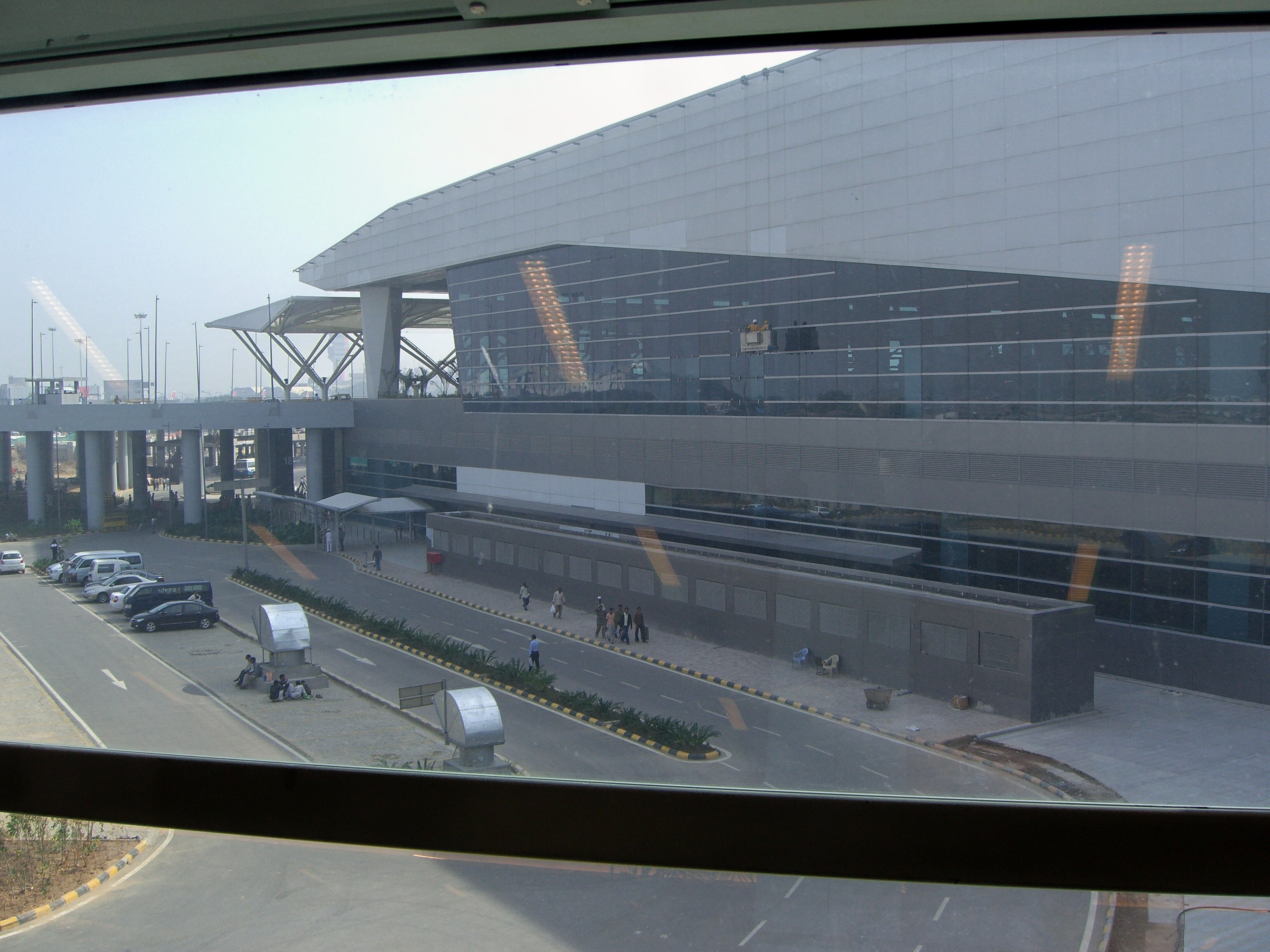
The brand new, state-of-the-art airport in Delhi , where you see turbaned security guards cruising around on Segways (modernity juxtaposed to poverty:
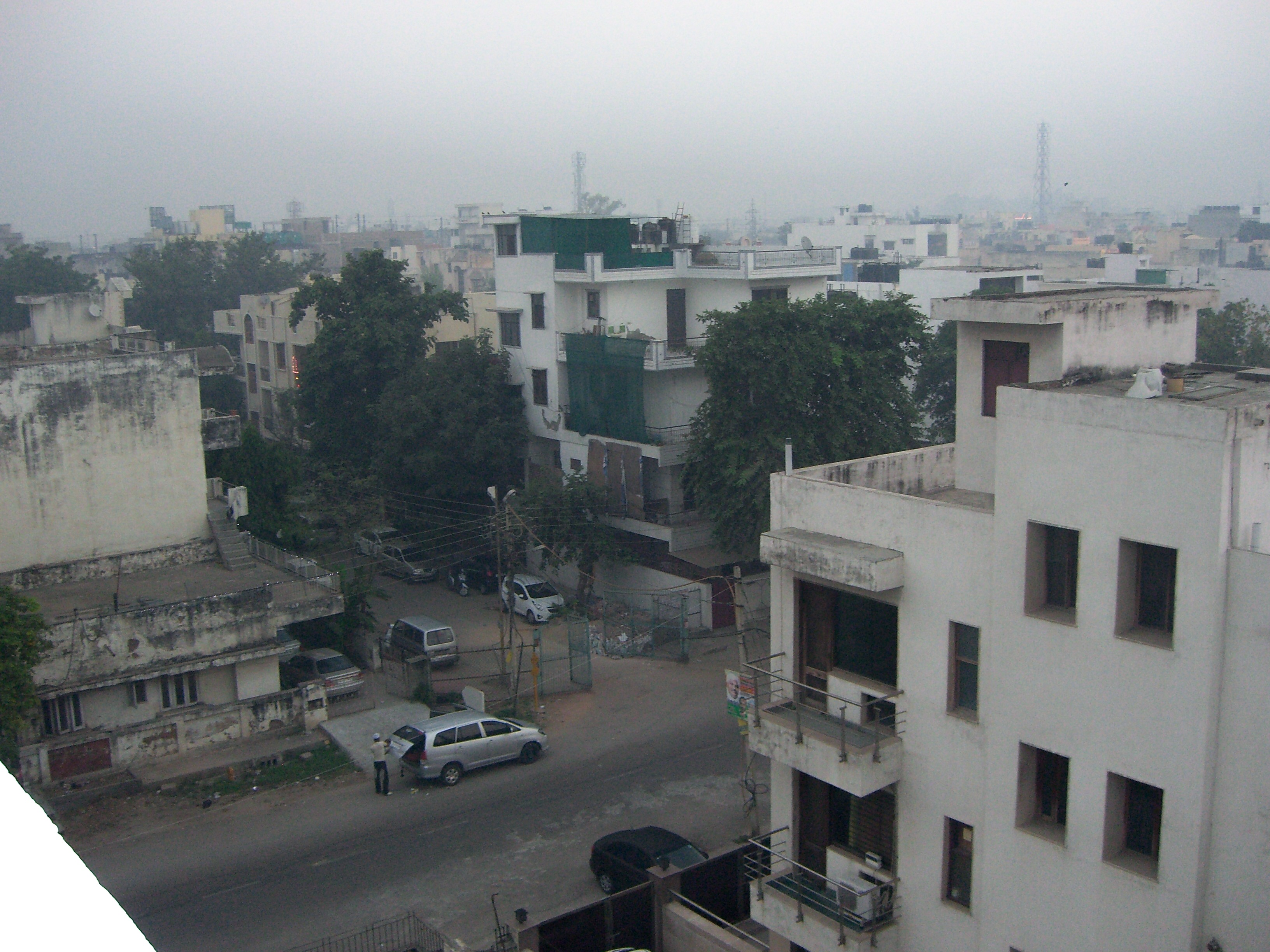
Late afternoon in Delhi—it is not raining. It is pollution:
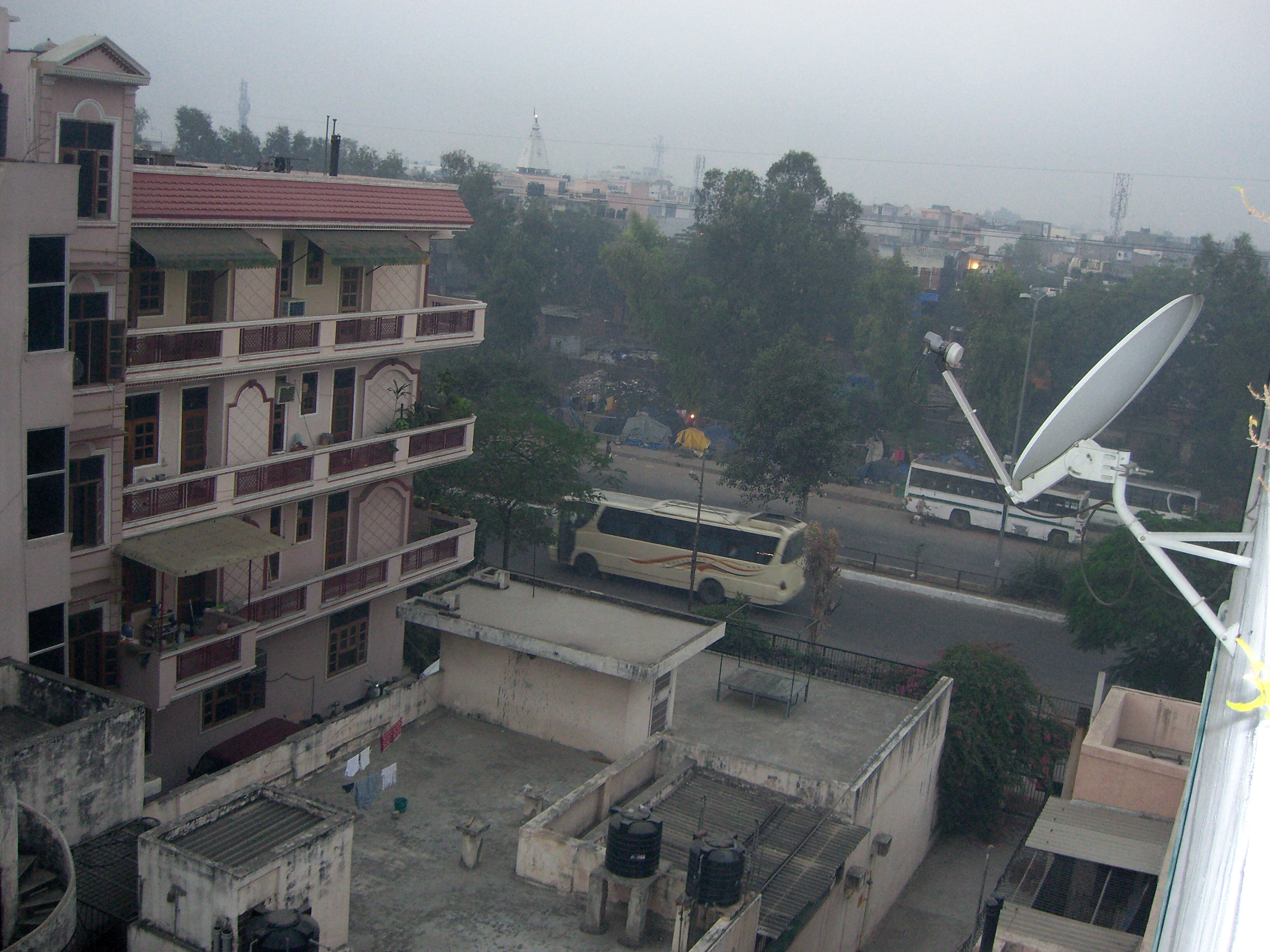
Impossible to ever forget….those who are not so fortunate (street view of homeless outside our hotel):
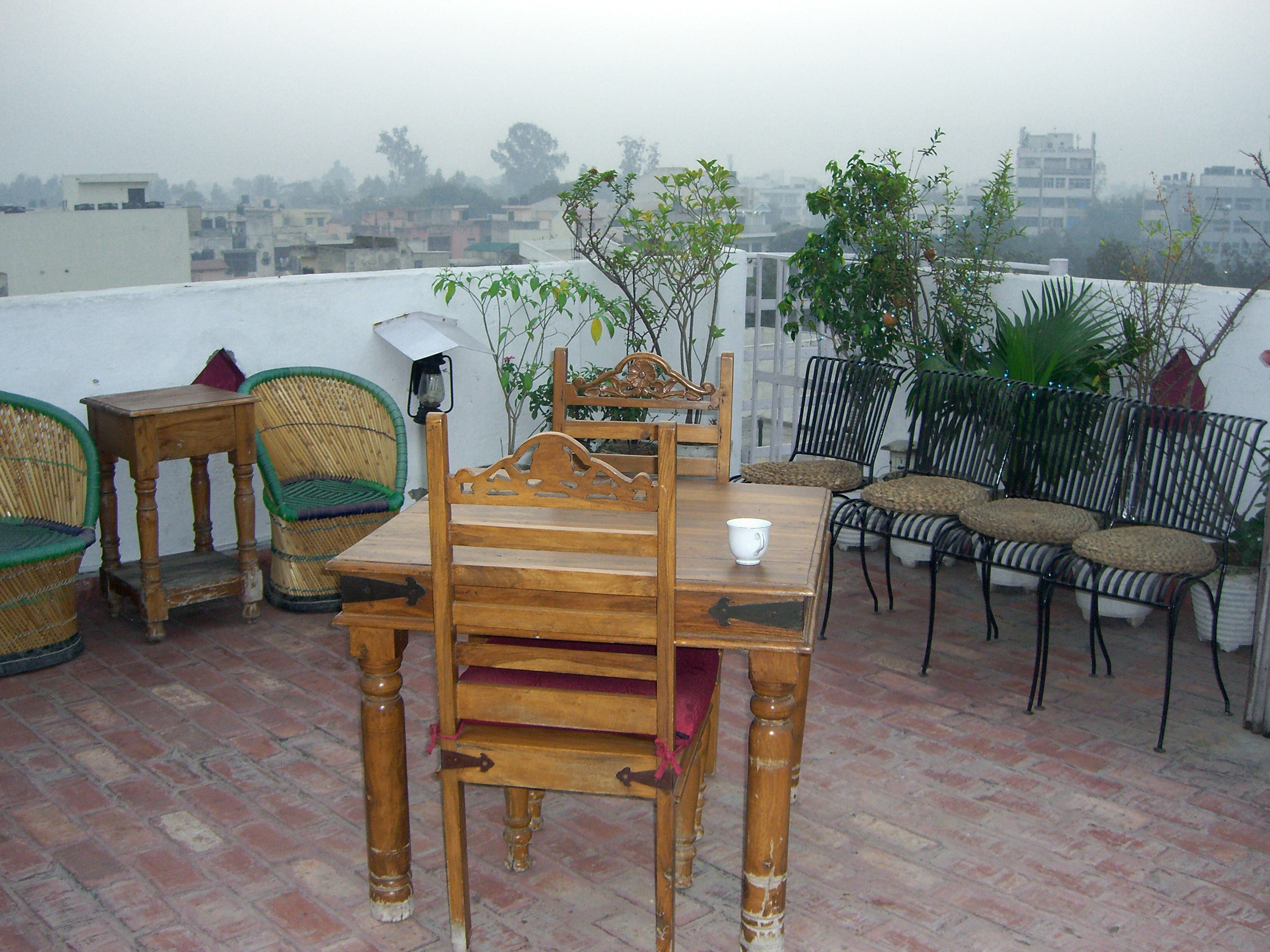
Sunrise and breakfast on rooftop deck. Another day with the thin blanket:
As our jet plane took off and climbed five thousand, ten thousand and then eighteen thousand feet, I realized in awe that only a few days ago I had been at almost the same altitude as the plane. It was a wild thought. Almost a little frightening.
As I looked down, out the airplane windows, I finally was able to conceptualize how high 18,000 feet truly is. The buildings became smaller and smaller, the cars like ants lining the roads. The vastness of the green, voluptuous rice fields stacked one on top of the other, bursting in color and life. Then, for the last time, I saw the godlike, mighty Himalayas, strikingly beautiful, like a mirage of flying towers soaring upwards into the heavens of the sky. I had to pinch myself to believe that I was really here and had really been there. It was all like a dream.
Months before I left for Nepal, I made a decision that I no longer wanted to be simply a tourist that visited a country, enriched myself in all its culture and beauty, and left nothing in return, no gift behind. My new way of thinking all began on a recent trip I made which was different from anything else I’d ever done: A volunteer trip to work in Costa Rica. Although I was only there for one week, the impact volunteering made on my life and the people I helped during that short time led me to believe strongly that you must give back. You receive a gift when you travel, and it is important to give one back.
I wracked my brain for different ways I could raise money. I knew that I wanted to donate money to a non-profit organization that focuses on education in Nepal. After reading several inspirational books on education in poverty-stricken lands (Two Cups of Tea, Stones into Schools, Half the Sky), I knew that this was the area to attack. I searched Lonely Planet who has an excellent listing of non-profit organizations as well as volunteer opportunities, and found just the organization I was looking for: READ Nepal.
READ Global pioneered the concept of sustainability as an international development organization dedicated to combining education and private enterprise to make rural communities viable places to learn, build, and prosper. READ partners with rural communities to create, sustain and grow projects in a manner that is politically and culturally appropriate. READ has helped establish forty nine Community Library and Resource Centers paired with for-profit enterprises throughout Nepal and India that serve over a half million people annually and has also recently opened up a center in Bhutan.
Finding the right organization was the easy part. The hard part was figuring out how a “thirdeyemom” could raise the money. A mom, who had voluntarily left the workplace to raise her two young children (aka a mom with no income). Of course we could just write a check out of our own money but that didn’t feel right. I wanted to earn the money. Furthermore, I wanted to involve my children in the process so they could learn the importance of giving back.
That was where my creative thinking came into play. It was summer in Minnesota—-a time to be outdoors, out of our long winter’s hibernation, and back into the world again enjoying our 10,000+ lakes, beautiful parks and nature. There was no school for the children. Thus opportunities lurked. Why not host a “babysitting extravaganza” all in the name of charity, at my house? I sent out the email to my group of trusted friends with small children. Parents who knew what I was doing and who also wanted a break. I set up three Friday morning playgroups with ten children each ages 5 and under (yes I’m crazy), with a suggested donation of $10 per child. A pretty good deal when you consider it usually costs at least $10 per hour for a sitter. It worked great (except for the huge mess I had to clean up afterwards). I was able to raise almost $300, which was only $200 shy of my initial goal of raising $500 for READ Nepal. Hurrah!
After the initial joy of raising the money, I realized that I still had to figure out how I would earn the rest. That was when I came up with the idea of having a “lemonade sale” on the corner of our street. This may sound funny to people who don’t live in the United States but it is one of the trademark events of childhood. Every American child at some time in their life have a lemonade stand in which passing people stop to purchase an ice-cold glass of lemonade on a hot summer day. It is a tradition. So why not do one for charity? I made four pitchers of ice cold lemonade, some handmade signs and we set up shop on the corner of our street with hopes of staying until we sold it all. Unfortunately sales were very slow despite the singing, shouting and jumping up and down of my 4 year-old blond-haired daughter. My six-year-old son quickly became bored. After making a disappointing $25 we closed the stand and drank the remainder of the lemonade. Not such a great idea after all.
Summer was quickly ending and my trip to Nepal was rapidly approaching. I was well short of my goal but didn’t give up. My last ditch effort was the all-American yard sale. Again, for those not familiar with the American “Garage Sale” or “yard sale”, let me explain. Basically you go through all your closets, boxes, and drawers and gather up all the stuff you don’t need or use anymore, and place it in a pile. You meticulously go through each item, one by one and put a ridiculously low price on the item. Then you haul all the items outside either to your garage or your yard, place up a few advertisements (aka homemade signs) around town, and wait. Believe it or not, people go absolutely NUTS about garage sales. They are out at the crack of dawn, sneaking around like cats trying to get the best deal they possibly can. Before I had even set up all my tables of stuff, they were knocking on my door trying to get a deal. It was pathetic in a sense. My large sign said “all proceeds are being donated to charity” yet people still tried to weasel down the price. Go figure! After three hours, the sales piled in and my old “junk” was packed away in other people’s cars, to be used or stored in their house. The garage sale wound up being a huge success and brought my total up to $550, well past my goal!
Exhausted, I cleaned up the remaining items and my husband packed everything up to donate to a local charity. I had met my goal and felt proud. But little did I know there were others (friends, family, neighbors, etc) who noticed my effort and contributed to the cause. The money raised eventually made it to $2,000 which was matched by my husband’s employer, bringing the total donation to READ Nepal up to $4,000! Wow, just like that a small idea ended up being a big help. The funds were donated a week before I boarded the plane to Kathmandu. READ Nepal was delighted with the donation and informed me that the money would be more than enough to open up an entire library and reading center in rural Nepal. The gift was given and I realized that it is the things you do for others in life that make you feel the best.
The beautiful smile of a young child in rural Nepal:
We spent our last night in Nepal attending another Culture night (music, dance and food representing a variety of diverse Nepali Cultures) with Rajan, the President of Earthbound Expeditions. Another couple from Spain joined us for the last hurrah in Nepal. The couple was recently married and spent the last two weeks on their honeymoon in Nepal touring the remote Mustang region, a newly opened trekking area which has very limited facilities (basically camping the entire time) yet is supposedly Tunbelievable.
We had a wonderful time sharing stories of our treks and praising Rajan for his remarkable service and commitment to ensuring every need was met on our trek. Another friendship was made with the “social ambassador” himself (see post dated 2/28/11). Rajan depends a lot on word of mouth for his business so we promised him that we would complete a review of Earthbound and our trek on tripadvisor, which I gladly did immediately upon my return to the states. Earthbound has over 126 reviews on tripadvisor to date and all are 5 stars. To read the reviews, go to: http://www.tripadvisor.com/Attraction_Review-g293890-d1148178-Reviews-Earthbound_Day_Expeditions-Kathmandu.html)
Since this was my last night in Nepal, I had time to discuss with Rajan and also reflect on what the “third eye” had discovered and learned in Nepal. Hari, our cultural, nonstop smiling and laughing guide really taught us a tremendous amount and our experience in Nepal would not have been the same without him. We learned about the importance of religion in Nepal and how Buddhism and Hinduism coexist somehow without problems. We also learned about how the culture is struggling to move ahead into the future. There needs to be some give and take between abandoning some of the old traditions and customs (such as the caste system which is still very prevalent in Nepal) and modernizing to newer, more western traditions. For instance, living together as an unmarried couple is pretty much unheard of in Nepal and is unacceptable. Marriages are not always “arranged” per se, however, the entire courtship process in Nepal is much different than it is in the States. Prospective brides are usually picked out from the village or a neighboring village and are of the same caste. The prospective groom meets with the young woman and talks to see if there is any interest in a union. Love marriages happen but are not that common. Dating before marriage is still something that isn’t really done.
As for the male and female’s role in Nepal, women do not have anywhere near as many freedoms and rights as women do in other countries. Women are expected to work very hard, raising the children, keeping the house, cooking the meals, and working in the fields. It is the male that holds the most esteem, respect and responsibility in the family structure. The oldest son is responsible for caring for his parents as they grow old and often returns to the village to help out with the harvesting, and is involved in important religious ceremonies and holidays. Due to lack of opportunities and poverty, many women end up in prostitution, either by choice or not. It is a sad reality that needs to be addressed.
Hari, as a twentysomething, modern young Nepali man with a bright future, hopes that Nepal can move ahead economically and socially soon. However, change is slow and the government is very corrupt. There is a lot of opportunity in Nepal yet no real infrastructure or jobs. Hari hopes someday Nepal can follow the path of other neighboring stars such as India and South Korea while retaining their rich cultural heritage and importance of family. It is a mixed bag that is for sure. For one thing, the people in Nepal are lovely people and their culture is absolutely amazing. Yet they are much too poor overall and lack education and opportunities (ranked 142 out of 177 countries on the UN Human Development Index; 82% Nepalis live on less than $2 a day; Literacy rate of 48.6%—-facts from Lonely Planet Nepal 8th edition). It is a tragedy however hopefully bright stars like Hari and Rajan, through their work, will help move Nepal slowly forward, one step at a time.
We left Nepal early the next morning, headed for our final leg of the trip, a few days in India. It was a bittersweet feeling boarding the plane. As we lifted off, we passed above the vibrant green rice terraces, stacked up towards the sky and over and beyond the magnificent snow-capped mighty Himalayas. I felt that I had experienced a lifetime in only two weeks. It was a peculiar feeling. I was very sad to be leaving but I knew deep down in my heart, that I would be back.
Our final night out during the continuation of The Festival of Lights, in Kathmandu Nepal:
It was our last full day in Nepal so I wanted to make the most of it. We had been away from home for two weeks now but it felt like a lifetime. I find that when you travel, the further away from your own life at home you get, the longer it feels like you’ve been gone. That is one of the beauties and pleasures of traveling off the beaten path. You can only find and remember home if you seek it.
For our last day, instead of lounging around our incredibly beautiful, luxurious, living museum hotel, I wanted to get right into the thick of all things cultural and do a tour of all the ancient, magnificent sites of old Kathmandu. With the help of Rajan (Earthbound Expeditions), I hired my own English-speaking guide and driver who took me on a mini-three hour tour of the stunning temples and palaces of Durbar Square, and then a visit to magnificent Swayambhunath, also known as The Monkey Temple.
Located in the heart of the ancient city of Kathmandu, Durbar Square, a World Heritage Site, is a complex of beautiful temples and shrines representing both Buddhist and Hindu culture and architecture. Most of the buildings were built between the 12th and 18th centuries, and was the place where the kings lived and were crowned up until the early 20th century.
Here are some pictures of my favorite sites in the square:
Leaving Thamel:
Shiva-Parbati Temple:
Maju Dega Temple:
Kumari-ghar (Built in 1757 and home of the “Kumari” or living goddess):
After taking in as much as I could in Durbar Square, my driver took me on another wild and crazy, chaotic drive, up the windy roads filled with trinket shops and monks, to Swayambhunath, or The Monkey Temple.
I thought about how to describe the place and found that there were really no words that I could conjure up better than Lonely Planet. Per the 8th edition of Lonely Planet Nepal: “A journey up to the Buddhist temple of Swayambhunath is one of the definitive experiences of Kathmandu. Mobbed by monkeys and soaring above the city on a lofty hilltop, ‘The Monkey Temple’ is a fascinating, chaotic jumble of Buddhist and Hindu iconography”. It is something you have to see and experience for yourself to really understand it’s significance and beauty. It is quite a site!
As we entered the grounds, there was this immense expectation and anticipation of seeing monkeys. Where are the monkeys? I wandered, looking around a bit confused. Lone behold, after taking my first steps up to the temple, the place was loaded with monkeys. Monkeys were everywhere….climbing up the steps, eating on the railings, nursing their babies, posing for pictures, chasing tourists, fighting each other, and my most favorite of all, swinging for the colorful prayer flags that lined the trees! In fact, you couldn’t even escape the monkeys even if you tried.
Here are some pictures of the monkeys at the Monkey Temple:
The sights at the temple:
Beautiful!
The stupa:
View on top of temple, overlooking massive Kathmandu:
The president of Earthbound Expeditions, Rajan Simkhada, is an amazingly talented, impressive and humble man. He has worked in Nepal’s tourism industry for years, was raised in the villages and now resides in Kathmandu where he runs his travel agency.
Earthbound Expeditions was created over 14 years ago, and is a leading adventure tourism agency that leads the traveler “off the beaten path” on trekking trips throughout the Himalayan darlings, Nepal, India, Tibet, and Bhutan. Over the years, as Earthbound gained raving reviews and more and more customers came, the company branched out into philanthropy work focusing on responsible, sustainable (social and environmental) travel. His company promotes rural development by giving back 10% of their profits each year in these areas. Per Earthbound, “responsible travel is a new way of travelling and trekking for those who’ve had enough of mass tourism. It’s about respecting and benefiting local people and the environment-but it’s far more than that”. It involves respect for the local culture, minimal environmental impact and giving back to the community. In an increasingly global world, social responsibility and tourism go hand and hand and it is refreshing to find a company dedicated to working with and for their people.
Besides running the trekking company, Rajan is also very busy in his philanthropic work. He is the founder of Mamata Volunteers a non-profit organization that matches US volunteers with customized volunteer programs within Nepal. Below is information on the scope of Mamata Volunteers, written on their website, www.mamatavolunteers.org:
Mamata Volunteer’s mission is to provide volunteers with a customized program that will enable them to make an important contribution to the people of Nepal, while also gaining an in-depth experience of Nepal’s language and culture that will stay with the volunteers for the rest of their lives. Join us and experience this unique Cultural Immersion and Responsible Travel Program in Nepal one of the most beautiful countries in the world.
Mamata Volunteers is a non-profit organization stationed both in Nepal and in the United States. As a part of our Volunteer Program, Mamata first provides instructional training on local language and culture and only then do we place our trained volunteers in schools, hospitals, orphanage and communities across the region. Volunteers will have the chance to teach English, stay with children in local care houses, and help with community based programs like health camps, environment cleaning, empowerment of women and more. Come join us for a truly life changing experience at the Top of the World, Nepal.
Rajan also serves as National Director of HANDS IN NEPAL, a grassroots non-profit organization founded by a young, highly talented American man, Danny Sprague Chaffin, that focuses on building schools in rural Nepal. Their first school (a four-room schoolhouse made of stone and cement with a tin roof) was recently completed for the cost of around $6,000 and provides education to over 80 children in the village of Dharka. To learn and heard more about his story, you can visit the website at: http://www.handsinnepal.blogspot.com/
You can also see an amazing documentary of Danny’s experience on YouTube. Here is the link and it is definitely worth a view and incredibly inspirational:
Finally, Rajan and Earthbound is the leading patron and sponsor of the Buddhist Bal Griha Orphanage in Kathmandu, Nepal. The Orphanage provides a home for over fifty children who come from disadvantaged rural communities. In many cases, the families simply cannot afford to keep their children so they are abandoned.
It is amazing people like Rajan and Danny (and all the others out there in the world) who are making positive change in Nepali people’s lives. Something that should inspire each one of us travelers to follow in their path and make a difference in the world, whether it be a financial donation, volunteer work or simply a smile. I believe that sharing our unique cultures, respecting and learning from other cultures, and helping others, all go hand in hand to make the world a better place!
————————————————————————————————————————————–
To learn more about Earthbound Expeditions and their work please see their website:
Our hotel in Kathmandua, The Dwarika’s Hotel, is a treasure of a find. It is a World Heritage Hotel (one of only two in Nepal) and is a sort of living museum. The hotel has a unique and fascinating history. It all began in 1952 when the founder of the hotel, the late Dwarika Das Shrestha was on one of his morning jogs around the city and noticed that several ancient, exquisite woodcarvings dating from the 14th century were being cut down by carpenters to be used as firewood in the face of modernization. Horrified and angry that these ancient cultural jewels were being destroyed, he begged them to stop. Over the years, the saving, restoration and preservation of these woodcarvings became a lifelong passion and resulted in the building of The Dwarika’s Hotel. The hotel was built using these gorgeous woodcarvings and terra cotta artifacts and captures the beauty of Nepal’s ancient cities. It truly is a work of art and is continually being restored and preserved to this day. There is even a school located on the hotel grounds where carpenters are trained in the creation, preservation and restoration of the ancient woodcarvings. It is quite an excellent example of how tourism and cultural preservation can go hand and hand.
For those interested in learning more and seeing more intricate photos of this amazing hotel, please see their website at:http://www.dwarikas.com
We sadly left Pokhara the next morning for our short half-hour flight back to Kathmandu. The plane was bigger and better than the last flight from Jomson but still not a jet. I had mixed feelings about returning. Yes, I was excited to be finished with the trek and shortly returning home to my husband and two young children (4 and 6 years old…still that delightful, imaginative age where they cuddle, laugh and think I’m the best!). Yet, I was very sad because I knew that we would soon be saying goodbye to Hari and Chhring, who we had spent the last two weeks inseparable—- laughing, learning and sharing our different worlds. Our goodbye to Chhring came sooner. He was headed home to his village via an eight hour bus ride, followed by six hours hiking up to his remote village where his young wife and baby awaited his return.
We waited for our flight in the crammed, smoky departure lounge of the small Pokhara airport. I was thirsty and wanted to purchase a Sprite but just couldn’t do it when I learned it cost $4. I had spent too much time in Nepal! But there were some things that I had to remind myself of the importance of using that “third eye”. Like the dirty, fly-infested women’s bathroom inside the Pokhara airport. It wasn’t the hole in the ground that made me cringe. After two weeks with rarely a western toilet in sight, that didn’t bother me anymore. It was the other thing I noticed. The dirty, used syringes lying naked on the floor. I chose to look the other way but it really brought everything I learned and saw in Nepal back to home. Remember the third eye!
The flight was nice and smooth and soon we returned to the same vibrant green rice terraces and the low-lying coating of smog that covers Kathmandu Valley like a blanket. We were welcomed at the airport by Hari’s wife, son, uncle and niece, with a Namaste and of course a marigold necklace. It was such an honor to meet his family. The only regret was that we couldn’t speak the same language. We wanted to tell them how wonderful Hari is and how much we love Nepal. Hopefully our warm, glowing smiles made them understand what words could not say.
The seven of us all piled into Hari’s uncle’s small sedan with four of us smashed in the back and three in the front. This is not something I would do at home but it is quite common in Nepal where cars are expensive and safety standards are much different. It was an uncomfortable ride back in the insane traffic and driving madness of Kathmandu. It was still the festival so more people than ever were out and about, shopping, visiting family and hitting the roads in jam-packed, overflowing buses headed off to the villages. We arrived at Hari’s neighborhood an hour later to see his pride and joy: His cybercafé. Hari had spent three years working in Dubai in order to save enough money to start his business and it was a major accomplishment for a 28-year-old Nepali. Unfortunately he is having a tough go at running the business since the government has daily electricity shutdowns of sometimes up to 6 hours in order to conserve energy. As a developing country, Nepal does not have enough power to keep the country going so they have to turn it off. It doesn’t reflect well on running a business that’s for sure but it sadly is a way of life. Nepal desperately needs better infrastructure so they can move ahead like their neighbors India and South Korea who are booming. But it never seems to happen.
We took our final snapshots of us together at our hotel and said our goodbyes. It was very touching because Hari had secretly bought my children a gift. He gave me one pink and one red handmade Nepali journal made with rice paper and a hand-woven bag for each child. I was very humbled by his gift. He wanted my children to have something special from Nepal. And they did.
Here is a beautiful picture of Hari and his family in Kathmandu:
Inside Hari’s cybercafe, Kathmandu:
The blessing of the cow on the streets of Kathmandu:
We woke early to darkness and silence. It was 6 am yet no other guests were up and there were no yaks grunting or bell-jingling of a passing mule train to break the silence. It was time to go to the airport and pray the planes were flying. It wasn’t that I didn’t like Jomson. I was just ready to move ahead to Pokhara…beautiful, dreamlike heaven. I had heard from many that Pokhara is a special place, the Shangri-La of Nepal. Gorgeous mountain views of the Annapurna range in all their glory reflect across the aquamarine Phewa Tal lake. Besides Pokhara’s serene setting and beauty, Pokhara is also known as a more laid-back Thamel (the touristy, shopping district of Kathmandu) and offers the visitor an array of shopping, dining and adventure-seeking sports. I couldn’t wait to get there. Initially we had only planned on flying through Pokhara but due to a few back-to-back days of extra hiking we were able to land an extra day into our tight schedule and looked forward to enjoying it in Pokhara with our friends Hari and Chrring.
The airport experience was frightening. A large group of trekkers were lined outside the gates at ten to seven with weary, tired looks on their face. The machine-gun clod airport security guarded the small airport doors with looks of superiority and boredom. Finally, at seven am the doors opened and the hordes filed inside. There was no rhyme or reason to the ticket lines: Just lots of budding in line, pushing and shoving. Hari, whose miraculous guiding expertise, saved the day once again and got us the last four tickets on the flight.
Next we headed to the “women’s” and “men’s” lines for our pat-downs. Each passenger went through a private room, where their entire body got a check for weapons. It was funny because there was so much fuss back at home in the US about the detested pat-downs and how it invaded privacy and personal rights. Yet pat-downs are just a fact of life traveling in Nepal and India. At any airport, you have at least two of them (in Dehli, even three!). It never bothered me one bit and instead, made me feel much more secure. I found through my travels that security is on an entirely different level. Bags and luggage is hand-checked, smelled and tested. Pat-downs are fierce, and the intimidating guns are there to remind you to stay in line. You can’t even enter the Dehli airport without a printing out boarding pass. The security is so intense that there are dudes with enormous guns waiting outside every single door into the airport. No ticket, no entrance.
We boarded the small, 14-person aircraft with elation and fear. I detest small planes and was nervous about this flight even before I left the States (see earlier post: Is it Safe?). The plane was old and you could barely stand up inside. I held my Buddhist prayer beads tightly and tried to relax. Hari found my nervousness humorous and tried to make me laugh. The engines revved up, my heart fluttered and my palms were soaking wet. Then we started to go, not fast, not slow, down the runway and gently lifted into the sky.
The plane flew at an alarmingly low altitude (Only 10,000 feet!) which felt so strange after hiking ABOVE that altitude for days. You had to crane your neck to see the mighty mountains soaring above you 15,000 feet up into the sky. I tried not to look at how close we were to the rocky sides of the mountains or how the plane barely made it over the trees. I squeezed the beads tightly yet marveled how much the flight reminded me of a scene in an Indiana Jones movie (for those readers who are not as old as me, Indiana Jones is an adventurer whose first big movie was a hit in 1981 called Raiders of the Lost Ark).
Alas, we saw the gorgeous green, terraced rice fields and the outline of a town tucked away at the base of the mountains. It was Pokhara and we landed safe and sound into the hot, bright sun once again. I finally let go of my prayer beads yet did not take them off until I arrived safely at home in Minnesota several days later. I still needed them for surviving the drive of terror in India! That will come later!
For now, here are some lovely shots of the flight and beautiful, serene Pokhara.
The next morning we set off for the last leg of our Annapurna trek: The short, four-hour trek to Jomson, which is the major hub in the region and boasts an airport, hospital and other resources. We had made it over three-fourth of the Annapurna Circuit trek (there were about six more days of walking if you wanted to complete the entire circuit making 19 days total). We were ready to be done, though.
The walk was probably the most uninteresting one of the trek. It was brown, rocky and barren without the unbelievable mountain sites you normally see. We followed a huge river valley, one foot in front of the other, walking at a good speed as we had an extra motivation to arrive quickly to Jomson. Hari, our unbelievably, magical, “can make anything happen”, guide had called ahead to Jomson airport and had confirmed there was one more flight out that morning to Pokhara. Pokhara….just the sound of it brought images of breathtaking mountain views, gourmet food, much wanted shopping and fun! It represented the finish line, the celebration, and heaven.
A funny thing happened along the way. In front of us, we approached a party of three walkers and noticed a monk, dressed in his long, flowing maroon robe. He was doing some sort of a pilgrimage to the next monastery. The sight of him in his magical robe, walking so effortlessly in sandals, made me smile. I waited behind our group and took some photos of him. As I started to pass him along the trail, I noticed he was wearing a white knit hat that said USA on it. I had to laugh. Again, what are the odds? A Buddhist monk walking the Annapurna trail in his American hat!
As we neared Jomson, my nerves were driving me crazy. I wanted to make that plane yet I didn’t. Hari had promised hot, delicious meals (other than our standard Dal Bhat, the national food of Nepal), lots of beer and fun. Wouldn’t that be better than spending yet another night without a western toilet? We walked and walked, as fast as we could, and noticed the wind begin to pick up. Wind is one of the main reasons why flights are unpredictable in mountainous Nepal. They fly small (14-person) planes, relatively low throughout the valleys (10,000 feet!) so it can be quite dangerous. The flight was the one and only thing I had been nervous about my entire time in Nepal (well, besides making it over the pass). I had read in Lonely Planet and researched on the web that airline safety is not Nepal’s forte. I’ve flown a lot in my life but I do not like small planes. So I was very anxious about it.
Four hours later, we arrived in Jomson and literally walked right up to the airport with our packs on. It was a strange feeling, walking right to the airport. But security was still tight. In fact, it was surprisingly tight. There were a few military guys waiting outside holding their big, intimidating guns to make sure no one who wasn’t wanted got through. To our dismay, the last plane just left. The winds were too strong so the airport closed. It was only one o’clock.
We headed back to our “hotel” (it was actually a hotel and not a teahouse…a sign of civilization) which was directly across the street from the airport. The afternoon was spent resting, reading, and an early happy hour of jacks and Tubourg with our friends Hari and Chrring. It was also a special night because it was gratuity night. Guides and Porters are paid a small stipend for their work however the big reward for their services is the tip. We wanted to make sure they were well-paid for their incredible service, loyalty and help. Yet we also didn’t want it to feel awkward given the difference in monetary standards between what is a good tip in America and Nepal. As I mentioned earlier, most Nepali people survive on less than $2/day so we had to be sensitive about this imbalance. Before we left for the trek, we had asked Rajan, the owner of the trekking company, what is standard and opted to give them the standard plus a little more. As a Westerner, you often find yourself in an uncomfortable situation in which you desperately want to give them everything you’ve got, to help them succeed and build their lives, but you know you can’t. You hope that the memories of the time you shared together and your friendship is a better gift than just the money. But you also are well aware that the money helps tremendously to gain a better future for themselves and the next generation.
Here are some shots along the way.
Here it is! The walk with a Monk:
And here is Chrring, 22 years old, strong, happy and smiling still (word has it that he is taking English lessons in Kathmandu and hopefully will be promoted to a guide):
The town of Jomson. Traditional houses.
Our hotel with the airport across the street:
A much too common site in Nepal. Cow eating garbage:
After our initial jumps of joy and jubilation, followed by the throngs of fellow trekkers in line for the primo photo op, a tasteless mint tea, and hugs abound, we set off for the long, knee-aching hike down. Unfortunately I was so focused on making it to the top of the pass that I kind-of forgot we had a very long way left to go. Probably the worst part of the hike remained: Six more, grueling hours descending 6,000 feet until we would be done for the day. Even the mules were tired.
The trek down was surprisingly dangerous. It was very slippery, loaded with ice and plenty of loose rocks along the steep path. My knees killed with a sharp excruciating pain during each, careful step down. The craziest thing of all is that we were soon passed by a couple of Belgium guys on mountain bikes! It was extraordinarily dangerous and shocking that it was even permitted. There were points on the trail when the bikers had to get off and walk their bikes down because it was so steep. Perhaps what was even more surprising was the fact that they had to carry their heavy bikes all the way up to the pass on their backs, at such high altitude. At least the ride down was easy despite the danger involved to themselves and other trekkers (there were a few close calls).
The landscape turned barren, bleak and brown. There was no vegetation in sight. It was the closest point along the trek to Tibet and I felt like we were on another planet. Yet despite the starkness, the landscape was beautiful and serene. The foothills and slopes of the brown mountain landscape looked like freshly whipped butter. The folds went on and on into the vast emptiness of the land. The pass was now far behind us and in the distance, the snow-capped peaks of the mountains juxtaposed nicely against the dirty brown landscape.
We walked down, and down, and down, dragging our feet while conversation flowing steady but slow. There were no teahouses along the way for a tea break or snack. Nothing but the land. The familiar “Are we there yet” questions began to creep back out of my mouth, even though I didn’t want to be the wimp. My 68-year-old father pressed ahead, continually amazing me and Hari alike. I followed painfully as the third and Chrring with the two thirty-pound backpacks and as always a smile, was at the end of our group.
I felt bad even thinking about being tired and “struggling” with the hike. For this is a way of life for most Nepalese. They didn’t have the latest gear: The REI brand, heavy-duty hiking boots, the fleece jackets, sunscreen, trekking poles, and serious backpacks. No they didn’t have any of these “luxury” items which are a trekker’s standard. Instead, they hiked uncomplaining in worn-out sneakers, torn pants, old coats, no sunglasses, and sometimes even flip-flops. The guilt crept in my head and made me feel ashamed. Ashamed of my complaining and sad that our lives had so many material comforts that are unknown to most of the world. Life isn’t fair, that is for sure.
Finally, like an oasis in the dessert, the tiny, brown formation of a village appeared within the distance. It was still an hour away but at least we finally saw it and knew it was real. The village of Muktinath awaited us and it was only at 11,512 feet! We could barely walk when we arrived. Utterly exhausted. Thankfully, we FINALLY had a hotel with a hot shower, yet it was still outside our room. It was the first hot shower we’d had since leaving Kathmandu. Plus there was an unexpected surprise….the long-forgotten western toilet was in our room! No more walking to the communal holes at two am. I was overjoyed at these small plumbing luxuries that we always take for granted at home.
The day was spent relaxing in the bright, warm sun on the rooftop deck of our teahouse. Happy hour was more joyous than usual since we were at a lower altitude where it was a little safer to drink and we were celebrating. We only had one day left of hiking and then we would be off to Pokhara, the real reward of the trek.
There was nice local shopping in Muktinath. The next morning before setting out on our final walk, we did a little shopping and I negotiated a new hand-woven, wool scarf for the “morning price” of $2.00. Wow. I still wear it happily today.