
Last month, I attended the Tourism Cares Meaningful Travel Summit in Peru. Tourism Cares is a nonprofit dedicated to advancing sustainability and meaningful travel within the travel and tourism industry. I have followed their work for years and, as a strong advocate for sustainable travel, this conference was the perfect way to explore these opportunities in action in Peru.
The summit took place in Lima, Cusco, and the Sacred Valley, three places I had visited twice before. Yet, I had found it difficult to wade through all the tourism experiences and find truly sustainable, community-led options, which is why I was so interested in attending this event.

Our group at the Community Visit in Amaru, Sacred Valley, Peru (I’m the second person in on the leftside with the orange colored hat!).
I was in Peru in August 2025 with my daughter to do the Salkantay Trek to Machu Picchu – Peru’s biggest tourist attraction. Like many iconic destinations, Cusco and Machu Picchu have been struggling with overtourism. While the trek was spectacular, I found it hard to find one authentic sustainable tourism option out of Cusco. After digging around, I found a day trip to the Amaru community in the Sacred Valley. It was a beautiful experience that left a lasting memory. However, I was stumped by how hard it was to find this tour.
This past October, when I was back in Peru with Tourism Cares, I learned that Peru has many sustainable, community tourism experiences available. In fact, the country is committed to developing these kinds of experiences even more.
During the week, together with PROMPERÚ (Peru’s Tourism Board) and incredible partners, we explored what it means to create tourism experiences that do more than bring visitors to a destination. We learned about how community tourism can make an impact and transform both the community and the guests. We explored different kinds of community experiences that support local businesses, celebrate living cultures, protect natural and cultural heritage, and create new opportunities for the people who call these places home. Whether it is visiting a local community for a traditional meal, hiking with llamas who are restoring the environment, or visiting a museum that showcases traditional Peruvian art, tradition, or food, there is a little something for everyone.
Here are two of the community tourism programs we visited and the impact they made on both the communities and the travelers.
Pachar Pueblo Mural Project
The Pachar Pueblo Mural Project is a community-led initiative in the Sacred Valley of Peru (near Urubamba and Ollantaytambo) that transforms local homes and buildings into an open-air art gallery. Launched in 2023 with the help of Turismo Cuida, its mission is to celebrate ancestral stories, culture, and local traditions while fostering a strong sense of community pride and sustainable rural tourism.
The project started around 2022, after the pandemic, when the community realized that they needed to do something to improve their lives. Their village was in disarray, and there were not many options to earn a living outside of farming. The community came up with the mural project as a way to share their culture, traditions, ancestral knowledge, and daily life with guests. Making the village a beautiful open-air museum was also a clever way to attract visitors, and soon the town became a destination in its own right.


Today, there are 40 murals painted across the village walls, and each mural tells a story about their traditions and life. Our group of roughly 20 participants got to paint a new mural across the home of a woman in honor of her late husband. It was a deeply moving experience and also a lot of fun.
Photos: L-R Painting a group mural. The woman of the community whose home we were painting, standing alongside the murals of her late husband. Bottom photo: A community member standing alongside her favorite mural, of the bulls, which represent prosperity in Andean culture.


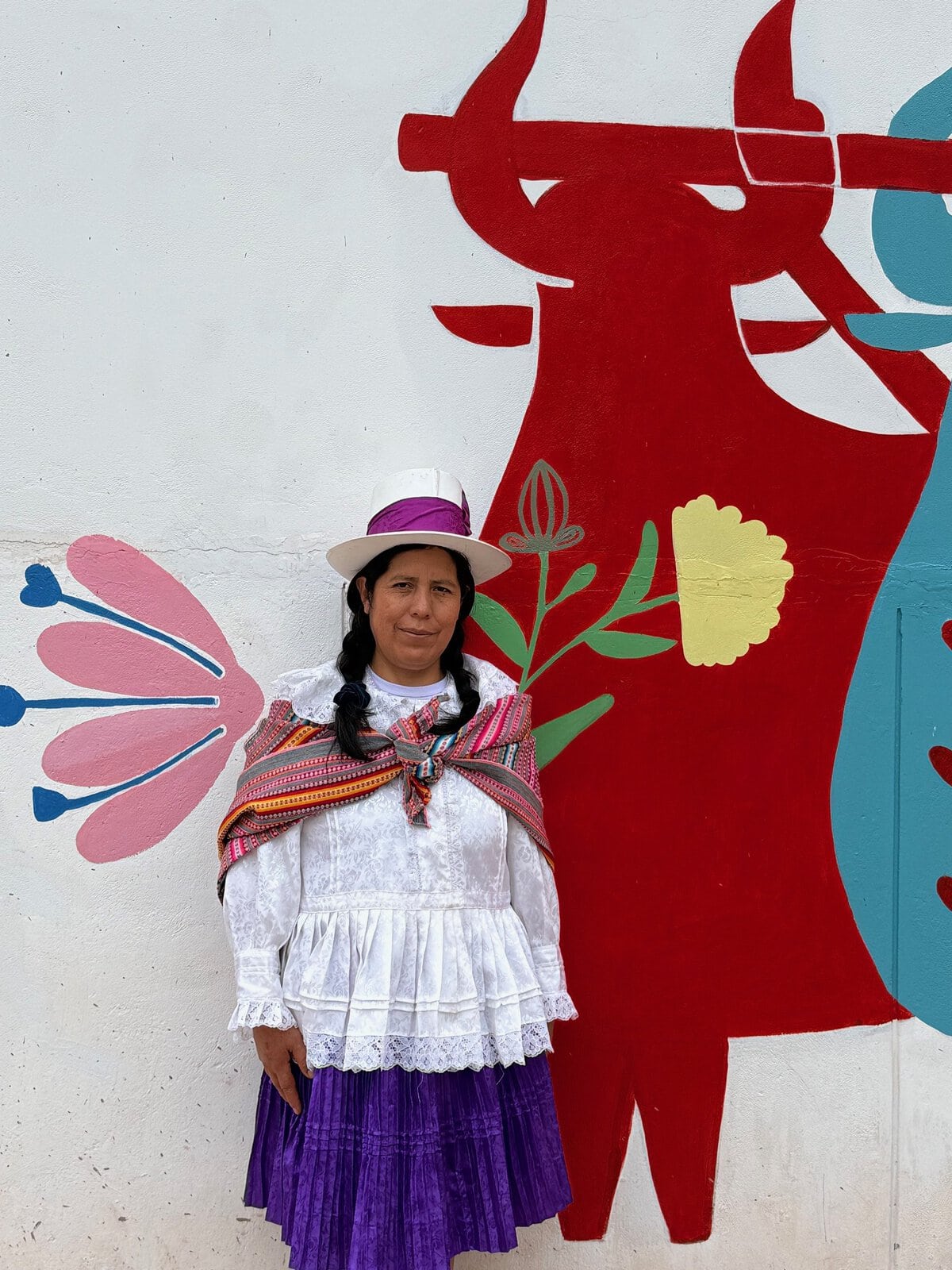
The community has approximately 100 families living in the village (around 500 people), and roughly half of the members are involved in the mural project.
“By making our village beautiful, tourists now want to come and visit us,” said the project’s leader, Berenice Diaz. “Families are also starting up their own local businesses such as small shops and restaurants for the tourists, which is helping to improve the community as well”. Visitors can also come for a few hours to help paint murals. It is a win-win experience that not only positively impacts the community, it also leaves lasting memories for the guests.
For more information or to book a visit, Totemiq Experiences. Email: totemiqperu@gmail.com or contact them via Instagram here. Program Coordinator: Bernice Diaz. +51-986-253-867.
Tierra de los Yachaqs, Amaru Community Visit
Tierra de los Yachaqs is an association of eight communities located in the Sacred Valley. Our group visited the Amaru Community, located about an hour outside Cusco in the Sacred Valley. The project is run by 32 local women (who are referred to as “mamas”), and each woman has a different role in the tourism experience.
As we ascended the winding roads of the Sacred Valley to Amaru, the views of the terraced hillside, terracotta rooftops, and fertile fields filled me with a profound sense of place. It was an overcast day with a few passing rain showers. Yet instead of feeling dreary, the drizzly day made the landscape feel magical.
The Amaru community sits proudly above the valley and is dotted with bright, yellow-painted homes welcoming visitors as they enter the village. The community is made up mostly of farmers who have worked the land for generations. Like many Andean communities, they have faced challenges with the loss of traditions and culture, and depopulation to the bigger cities of Peru. Yet, in recent years, the community has banded together to offer community tourism experiences that showcase their culture, traditions, and daily life for visitors. It has transformed their lives.

We arrived for our half-day visit shortly after ten o’clock and were warmly welcomed by song and dance from the local women (also known as the “mamas” who hosted the experience). As we entered through the gate, white flowers were sprinkled across our heads, and there was singing, dancing, and the beat of the drum.
After the welcoming song, the 16 women hosting us for the day lined up and one by one they introduced themselves. We learned their names, how many children they have, and what their unique role was in the community tourism project. From a 72-year-old mama with four grown kids and 10 grandchildren who worked as a weaver to a 37-year-old woman with five kids who worked as one of the cooks, we heard each woman’s story. Every woman thanked us with deep gratitude, telling us how much our visit meant to them. Not only did it help these women have an income outside of farming for the first time, but it gave them something else. Empowerment. Many told us that they finally had a voice in family matters, and with their new income, they were able to make important financial decisions and contributions for the family and their children. Healthcare and education have improved, and the women learned new skills and gained self-esteem. It was a powerful way to start the day.


Next, it was time for our group to dress in the Amaru traditional clothing. Putting on traditional textiles is a way to be received and welcomed into the community as family, not just as guests. Traditional clothing is extremely important in Andean culture and has seen a resurgence in the past couple of decades. Each Andean community has a distinctive style and color of their dress, and their clothing is an important part of their identity and culture. We learned that textiles are used to tell stories and keep ancestral traditions alive. Weaving is passed down by memory from generation to generation and is a huge source of pride. By wearing the Amaru clothing, we were now officially a part of the community.

Preparing the pachamanca, earth oven grill.
For our community experience, we did a cooking class and helped the mamas prepare a traditional Andean meal called a pachamanca. The word is derived from Quechua and literally translates into “earth pot or oven”. A large hole is dug into the ground, and layers of hot stones, followed by marinated meats and local vegetables, are slow-cooked.
The stones are heated over a fire for roughly four hours. Then, once the different meats and vegetables are prepared, they are layered over the hot stones – first the meats, then the potatoes and root vegetables, and lastly plantains, pineapple, and cheese. A final layer of stone is placed on top, then it is all covered with a tarp and dirt. The finishing touch is a small offering of flowers to Pachamama (“Mother Earth”). Then the food cooks for roughly 45 minutes and the layers are removed one by one, and voila! Our Andean barbecue is ready to consume.
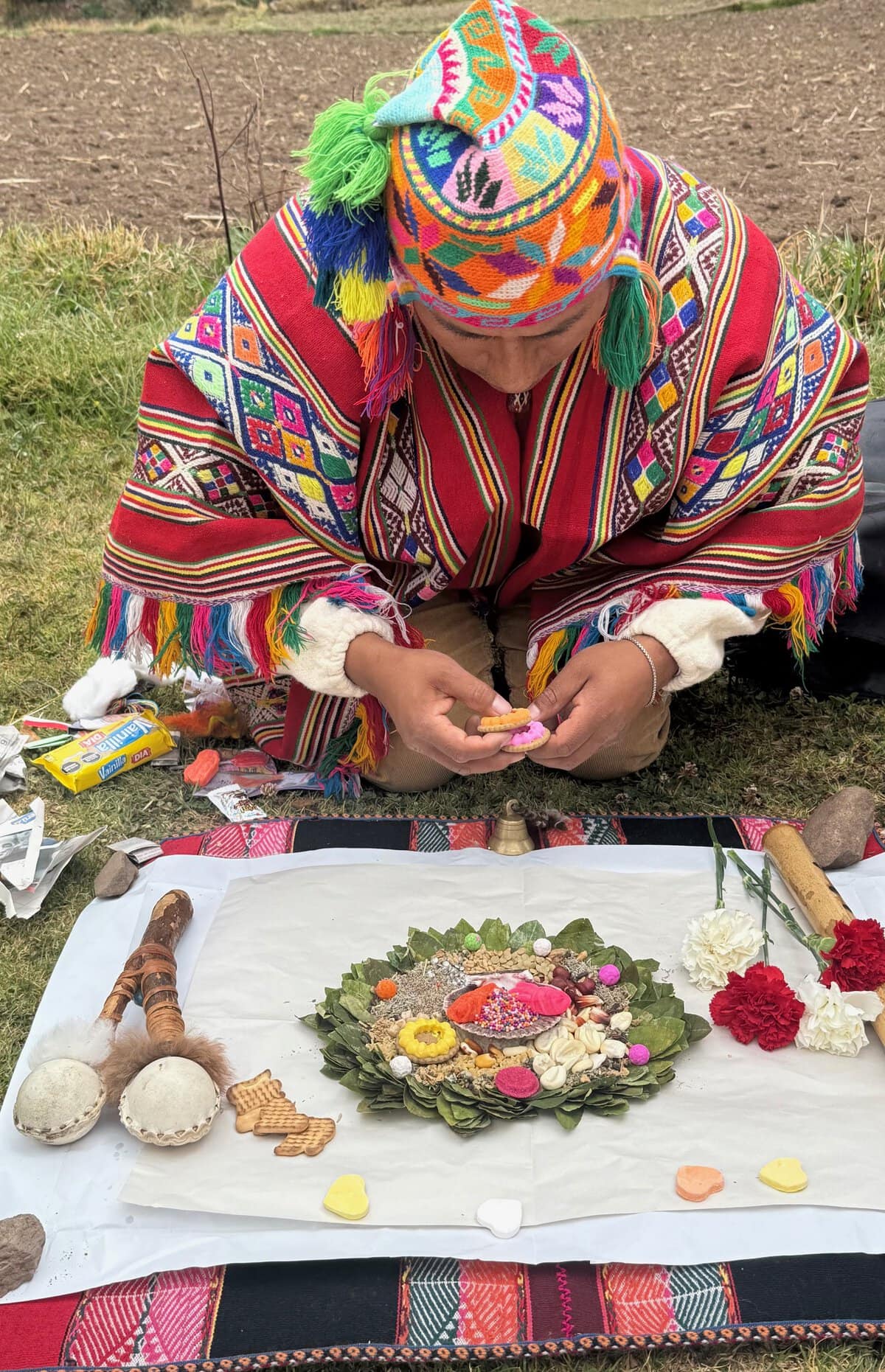
Preparing the offering of candy, mint leaves, flowers, money and more for Mother Earth
While the food was cooking, our group participated in a Pachamama ceremony and offering to thank Mother Earth. A local shaman performed the ceremony, and we were each asked to close our eyes and reflect. As I sat on the warm ground, a gentle breeze lightly ruffled my hair. I had so much to be grateful for. I said a special thank you as I passed over my three mint leaves to the shaman and accepted his blessing.
We were finished just in time for the unveiling of the pachamanca. Layer after layer of dirt and stone were removed, as the gloved hands of the women scooped out the food. It was a feast! Beef, chicken, trout, and even the local delicacy, guinea pig (a food that has been eaten and cherished in the Andes for thousands of years and is high in protein), potatoes, plantains, and roasted pineapple.
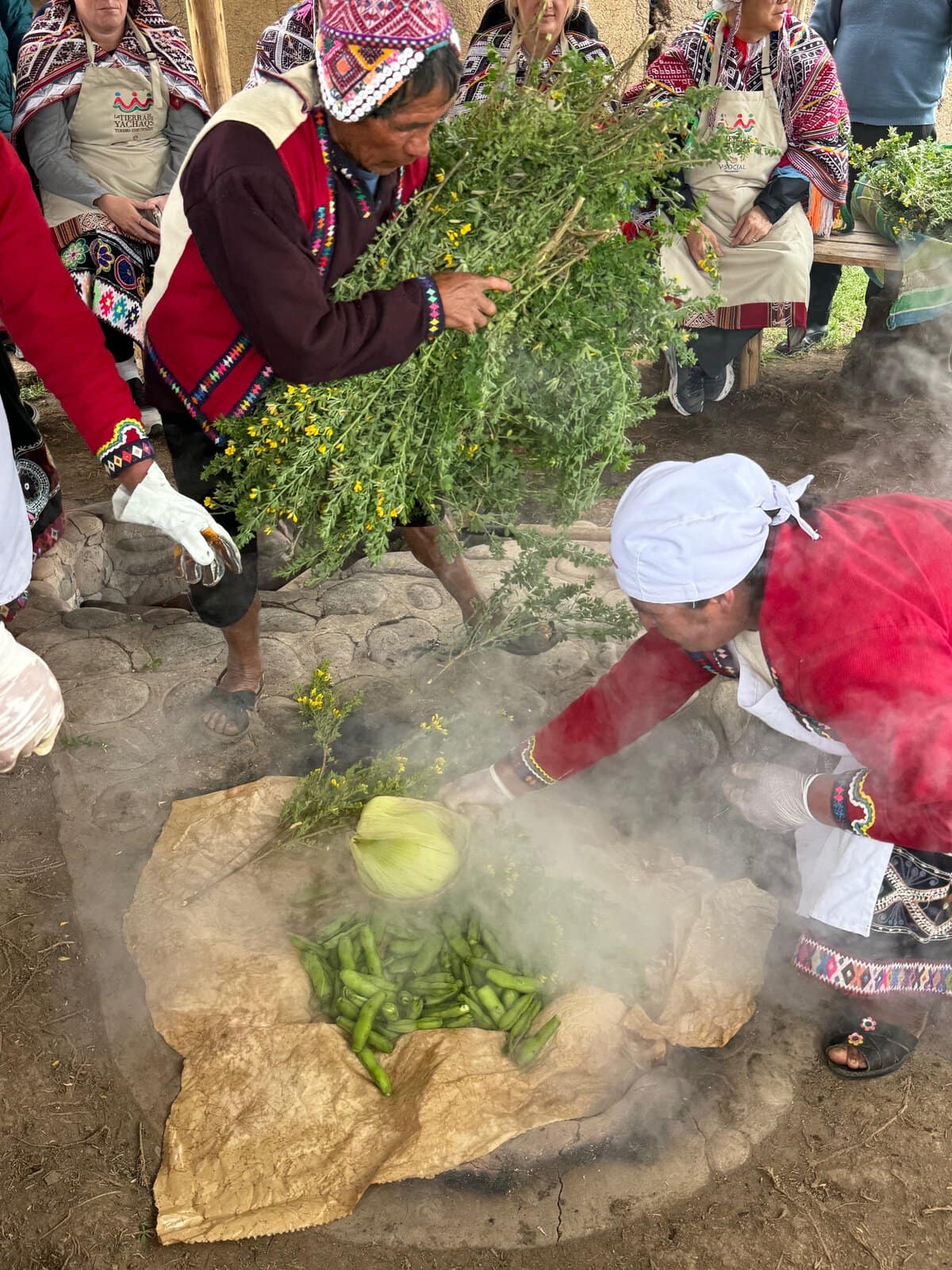
Uncovering the layers of the Pachamanca
As we prepared to leave, one of the mamas told us this: “We have been doing this work for years and have learned that results don’t come overnight. It has taught us to be patient and resilient. We are sharing our wisdom and the richness we have in so many aspects of our life. In the textiles we make, the stories we tell, the food we share, and our lives. This opportunity has taught our entire community how to live a better life, and now as women, we have a say in our future.
We left with full bellies and even fuller hearts, knowing that our visit made an impact not only on the women but on ourselves.
To book a visit, please contact Tierra de los Yachaqs here. Email: reservas@yachaqs.com
Thanks to Tourism Cares, PROMPERU, and all the partners that put this summit together. It was an amazing experience. To learn more about community tourism experiences around the world, check out the Tourism Cares Meaningful Map here.