
Is a Quechua Weaving Day Trip From Cusco Worth It?
A traditional Quechua weaving day trip from Cusco is worth every penny, and it stands out as one of the most meaningful cultural experiences in Peru. My daughter and I spent a half-day with a multi-generational weaving family in Amaru Village, about 1.5 hours northeast of Cusco, learning how alpaca and sheep wool is sheared, cleaned, naturally dyed, spun, and finally woven. The whole process, from raw fiber to finished textile, is done entirely by hand using techniques passed down for thousands of years. It was a beautiful, hands-on, and deeply moving experience. Here’s why you should do a day trip from Cusco to see traditional weavers.

Our amazing guide Martin holding Betsy’s little boy, Samir, who stole the show with his cuteness.
Last August, my daughter and I completed the Salkantay Trek to Machu Picchu, an unforgettable adventure through the soaring Andes to one of the most iconic treasures of the Inca civilization. While visiting Cusco, the historic heart of the Inca Empire, I was eager to experience another important part of Peruvian culture: the ancient weaving traditions of the Quechua people.
The Quechua people of Peru are renowned for their extraordinary textiles, colorful handwoven fabrics created and preserved for thousands of years in the Andes. More than simply beautiful souvenirs, these traditional Andean textiles are deeply connected to Quechua history, spirituality, and daily life. Because the Quechua language was historically passed down orally rather than through written texts, weaving became an essential way to preserve ancestral stories, mythology, cultural identity, and regional traditions.
Today, Quechua weaving remains a sacred art form passed from one generation to the next. Every pattern, color, and symbol woven into the fabric carries meaning, telling stories of family, nature, and life in the Andes. Visiting a Quechua weaving community near Cusco offered us a rare opportunity to learn firsthand about one of Peru’s most enduring and meaningful cultural traditions.
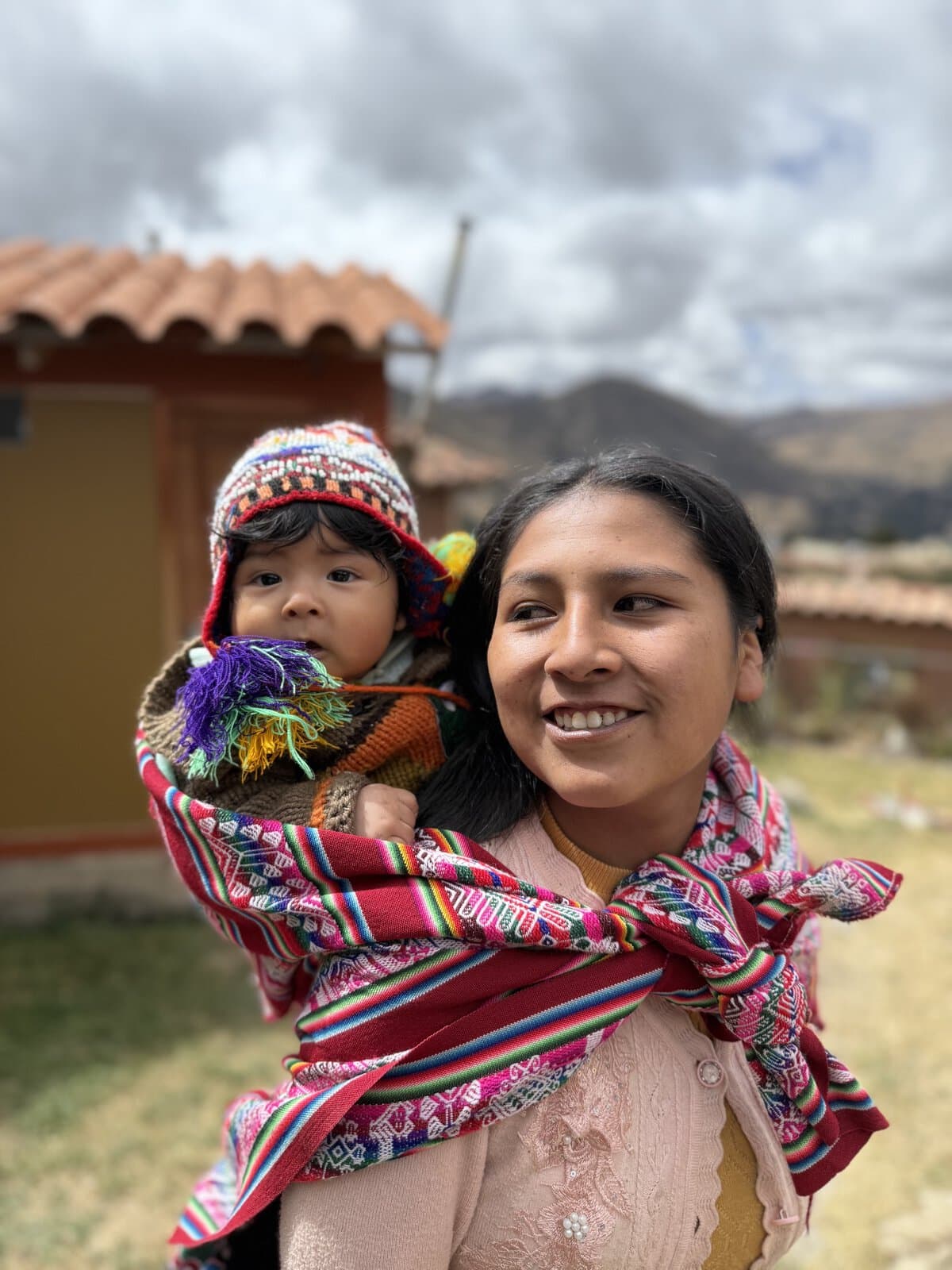
Beautiful mama and baby (Betsy and her son, Samir) who showed us how to thread wool – not an easy thing to do – with a baby on her back.
Finding the Right Guide for a Traditional Quechua Weaving Experience
Through careful research, I found the perfect Cusco-based guide, Martin Claure, to take my daughter and me on a half-day visit to witness traditional weaving firsthand. Martin is deeply passionate about the history of Andean textiles. After working in various non-profit organizations, he launched his own sustainable tours on Airbnb Experiences roughly seven years ago to connect travelers with a Quechua family in Amaru Village, located about an hour and a half northeast of Cusco in the Andean Highlands.
We left Cusco after breakfast, passing through villages and terraced pastures until we reached the tiny village of Amaru, which means “snake” in Quechua and perfectly described the winding roads. Amaru is a small Quechua community of mostly farmers, and has slowly been opening up to sustainable, community-based tourism initiatives thanks to people like Martin.
During our visit, we met Walter and his wife Lucia, both incredible weavers, along with their son Fernando, his wife Betsy, and their adorable baby, Samir. The entire family would participate in the experience, ending with a traditional lunch of quinoa soup and fresh vegetables.
We were warmly greeted by our hosts, Lucia and Walter, and offered a cup of mint tea. Then, it was time to learn about weaving with Fernando and Betsy.

Our host’s home in Amaru

Lucia and Walter greet us at their home
From Fleece to Fiber: How Quechua Wool Is Prepared
The process begins with gathering the raw material. Because many Quechua families are traditionally alpaca farmers, alpaca wool is most commonly used for its softness, and sheep’s wool is also used for smaller items like hats and mittens. Every six months, families climb into the high pastures to carefully shear the alpacas using special knives.

Next, we learned how to spin the wool by hand, which was far more difficult than it looked. It takes patience, coordination, and years of practice to master the technique.
The alpaca wool is cleaned entirely by hand, but is not washed because it naturally contains little oil. Sheep’s wool, however, is much oilier and must first be washed with a natural soap before being laid out to dry before it can be dyed.
Natural Dyes: The Colors of the Andes
The dyes themselves are completely natural and locally sourced from plants, volcanic rocks, minerals, and even insects. The Quechua people possess an incredible knowledge of how these natural ingredients work, not only for textiles but also for traditional medicines.


To dye the wool, water is heated in a clay pot over a fire and mixed with the natural coloring agents. The wool is then submerged in the boiling water for five to twenty minutes, allowing the fibers to absorb the rich colors before being hung out to dry.


The red dye on my hand comes from a beetle that eats prickly pear cactus. It makes red as well as a dozen more colors. Pretty amazing!
Learning to Weave: Bracelet-Making and the Loom
Once the wool is ready, it is used to make sweaters, blankets, clothing, hats, gloves, and tablecloths using traditional looms. For our experience, we learned how to make a simple bracelet, which honestly was much harder than it looked.


Here is a video I made of our experience. At the end, you can see some of the elaborate hand-woven goods they made for sale in their shop. While no purchase is required, I could not resist buying a beautiful decorative table runner to remind me of my trip and the beauty of the Quechua culture.
What Do Quechua Textile Symbols Actually Mean?
One of the most surprising things I learned during our visit was that the patterns woven into Quechua textiles are not decorative. They are a language. Because the Quechua people historically had no written alphabet, every motif carries meaning that has been passed down through generations of weavers.
Animals like the condor, puma, and snake represent the three worlds of Andean cosmology: the upper world (Hanan Pacha), the middle world (Kay Pacha), and the inner world (Uku Pacha). Geometric shapes indicate the weaver’s home community, family lineage, and social status. Flowers and plants are tied to the agricultural calendar and the seasons. Even the colors carry meaning: red represents the earth and vitality, gold represents the sun, and green represents the fertility of the Andean landscape. (check this resource for more on meaning of symbolism).
What struck me most was that two weavers from different villages, meeting for the first time, could read each other’s clothing and understand exactly where the other came from and who their people were. A textile was, quite literally, an identity document woven in wool. Pretty amazing, huh?
How to Book a Quechua Weaving Day Trip From Cusco
The experience I did was arranged through Martin Claure, a Cusco-based guide who spent years working with non-profit organizations before launching his own small cultural tour company. Martin personally connects travelers with the weaving family in Amaru Village, and his deep knowledge of Andean textile history adds enormous context to what you are seeing.
Dress for the weather as it can be chilly and change at any moment. Also bring a wide-brimmed hat, a water bottle, some spare money in case you want to make a purchase in their lovely shop, and a sense of adventure.
It was the perfect way to end our amazing time in Peru. If you visit Cusco, I highly recommend this tour.
Author’s Note: This post is human-written, by me, Nicole Melancon aka thirdeyemom.
The content below is AI-assisted and edited by me (i.e., I used AI to summarize and group my content into easily digestible nuggets).
How to Book a Quechua Weaving Day Trip From Cusco
I arranged this experience through Airbnb Experiences with Martin Claure, a Cusco-based guide who spent years working with non-profit organizations before launching his own small cultural tour company. Martin personally connects travelers with the weaving family in Amaru Village, and his deep knowledge of Andean textile history provides invaluable context for what you are seeing.
A few practical details worth knowing before you go:
For other weaving experiences in the region, the community of Chinchero is known for its cooperative textile workshops, and Awamaki runs highly regarded weaving programs in Ollantaytambo in the Sacred Valley. Patacancha is another community frequently mentioned for full-day textile immersions.
Frequently Asked Questions
What is the traditional weaving of Peru called?
Traditional Peruvian weaving is known as Andean or Quechua textile weaving, and the core technique is called pallay in Quechua, meaning “to pick up.” It is one of the oldest living textile traditions in the world, with roots stretching back over 5,000 years to pre-Inca civilizations. The most iconic form uses a backstrap loom called an awana and natural dyes sourced from plants, minerals, and insects like the cochineal beetle.
What natural dyes do Quechua weavers use?
Quechua weavers use entirely natural, locally sourced dyes. The most famous is cochineal, a red dye extracted from a beetle that feeds on prickly pear cactus, it produces not just red but a whole spectrum of pinks, purples, and oranges depending on the mordant used. Other dyes come from plants like achiote and indigo, volcanic rocks and minerals, and bark. The wool is submerged in boiling water mixed with the dye agent for five to twenty minutes to absorb the color.
How do I get to Amaru Village from Cusco?
Amaru Village sits roughly 1.5 hours northeast of Cusco in the Andean Highlands, at an elevation above 3,800 meters. The most straightforward way to visit is with a local guide like Martin Claure, who arranges private transport from Cusco as part of his cultural tour. Independent travelers can reach the area by collective taxi or private hire from Pisac market, but a guided visit is strongly recommended because the experience with the host family is arranged in advance and would not otherwise be accessible to walk-in visitors. Plus there are language barriers if you don’t speak Spanish.
What day trips can you do from Cusco?
Cusco is one of South America’s best bases for day trips. The most popular options include Machu Picchu (a full-day trip by train through the Sacred Valley), the salt pans of Maras and the agricultural terraces of Moray, the market town of Pisac, the fortress of Ollantaytambo, and community-based cultural experiences like a traditional Quechua weaving visit to Amaru Village. Half-day weaving and cooking experiences in nearby Quechua communities are a quieter, more personal alternative to the major archaeological sites, and often the most memorable part of a Cusco trip.
What do locals wear in Cusco, Peru?
In Cusco and the surrounding Andean communities, traditional Quechua dress is still worn daily, especially by women. Women typically wear a pollera (a layered, brightly colored skirt), a manta(a woven shawl pinned at the front), and a montera (a distinctive hat whose style varies by village). The colors and woven patterns of the manta identify the wearer’s home community, a living example of the textile-as-language tradition. Men in rural communities wear ponchos, also woven with community-specific patterns. In Cusco city itself, dress is a blend of traditional and modern styles.
What should I buy as a souvenir from a Quechua weaving community?
Handwoven textiles purchased directly from the weaving family are the most meaningful and ethically sourced souvenirs you can bring home from Cusco. Every sol goes directly to the family rather than to a middleman. Popular items include table runners, blankets, hats, gloves, and small decorative pieces. I could not resist a beautiful decorative table runner, and it remains one of my favorite reminders of the trip. No purchase is ever required during the visit, but if something moves you, buying it is a direct and tangible way to support the community.
This is the kind of tour I’m interested in — apart from ones that involve tasting traditional food made from locally-sourced ingredients. I love how all of those colors are natural, and the end products just look so beautiful. No wonder you got a table runner to bring home!
Thanks as always for commenting Bama. These are the kinds of experiences I love when I travel. It took some work to find this opportunity but it was one of the best tours we did. I love connecting with the local people and learning about their culture and traditions. For me, this is the best part of travel. I got so much video footage as it was hard to resist.
The Quechua weaving traditions sound so meaningful, and the colors and craftsmanship are incredible. Loved reading about your time in Amaru and meeting the lovely family there!
Thank you so much. These are the kinds of experiences that I treasure when I travel. Meeting the local people and learning about their beautiful culture and traditions.
Absolutely! Those personal connections make travel so unforgettable. It’s amazing how much you can learn about a culture through the people and their traditions and truly the heart of meaningful travel experiences.
Yes indeed! 🙂
This red colour from the beetles, the cochineal or carmine, is used in lipstick, Campari and food products as well worldwide.
Nice pictures, thanks for showing
The Fab Four of Cley
🙂 🙂 🙂 🙂
Wow, lipstick? I guess that makes a lot of sense. It was a wonderful experience and glad I got to share it with my daughter. Thanks as always for your comment! 🙂
Great experience
It really was magical. Most of what I captured is video which is hard to share in the blog. Thanks for reading Sue!
My pleasure😊