
A highlight of our recent trip to Ireland was a half-day visit to the Great Blasket Island. Located off the coast of the Dingle Peninsula in western Ireland, the Great Blasket Island is the largest of an archipelago that includes Beiginish, Inishtooskert, The Tearaght, Inishabro, and Inihvickilane, forming the aptly named Blasket Islands. While none of the islands are currently inhabited, the Great Blasket Island was inhabited up until 1953 and is steeped in culture, nature, and history, making it a fascinating place to explore. Furthermore, a visit to the Great Blasket Island invites you to get off the beaten path and find the true heart and soul of this magical country without overtourism or large crowds. For me, that is the most enriching way to travel.
Why visit the Great Blasket Island as opposed to the over-touristed places in Ireland
In 2025, over 1.5 million people visited the Cliffs of Moher, one of Ireland’s most iconic and visited places. While the Cliffs of Moher are exceptionally beautiful, it can be argued that there are many other equally if not more, majestic and beautiful places in Ireland that are nearby and without the crowds.
As a sustainable travel writer, I ask: Is visiting the Cliffs of Moher even a good experience anymore? Is it good for the fragile ecosystem, or the masses of tourists arriving on buses (up to a couple hundred buses make the stop each day), cramming together to get the one photo for their memories and check off an item on their bucket list? This kind of mass tourism quite frankly is terrible and does no one any good. Instead, it is important to seek alternative places to visit without the crowds, which is how we found the Great Blasket Island Experience and tour.

Why choose the Great Blasket Experience as your local guide?
We chose The Great Blasket Island Experience as our guide because they are family-run, locally based, and focus on ecotourism and sustainable travel. Per their website:
We are a small, family-run business based in the heart of Dingle, offering award-winning Dingle Bay boat tours and unforgettable wildlife adventures along the Wild Atlantic Way.
Our eco-friendly wildlife boat tours in Dingle take you along the stunning Dingle Peninsula coastline, where you may encounter dolphins, seals, seabirds, and breathtaking sea cliffs. Each tour combines a scenic cruise around Dingle Bay with a landing on the iconic Great Blasket Island, giving you the perfect balance of adventure, nature, and heritage.
Unlike standard boat trips, our tours offer a true eco-experience, guided by local experts who are passionate about marine wildlife, conservation, and the unique history of the Blasket Islands.
After doing the tour, I wholeheardly agree that this company is the one to use as your guides. The guides were courteous, extremely knowledgeable, and respected the flora and fauna of this special place. They are strongly committed to conservation and protection of the sea as well as the flora and fauna of the island and its history. This is critical in today’s world in my book.
Setting off on our tour to the Great Blasket Island
We set off from the Dingle pier around 9 am with a small group of around ten people and two crew from the local outfitter, The Great Blasket Island Experience.


As we left the Dingle harbor, I could see the immense raw beauty of Ireland and its colorful, quaint towns. We would not have nearly enough time to spend in Dingle and I regretted it.
The boat ride took approximately an hour to reach the Great Blasket Island with commentary and a few short stops along the way. Our guide pointed out with pride the all-girls boarding school along the coast where the children take all their classes in Irish, a language that was forbidden at the time of English rule and has seen a resurgence since the birth of the Gaelic Revival in the late 19th and early 20th centuries. Today, thankfully Irish is taught in the classroom and being strongly embraced as a big part of Irish heritage, and cultural identity. Signage throughout Ireland is written in both English and Gaelic, and Gaelic can be heard spoken in many parts of Ireland especially along the western coast.


After passing the Irish school, we stopped briefly along the coastline of the mainland where our guide pointed out the vertical ridged lines in the rock that were the result of the tectonic plates shifting underneath the earth millions of years ago, eventually flipping the landmass 90 degrees. It was astonishing to see! Our guide also pointed out a prehistoric lake bed flipped vertically, within the coastal walls

Around ten o’clock we pulled up to the tiny island dock at the Great Blasket Island, where we got off and had the next three and a half hours to explore the beauty of this mystical place on our own. We were the only souls there and I was elated. While another small boat arrived later, there was never more than a couple dozen people on the island.
Before setting off our guide shared why this island is so special.

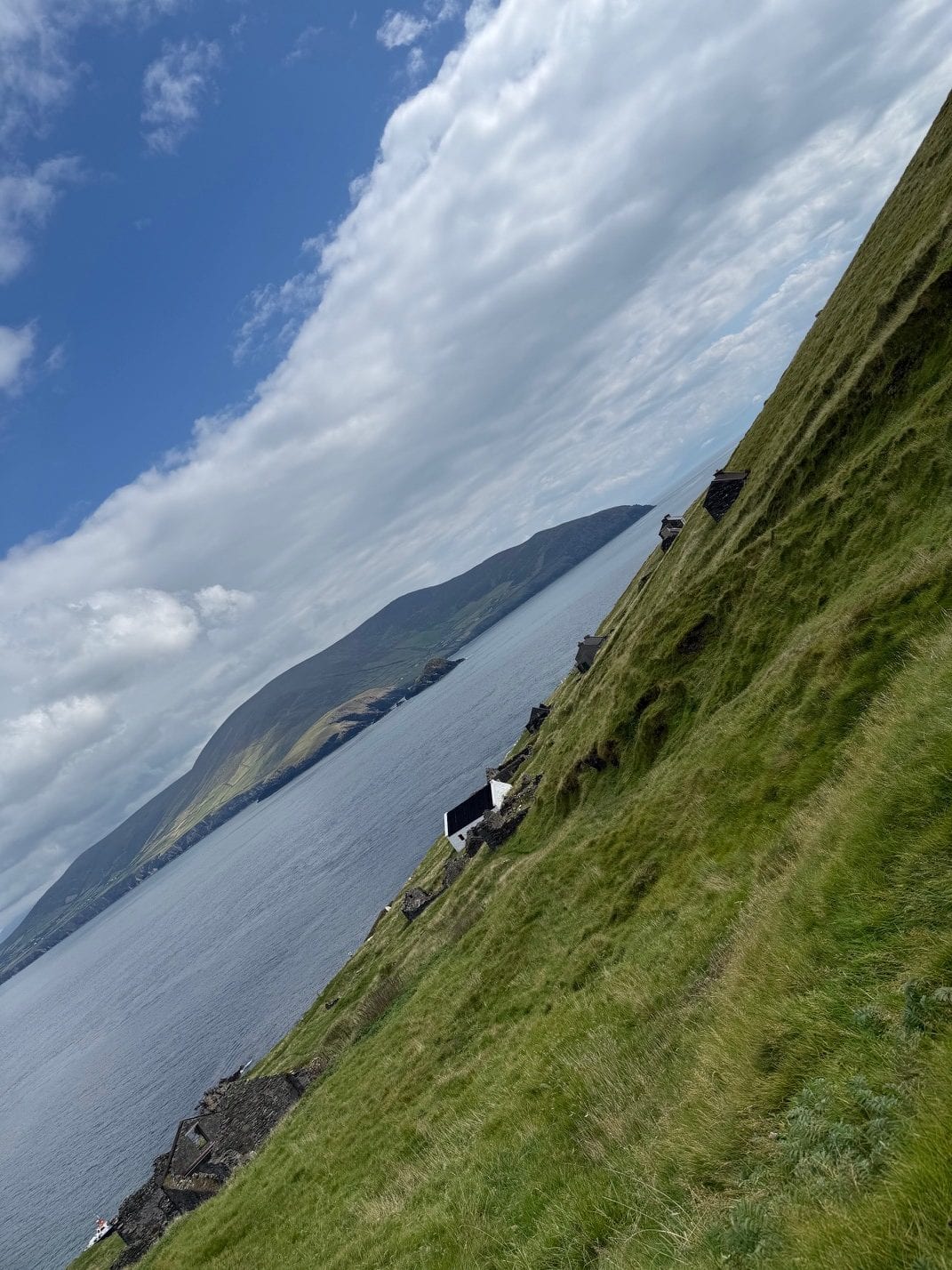
The remains of the small community who once lived on the Great Blasket Island
What makes the Great Blasket Island so unique?
The Great Blasket spans over 1,100 acres of unspoiled, mountainous terrain. Approximately 4 miles long and 1/2 mile wide, this island is now a Special Area of Conservation, teeming with wildlife and flora. Steeped in Irish history and heritage, the Great Blasket Island was one of the most remote Irish-speaking areas of Corca Dhuibhne (Cork).
Although uninhabited since 1953, it remains renowned for the rich literary heritage left by its former residents, who documented the extraordinary details of their everyday lives in writing, song and dance. The stone remains of some of the most important buildings of the villages remain and are open to a free half an hour tour daily (at 11:30 am and 12:30 pm) presented by the OPW (Office of Public Works).
There is also an hour and a half trail along the top ridge of the island that affords stunning views of the archipelago. If you time it right, you will also see some of the island’s precious sea birds such as the puffins who come to lay their eggs along its rocky cliffs.
Lastly, the island is home to the largest Grey Seal Colony in all of Ireland and seeing them resting along the sandy beach with their calves is precious.

A large group of seals can be found basking in the sun and raising their young on the island’s beach (the large gray mass that looks like rocks in the photo above towards the end of the beach are the seals!)
On the island, the first recommended thing to do is catch a glimpse of the seals before they left the beach in search of food.
The Grey Seal Colony
The Great Blasket and its surrounding islands are home to the largest Grey Seal colony in Ireland and they love the island beach where they bask in the sun. The seals are protected by law and you are not allowed to approach them within 50 meters.
It is highly recommended that you view them from the cliff above the beach, since many of the seals are with calves and if they get spooked, sometimes the mothers leave their calves behind. We followed the rules and observed them from a distance and that was enough. Sadly we saw a few tour boats come up close to the beach and the seals started to race into the water. Again, choosing an ethical, responsible tour company is critical to protecting and conserving this place.
Hiking the Island
The hike begins at the cafe (you can’t miss it as it is one of the only white buildings on the island). From there, you can go down to the cliff that overlooks the beach to view the seals, and then climb back up to rejoin the trail. The hike continues upwards and weaves around the island in a loop ending back at the village. The views were surreal and we were so fortunate to have perfect weather not the expected Irish rain. I imagine the hike would still be beautiful on a rainy day yet in a different way.


The Island is home to many resident and migratory sea birds such as puffins, gannets, arctic ferns, and guillemots but you have to time it right. We were there in late August so we missed Puffin season which ranges from March until August. (For a complete guide to the island and area’s wildlife and times of year to see them, click here). I have seen them in Iceland and Alaska before and they are an amazing sight to see!
There are also lots and lots of sheep on the island as they are still being raised here.

A family shot on the Great Blasket island
History of the Great Blasket Island
We arrived back in the village in time for a stop at the Island’s small cafe for a quick snack before heading to the free tour at 12:30 PM.
The Great Blasket was inhabited for centuries, with a population which peaked at 180 in 1920. To survive their long, harsh winters on the island, they cultivated a life of storytelling and writing making the island one of Ireland’s most renowned writing communities. They also were incredible dancers and musicians.
Their days were long and hard searching and foraging for whatever possible they could find to eat such as puffin eggs, foxes, fish, seaweed and even at one time, seals. Winters were the roughest of all as they were trapped on the island since the sea was way too difficult to navigate (there are many shipwrecks).
From the early years of the 20th century the island was a magnet for Gaelic scholars (writers and poets) who wanted to learn the Irish language and study its ancient folklore. Beginning in the 1920s the island became famous as a series of very significant literary works were authored from within its community. The island “library” now numbers over 100 books.
Per the Blasket Centre:
Islanders were encouraged to write their life stories in their native tongue, and the books they wrote give a unique insight into the hardship of Island life. The three best known Island books are An tOileánach (The Islandman) by Tomás Ó Criomhthain, Peig by Peig Sayers, and Fiche Blian ag Fás (Twenty Years A-Growing) by Muiris Ó Súilleabháin. https://www.blasket.ie/udair-an-oileain/
The home of the foremost Blasket writer Tomas O’Crohan has been restored and can be viewed on OPW (Office of Public Works) guided tours at 11:30 and 12:30.
Successive waves of emigration and the growing unviability (they had a very hard life, which you can learn about at the Blasket Centre located on the mainland) of life on the island eventually caused it to be evacuated in 1953.
Today, the Great Blasket Island provides a glimpse into a unique and fascinating history of one of Ireland’s most hearty communities.
The Blasket Centre
A stop at the Blasket Centre located on the mainland is a must for its incredible history of the island and its writers. Furthermore, the exhibits are exceptionally done, the building itself is stunning and there is a spectacular walk along the cliff if you have time after your visit 1h30 min.
I would honestly recommend doing the Blasket Centre before visiting the island if you can but either way is fine. Just don’t miss it. It is located along the Dingle Peninsula and we did it the next day during the Slea Head drive. To see the centre at a good pace, allow at least an hour and a half and double that if you want to do the hike along the shoreline.
Book Your Tour
I highly recommend booking your tour with the The Great Blasket Island Experience online. They pick you up at the pier in Dingle and you can either do a short or longer tour that includes scouting for sea life.
While we were not visiting during the time of whale migration, we did enjoy a pod of dolphins who put on a magical show for us during the ride back.
For those seeking something even more special, you can book an overnight accommodation on the Great Blasket Island, allowing you to experience island life after the day visitors depart. Wake up to panoramic Atlantic views and enjoy a peaceful island escape like no other.

“Dheineas mo dhícheall an chuntas cruinn a chur síos ar an dream a raibh aithne agam ortha, ionas go mbeadh cuimhne orainn ar Shlí na Fírinne” Peig Sayers 1873- 1958 (translate for post)
“I have endeavored to give an accurate account of those I knew, so that we may be remembered in the Way of Truth” Peig Sayers (1873- 1958)
Author’s note: A lot of the factual information above in this post was given on our tour and taken from the Great Blasket Experience’s website and the Blasket Centre (both linked above).
Looks like a great extra excursion to this scenic island; I love the look of the hike! Did you by any chance get to Louis Mulcahy Pottery? My mom and dad “found” him in a tiny shop in the late ’70s, Jeff and I tracked him down in the mid-’80s, and then we all went back to his much larger place in 2012-ish.
It was a lovely place to visit. I have not heard of Louis Mulcahy Pottery. That is pretty cool to have seen this place grow over the years!
You capture a perfect piece of Ireland… one I haven’t seen, but sure would love to. Yours is a perfect account of a place that seems to hold Ireland’s natural beauty and cultural memory—the scenery brings out the Irish spirit. As always, your emphasis on traveling responsibly is so good to see, especially when observing the seals from a respectful distance (and all wildlife). Wishing you and your family a wonderful finish to summer, and to more adventures on the horizon!
Thank you so much for the comment and sorry for the delay in responding. It was a beautiful trip and so special to be with family. 🙂 I hope that you are doing well! I always look forward to reading your stories.