Heading to the land of gnomes and icebergs: A trip to Southeast Iceland

It is hard to not be completely awestruck by the beauty of Southeast Iceland.  A couple hours drive out of Reykjavik leads to nature as pure and fine as it gets, with little or no signs of civilization except the occasional passing of another car or a herd of sheep alongside the road.  The two hour drive to Vik is renowned for its spectacular views of the ever-changing and always fascinating landscape.  You pass through verdant green farms flocked with white fluffy sheep, craggy mountain peaks loaded with glaciers, brilliant waterfalls and finally nothing but the ocean as far as the eye can see.

We left Reykjavik early in the morning, after a hearty breakfast, expecting the drive Skaftafell National Park (our final destination) to take the entire day.  We had planned to stop along the way, in the small village of Vik to do a couple of hours hike, before continuing on with our drive.  I was immensely excited about the drive for I love to wander and see the countryside.  It is one of my favorite things to do when I’m exploring a new place.  To look at the great big world and breathe it all in, seeing it as if for the first time in surprise and in wonder.   To hold that moment in time inside your heart and soul, and to take every little detail in so you’ll never forget it.  That is what travel is all about.  Those moments in time. 

Heading South on Route 1 towards Vik, you are instantly reminded of how remote much of Iceland is.  Besides the blackened lava fields, lush green farms, and craggy mountains flowing with glaciers, all off in the distance, there are few towns and few signs of life.

The yellow-green grass blows quietly in the wind:

What makes Iceland so incredibly fascinating is that the landscape changes constantly, moving from once brilliant green pastures to dark, fierce lava flows.  This is indeed Iceland, the land of fire and ice.

Geysers off in the distance give an eerie feeling to the drive.  Am I dreaming?

And all those roads that appear to lead to nowhere make one indeed feel far, far away….

Along the ever-changing countryside…perhaps some of the most scenic, “out there” views in Iceland:

The sun slowly peaks through the thunderous clouds.  I am mesmerized…my mind is racing yet peaceful for this is the time I often reflect the most on my life, when I am in my element, exploring and seeing the world.


There is nothing in the distance except solitude and sheep.

Our drive seems to take longer than expected as drives such as this one often do.  There are too many incredible views; too many unworldly things to see and admire.  We pass yet another spectacular waterfall along the way, pulling over to the shoulder of the lonely road to take another picture.

The black lava rock field reminds you that one of the world’s largest ice caps irks not far behind…

The glacial remnants against the pale yellow fields are so stark and so beautiful, it almost hurts your eyes to see.

It is almost impossible to believe that we are less than two hours away from Reykjavik.

Yet this is Iceland.  A a land that is so absolute and so pure, it seems like from out of this world.

We are swept away once again by another gorgeous waterfall, Skogafoss in the distance can be seen from the road.

As we approach Vik and see the tiny village away in the distance, I think about Icelandic folklore and ponder on the possibility of gnomes.  Of course it isn’t possible!  But then again, Iceland seems like a fairyland to me.

Stay tuned….next post is titled “Attack by the Puffins: Our short hike in Vik”. 

Iceland TRAVEL BY REGION

A Hike in Hengill: A land awash in geothermal wonders

A short distance off the Ring Road along the Golden Circle tour (see earlier post:  Searching for Gold in the Golden Circle) is a fabulous afternoon hike in one of Iceland’s lesser-known spots:  Reykjadalur or the “Smoky Valley”.  Upon arriving at the head of the trail, it is instantly obvious where the name “Smoky Valley” came from:  All the pillars of steam and smoke spiraling up into the sky!

Reykjadalur is a typical Icelandic natural wonder.  The valley is surrounded by geothermal activity.  There are bubbling mud pools, venting steam, boiling hot springs, and if you bring your swim suit, a natural hot pool at the top of Mount Oklelduhnukur.  All this in a couple of hours hike!

As we pulled off the Ring Road and headed into Hengill towards the start of the hike, we were utterly stunned to see a real live golf course in the middle of this incredibly active geothermal valley!  Can you imagine playing golf in the midst of steaming vents and gurgling mud pools?  What if you ball rolled into one?  Would you pick it out or add a point to your score?

Here is a photo of the golf course in the “smoky valley”….Fore!

At the head of the trail:  Feeling a little uneasy about hiking through all this crazy stuff!  But “When in Rome”!

Setting off on the two-hour hike.  Easy, right.  Yet a bit on edge about all the natural hazards:

There is even a sign to remind you!

Not a great picture yet it illustrates the perils of this hike!  Plus it shows the surreal experience of hiking through steam.

We were soon passed by a couple of hardy Icelanders, dressed in swimsuits and carrying their towels, on a race to the top for a quick dip in the hot pools.    But the REI group (in picture below) couldn’t pass us!

Looking down below at the boiling, bubbling stream:

The views of the “Smoky Valley” are stunning and quite different from other parts of Iceland that I have seen.

The “Smoky Valley” is stunning!  Look at the color of the black rock juxtaposed to the verdant, green valley.  Incredible!

The end of the hike…we made it without any mishaps!

Soon after our hike, we were back in the car en route to Reykjavik.  All I could think about was what an amazing day it had been!  The Golden Circle tour was quite magical and the hike definitely let off some steam.  I was looking forward to another fabulous dinner, a good night sleep and my next adventure.

As I closed my eyes, I reflected on my day and came to the obvious conclusion that Iceland, the land of fire and ice, is a land of pure wonder and dreams.

Stay tuned….Next post will cover the highlight of my trip to Iceland.  A drive along the coast and visit to the remote, serene Skaftafell National Park.

Adventure Travel Iceland TRAVEL BY REGION Trekking/Hiking

Searching for Gold on the Golden Circle

If you only have a few days in Iceland, a drive around the infamous Golden Circle is a definite must and often a highlight of any visitor’s trip to Iceland.   There are loads of tour operators based in Reykjavik that can easily and happily take you there on a tour via bus.  Yet, in my humble opinion, the best way (albeit not the cheapest) to experience the Golden Circle is by doing it yourself.  That way you can really get lost in Iceland.  Lost in a metaphorical sense, as the route is fairly easy to navigate.

My father and I rented a car for our stay in Iceland which was not at all cheap.  Gas prices are high, and everything in Iceland at the time was very expensive (remember this was 2008, before the financial crisis thus prices may have dropped a bit since then).   But in order to see and do all the things we wanted, especially to truly see and visit the countryside, we needed our own car.

It was worth every penny; the highlight of our trip to Iceland was the driving and seeing the magnificent countryside for hours on end.  The astonishing waterfalls, endless amounts of glaciers dropping down to the ground like a cloud, the immense black, rocky lava fields, the coastline, the verdant farms and of course the grazing livestock.  None of this would have been seen if we hadn’t left Reykjavik and followed our wonderlust into the wild, pure, untamed nature which is the best part of Iceland.

The Golden Circle Tour is the most popular day trip from Reykjavik, probably for its accessibility (the first stop,Pingvillir, is only about 30 miles/49km northeast of Reykjavik) as well as its “bang for its buck”.  You can see history in Pingvillir which is the birthplace of Iceland’s first parliament in 930 AD; wild nature at the Geysir, a geothermal hotspot; and one of the most beautiful waterfalls in the world, Gullfoss- all within a day’s trip from Reykjavik.

Plus it is your main chance to get outside of Reykjavik and see what Iceland is most famous for:  Majestic, spectacular nature.  The beauty of Iceland’s countryside is as pure and sensational as nature gets.

There are many variations to the Golden Circle Tour yet we chose to stop at the three most popular attractions:  Pingvillir, Geysir and Gullfoss.  Here are the photos along the way.  You will instantly see why it is called the “Golden Circle”.  Unfortunately though, we didn’t see any rainbow or find a pot of gold.  But the views we saw were priceless.

Not far out of Reykjavik, perhaps only ten or fifteen minutes by car, you are suddenly surrounded by nature at its finest.  The Icelandic countryside is accessible, vast and simply put, spectacular.   As you drive along the Ring Road, heading east towards Pingvellir National Park, you are stunned by how green and pure the surrounding countryside is.  If there is a heaven on earth, Iceland easily fits the bill.  It is as close as you can get to a nature lover’s paradise. 

Iceland’s Horses (now how could you eat these gorgeous creatures?):

The amazingly green Iceland:  Pictures of hay wrapped in plastic to protect it from all that rain that makes Iceland so green:

The road to nowhere:  Following the famous Golden Circle on the Ring Road:

First stop:  Pingvillir, site of Iceland’s “Parliament Fields” founded in 930 AD.

View of Pingvallavatn, the largest natural lake in Iceland:

No one is exactly sure why Pingvillir was picked as the location of Iceland’s first parliament.  It is located about thirty miles from Reykjavik in a rift valley surrounded by cliffs.  Pingvillir is still known as the symbolic heart of Iceland, in which one of the world’s oldest known parliaments met until 1798.   Pingvillir is so important because it is where Iceland’s sense of nationhood actually began; Icelanders’ oral and literary traditions were passed on here in this very spot, and a sense of pride and independence developed which would eventually lead to Iceland’s freedom.

This photo here shows the fault lines.

All that remains of the parliament yet still fascinating to be in a place with so much history!

Views of Pingvillir:

In 2004, Pingvillir was declared a UNESCO World Heritage site:

Back in the car, heading east to our next stop Geysir (73 miles/118 km NE of Reykjavik).  The views of the magical countryside keep getting better:

This photo along the Ring Road reminded me of why you commonly see the phrase, “Lost in Iceland:  Is Anybody Out There”:

Besides the spectacular nature, the only other distractions to the drive were the crossing sheep, a common experience when driving in Iceland:

Finally we safely arrived in Geysir, without taking out any sheep for dinner.

Geysir offers a phenomenal display of geothermal activity all in one spot.  There are mighty erupting geysirs, steaming hot creeks, bubbling mud pools, and springs of boiling hot water.  The main attraction of the place is of course the big geysir which once erupted up to 80 m/262 feet!  A visit to Geysir is a great way to see one of Iceland’s great natural wonders:  The spectacular geothermal power brewing underneath its surface.

This photo shows the hot springs, steaming creeks and bubbling, boiling mud.  Wouldn’t want to walk barefoot in there!

Here is a picture of the Geysir before it erupts:

Look out below!

After watching the powerful eruption, we got back into the car and drove the short four minutes to our next stop, Gullfoss, home of Iceland’s most iconic waterfall.  As we drove along the Ring Road, we were pleasantly surprised with the sighting of our first glacier.  Off in the distance, like a cloud appearing from the heavens, flowed mightly magestic Langjokull glacier and Ice Cap. 


A closer look confirmed it was not a low laying cloud but a glacier!  Yep, a glacier unbeknownst to us, apeared magically and unexpectedly right before our eyes!  What a spectacular surprise!

The map showing the enormous size of the ice cap and glacier:


We finally reached the highlight of the Golden Circle, The Gullfoss (“Golden Falls”) waterfall….words cannot describe how spectacularly beautiful this waterfall is….it is like the heavens released a dam of magical water that casted the most magical spectacle on earth!

thideyemom having a thirdeye moment….Wow!

After a whole day of searching, I finally see my rainbow!  But I still couldn’t find the pot of gold:

As we walk closer, the power and sounds of the waterfall enchant me and I cannot stop taking pictures of this astonishing testement of nature at its finest.  Sometimes words cannot express the true feeling of being at one with the earth and all her wonders.  I am completely and utterly mesmorized….


After a splendid day of wondering Iceland’s countryside, we return to the Ring Road and follow it back to town.   The drive is lovely and peaceful.  I feel happy and relaxed to such a degree that can only be obtained after spending a wonderful day outside in beauty and nature.  I am in my element here in Iceland and smile to myself, dreaming happily about the days to come exploring this incredible, astonishing land of fire and ice.  If there is a Heaven on earth, I think I’ve found it.


Stay tuned….next post will highlight my first hike into a geothermal area where I see a REI group climbing alongside fellow Icelanders hiking up to a hot pool for a swim!

Iceland TRAVEL BY REGION

Righteous Reykjavik

Last night I went to dinner with my parents here in lovely, youthful Minneapolis, a city of a little over a million and known as the “City of Lakes”.  We dined at a newly reopened restaurant that is considered one of the best, “foodie” places in town.   I opened my menu and was startled and slightly disgusted to see one of the five appetizers on the list was beef tongue!  I didn’t order that thank goodness, however, I did opt for the “chefzilla” surprise.  The waiter brought it over, placed it meekly in front of me and smiled ruefully. 

“What is it?” I asked, optimistically while trying to remember my life motto about using the “third-eye” approach.

“Fish roe”, he replied smartly.

I nearly fainted.  Not wanting to embarrass myself, I closed my eyes and took a bite.

“It tastes kind of like liver” the waiter added, while I was slowly testing the food.

I nearly passed out and swallowed it hard, leaving the rest of the “chefzilla” surprise uneaten on my plate.

The experience instantly grossed me out yet it brought back nostalgic memories of all the other food oddities I saw on Iceland’s menus.  There was Horsemeat (how could you eat something so lovely?!), Whale (need we say more?!), Svio (half a sheep’s head, baby), Slatur (leftover lamb parts), Hrutspungar (pickled rams’ testicles), and ready…..Hakarl (Greenlandic shark, uncooked and putrefied…yep sounds real delicious).

Ok, no worries!  I am not that adventurous when it comes to “gross-out” food.  I love ethnic food but I find these kinds of items in a completely different category, and perhaps an “acquired” taste.

All this talk and memories about Icelandic food brings me back to my topic for today:  My visit to Righteous Reykjavik, a city under the midnight sun or moon, that never sleeps. 

Given Iceland’s northernly location, one would think it is always cold.  Yet, Iceland is fortunate to have the calming effects of the jet stream which moderates the climate.  Summer time in Reykjavik is usually damp and cool with the average temperature of 52 °F (11 °C), and winter is an average of 32 °F ( 0 °C ).   The best time to visit Iceland is in the summer months of June, July or August.  Yet, the shoulder months of May and September can also be good (and winter as well.  See earlier post:  Absolut Iceland).

We arrived in Iceland during the first week of August, when the days are impossibly long and the sun never seems to set.  We landed at the international airport in Keflavik, which felt like landing on the moon.  The landscape was dark, barren and full of black, dried lava.  It reminded me a little of the ancient lava fields in the big island of Hawaii.  It wasn’t at all what I had expected as my first impression of Iceland.  Where was all the green?

The airport is about a half hour’s drive to Reykjavik (population is roughly half of all Iceland, at 120,000 people).  We drove into town and were rewarded with the lifting of the clouds, presenting a spectacular, rare, clear-blue sky.  I was looking forward to exploring this eclectic city of contrasts and seeing what Iceland was all about.   As the day passed, I found that there is much to love about “Righteous Reykjavik” whether it be the culture, the restaurants, the nearby nature or simply the bars.  Here is a brief review of what I saw during my first few hours in the capital city.  Hope you enjoy!

Here is a photo of a lovely, unique day in Iceland in which it actually hit 80 degrees F!  The locals said this is highly unusual and had not been so warm in over 20 years.  What a treat!

Here is a view from our room at Hotel Fron, a three-star hotel located in the center of downtown, popping Reykjavik, right on the main drag, Laugavegur.  It is a must to have a room facing the other way as Laugaveugur is a loud, bustling street loaded with late night revelers who party until dawn.

A closer look at this quaint street loaded with bars, clubs, shops and cafes.  Iceland is one of the most internet-savvy countries in the world with the highest rate of cell phone and internet users per capita in all of Europe.

The one and only main drag, Laugavegur.  For such a small city, it sure has a ton of zest and activity!

Looking down towards the Atlantic Ocean.

Reykjavik is bursting with life and activity.  There are more tourists who visit Iceland in a year than the complete population of this unique island.  Unbelievable!

Reykjavik (these pictures are taken on a “normal” Iceland summer day.  It is not 80 degrees F and sunny.  Instead, it is the normal average high of about 60 degrees F and rain).  We certainly lucked out our first day there!

The Wall of Iceland’s Children.  Aren’t they precious?

Iceland’s Blue Lagoon (a famous geothermal spa) flagstone shop in downtown Reykjavik where you can stock up on their fabulous products from the land of fire and ice.

Iceland is located at 66 degrees latitude.  Here is their own Icelandic clothing line akin to North Face, but in my opinion much beter.  66 Degrees North (www.66north.com) “keeping Iceland warm since 1926”:


The children of 66 degree north:

More 66 Degrees North ads posted throughout Iceland:

One of many electric, eccentric coffee shops in Reykjavik where locals stay “wired”…..ok at the time (2008) my small cappuccino was US$6 and my Panini sandwich was US$10… a little steep…yet perhaps things have changed since the financial crisis.   Of course, it was still delightful!   I also enjoyed the “service with a smile”!


Icelanders, like most human beings, LOVE to drink beer.  Here is a sign for one of their national beers, with a very fitting name:
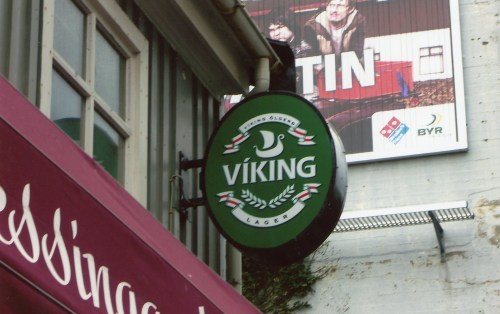
Iceland is not only technology savvy and cutting edge, they also like to have style.  We found many hip boutiques with relatively reasonable prices for pret-a-porter clothing in downtown Reykjavik.  Here is a shop focused on stockings:

As I mentioned earlier, our first day there was a rarity in Iceland:  Bright blue skies and a balmy temperature of 80 degrees F—-a record high!  We found a wonderful outdoor square, sat outside and fully enjoyed our US $12/glass of wine….steep, yet we were “Lost in Iceland”.

After happy hour, you can join the all night party train in which you drink til dawn!  No joke!  There is actually a bar and club hopping expedition and tradition in which party-goers start at dusk and drink til dawn.  Since it was our first night there and we were fighting serious jet lag, I opted to go back and hit the hay.  Meanwhile, my father decided to check out the next-door rock band and drank until the wee hours of the night.  Now, who was the smartest one of all?  Me, of course!  I woke the next day, fresh as a spring chicken and ready to see Iceland while my father was nursing a bad hangover and jet lag all at once.  Ok, what kind of father is that you may wonder?  “One who likes to enjoy and experience life!” I say.

If you get the late night munchies or need to nurse your overindulgence in Viking beer, you head towards the nearest hot dog stand and get a nice big, juicy fat Icelandic wiener!

The following day was not so great.  It has clouded over and turned into the “traditional” Icelandic summer weather.  Rather dreary, cool and rainy.  But at least we had the amazing, summery day before to get our fill of Vitamin D!

Views of Tjorin, the city’s central pond which is surrounded by beautiful, traditional Icelandic homes.

The City Hall:


The rain kicked in and we were welcomed with traditional summer weather in Iceland.  The pouring rain that makes everything so incredibly, intensely green. 


Here is a photo of one of many Toyota Land Cruisers, Iceland’s favorite “truck”.  They are fascinated with big rigs and large, four-wheel SUVs are quite common, especially for those adventurous souls who like to off-road it on the glaciers and no-man’s land.

Finally, a photo of the “Settlement Museum” built in 2001 after workers excavating for a parking lot found Viking ruins dating back to 871 AD…the oldest known ruins in Reykjavik.


It was quite a couple of days in Righteous Reykjavik!  No, I did not have pickled rams’ balls or long-dead shark.  Instead, I lavishly ate a meal at an excellent Indian restaurant and another night at an Italian darling.  Both meals were outrageously expensive at the time…at least US$200 for two people, but then again, I was in Iceland, at the most northern capital city in the world.  What could one expect?!  I had found true paradise and was looking forward to the next week there exploring the fantastic, magical countryside and seeing nature in all her glory!  This was going to be a trip I’d never forget!

Stay tuned….next post will feature my trip to the “Golden Circle”, one of Iceland’s most fabulous day trips!

Iceland TRAVEL BY REGION
Myrdalsjökull Glacier

Lost in Iceland: A Day of Ice Trekking in Myrdalsjökull Glacier

Heading northeast on Iceland’s famous Ring Road instantly reminded me why I had always dreamed of visiting….

Ok…I lied.  I was initially going to write my next post about intimate, eccentric Reykjavik, a city of only 120,000 or so hearty souls, yet on a whim I changed my mind.  I took one look at my pictures from my first Icelandic adventure, ice trekking on a real, live glacier, that I felt I couldn’t contain my desire and thrill to write about this adventure first.  So, lovely, playful Reykjavik will have to wait.  Prepare yourself for a real glimpse at why Iceland is known as the land of fire and ice, and why the wild, stark dramatic beauty of this amazing country enraptures one’s heart and soul and makes any visitor immediately promise to come back again.  Hold on tight…..and hope you enjoy the ride!

The geography of Iceland is absolutely amazing.  Despite its long history of Vikings and Sagas, it is actually a geographically young country that is still forming.  It contains some of the largest glaciers in the world (glaciers cover about 10.9% of Iceland’s total landmass.  There are over 4,328 square miles of active glaciers).   Three enormous glaciers represent 11% of the entire ice mass:  Vatnajökull, Langjökull and Hofsjökull.  These glaciers are so incredibly huge, that in the winter time Icelanders get out their Land Cruisers and actually drive across them for fun!

Iceland also has over some of the most active, turbulent volcanoes in the world.  There are over 200 post-glacial volcanoes (over 30 of them have erupted since the country was settled in the 9th century AD, per Volcano Discovery (for more information, check out their volcano website.  Recent volcanic eruptions in Iceland have caused airport closings and chaos throughout Europe.  On May 25th, The mighty Grímsvötn volcano erupted and wreaked havoc, just a little over a year after the powerful eruptions of the now world-famous Eyjafjallajökull volcano.

Besides volcanoes and glaciers, Iceland also prides herself in having the richest source of hot springs and geo-thermal activity in the world.   There are steam holes, geysers, bubbling mud holes and sulphuric precipitation.  Many Icelanders are known to hike to the top of a dormant volcano, swimsuit on and towel in hand, to take a dip in the hot, natural spring pool at the top of the mountain!  There is also the infamous “Blue Lagoon”, probably one of the largest, geothermal pools in the world where Icelanders and tourists alike bathe ensemble, coated in mud masks, drink beer and watch the world go by.

Iceland’s interior is uninhabitable; it is covered with glaciers, mountains and high plateaus which makes the support of any life impossible.  Therefore, all Icelanders live along or within easy reach of the coast.   A long, curvey group of roads circles the island. Although we didn’t make it all the way around, I was amazed and surprised by how much the topography and geography change.  There are endless amounts of things to see and do in Iceland, especially for the adventurous souls, which leads me to the topic of this post:  A Day of Ice Trekking in Myrdalsjökull Glacier.

The Myrdalsjökull Glacier is the fourth largest glacier in Iceland and is located about 96 miles southeast of Reykjavik.  Several adventure outfitters take the curious, adventurous and willing traveler on a full-day trip from Reykjavik which is pricey, but in my opinion, the best way to experience Iceland’s ice in the raw.

Here are some pictures from this epic, adventurous day.  Hope you enjoy!

Setting off early morning with the tour operator who of course drives a Land Cruiser, Iceland’s favorite vehicle! I chose Icelandic Mountain Guides and they were terrific.

En route following the Ring Road northeast towards Skogar, the magical Seljalandfoss waterfall, which can be seen from the highway:

Up close and personal with the Seljalandfoss waterfall, one of Iceland’s many incredible waterfalls:

As you get close, you can hear the water roar as it tumbles down and sprays all those who stand near:

As the drive continues, the scenery never ceases to amaze me.  It is God’s Country, a land so green and so beautiful that it almost hurts your eyes.  You pass through many small towns by the sea, farms loaded with white fluffy sheep, horses and hay, and nothing but green.  It is absolutely spectacular.  The beauty is stark, raw, mystical and unique.  Iceland is like no place I’d ever seen.  It is like no place on earth.

As we approached the glacier, I was curious about when I’d first be able to see it as the size and mass of Iceland’s glaciers is literally incomprehensible.  They are that big.  Unfortunately the weather began to change.  The clouds set in like a giant blanket overhead and rain began to fall lightly across the greening grass.  We arrived at the Myrdalsjökull Glacier shortly after our visit to the waterfall, just as the rain began to change from a drizzle to a downright pour.  Thankfully I was prepared.  I packed all my Gortex watergear which would definitely come in handy as we hiked the massive Myrdalsjökull Glacier.

The tongue of the glacier…there is no way possible to show the enormity of it!

The entrance to no man’s land…..

It goes on forever….

We get on our crampons in the pouring rain and set foot onto the glacier.  I’ve never walked on crampons before and we get a brief instruction on the techniques.  I felt like a penguin, it was hilarious, but once I got used to it, it was actually quite fun and such an amazing way to see the glacier.

Here is a photo from on top of the glacier:  The terminus of the glacier ends in a tiny pool of water and a river.

We see our first 100 foot crevasse.  Wouldn’t want to fall in there!  But the colors of blues are so intensely beautiful….

The clouds and rain set in and then the wind picks up speed and it was FREEZING, WET and MISERABLE!  But we were walking on a glacier so what could one expect?

A larger crevasse….

The stark beauty of the place felt like no place on Earth….

And the ice formations were unbelievable…

The rain still is pouring and I am freezing cold…yet the thrill of walking on ice from before mankind felt surreal.

And the colors of contrast between the dirty, ancient ice juxtaposed against the verdant green fields was spectacular in itself.

After 90 minutes of walking in severe wind and rain, we headed back to the terminus of the glacier and thankfully climbed into the warm, dry bus that will take us back to town.

It was an experience I’ll never forget….to be completely lost in Iceland and wandering….”Is Anybody Out There?” (A popular quote sold on t-shirts, mugs and postcards from Iceland).  After being there, I understood what this quote was all about!

If you go:

I chose Icelandic Mountain Guides who have a ton of cool tours. Check them out here. Be sure to pack waterproof clothing and lots of warm layers! It was freezing cold out there on the ice!

Like it? PIN for later!

The Myrdalsjökull Glacier is the fourth largest glacier in Iceland and is located about 96 miles southeast of Reykjavik. Several adventure outfitters take the curious, adventurous and willing traveler on a full-day trip from Reykjavik which is pricey, but in my opinion, the best way to experience Iceland’s ice in the raw.Experience a day of ice trekking on a sea of ice! 

Iceland TRAVEL BY REGION

Absolut Iceland

I’d always wanted to go to Iceland.  As a travel wonderer at heart, Iceland was one of those mystical places that highly appealed to me.   It seemed to have it all:  Incredible nature, explosive landscape (consisting of some of the largest glaciers in the world and several active volcanoes), a small, easily accessible country, loads of active opportunities and a culturally-rich capital city. Of course I’d heard about its soaring costs (this was before the financial crisis) yet the pros definitely outweighed the cons so in early August 2008 I found myself on a non-stop flight from Minneapolis to Reykjavik along with my father to the land of fire and ice.

Over the last ten years, this once rather isolated island has become one of the hottest travel destinations in the world.  Tiny Iceland, which has a population of a little over 300,000 people and a landmass about the size of Virginia, is geologically a very young country that is still in the process of formation.   Iceland was first settled by the Vikings in the 9th century AD and shortly thereafter, established the first parliament in Pingvellir in 930 AD.   Hundreds of years of dominance and control by other Scandinavian countries such as Norway, Denmark and Sweden finally gave way to Iceland’s independence in 1918. It is often said that this violent, turbulent past similar to that of Iceland’s mighty, active volcanoes, lead Icelanders to become the highly resilient, individualistic, creative and proud people that they are famous for.   How else would they have survived?

For me, going to Iceland was a real feat.  It had nothing to do with logistics.  Fortunately I had the money, the time and the babysitting (my wonderful Mom) all lined up. Instead, it had to do with the fact that only six months earlier I had broken my left foot and spent five long, agonizing, brutal months in a boot.  For someone like me who is incredibly active (I run year-round rain, snow, sleet or shine; hike; walk; bike; golf; inline skate; and chase after my children non-stop) the news that my foot was broken was like a hammer being slammed into my heart.  I was devastated.

Ok, you may wonder how does one go about breaking their foot?  Well, this is a rather embarrassing story so I’ll try to make it short but sweet (but knowing me, that is impossible).  I was walking hand in hand with my three-year-old son across the street to the pharmacy, both of us sicker than a dog, and saw a puddle. Instinctively, I took my right arm and flung his thirty-plus-pound body over the puddle.  I obviously didn’t know my own strength and his body flew across mine, tripping me, and knocking us both down smack into the pavement….W-H-A-M.  As we fell, my left foot slammed into the edge of the sidewalk at full speed and for an instant I could not even move.  We were both crying and in the middle of a busy intersection.  Not one person stopped to help!  I couldn’t believe it!  We live in Minnesota for God’s sake,land of the infamous Minnesota Nice.

After a minute or two of being motionless on the ground, comforting my bawling son, I was finally able to stand up.  Something didn’t feel right.  My left foot killed.  I got up hesitantly, limped slowly into the pharmacy, got the cold medicine I needed and drove home.

Feeling utterly miserable with a terrible cold, I ignored the pain of my foot.  It was throbbing(yet so was my head) so I put a huge pack of frozen blueberries on it.  I peeled down my sock and examined my foot carefully.  It was in a rainbow of different shades of black, blue and yellow.  My first reaction was “Yuck”!  It looked like something on a dead person’s body.  It didn’t look good yet I was too sick to care.

I spent the next two days in bed with a terrible chest cold, still icing my foot and trying not to walk on it much.  Every time I stood up, I felt a piercing pain and it throbbed constantly.  Silly me,though, did not go to the doctor.  I had never broken a single bone in my body thus I thought it was just a bad bruise or strain.

A week later, after fully recovering from my cold I decided it was time to get back into my regular workout routine.  It was February and cold as hell but that didn’t matter.  I run year round and in fact, actually prefer running in the cold, dry air.  It calms my body and soul and is pretty much the only way I can survive the long, cold winters of Minnesota.

I got on my running shoes, bundled up in hat and gloves and set off for the lake.  To ease into it, I decided to try walking first.  I walked the first couple of blocks and it still ached. But I didn’t quit.  I had to workout.  I’m a diehard, exercise freak and running especially is a requirement for my mental health.  I need the release that running provides me.  I have too much energy and too much tension.

Despite the excruciating pain in my foot, I would not quit.   I continued to walk in the bitter cold and gray skies until about twenty minutes later I had to turn around.  The pain was worse and becoming intense.  Something was not right.  I limped the next mile home, iced my foot some more yet still did not go to the doctor (yep I know stubborn and stupid).

Finally, over two weeks after the sidewalk tripping incident, I finally decided to load my two kids into the car and head over to the doctor.   The doctor, who also happens to focus on sports medicine and injuries, ran an x-ray of my foot and came in with the grim news.  I had a four inch fracture running across one of the major bones on left edge of my foot.  He couldn’t even believe I made it so far without coming to the doctor and confirmed that I must really be able to withstand pain.  Yeah, right!  He didn’t know about my almost immediate epidural at the very onset of labor with my two children.

I was quickly “booted up” in a knee-length black boot, given a pair of crutches and the contact information for a foot specialist where I would get further x-rays and consultation. What? I thought in fear.  How on earth was I going to drive home in a stick-shift car, wearing a boot and using crutches with two young kids, one of them only a little over a year old and hardly walking!

I saw the specialist the next day and the news was bad.  My foot was indeed broken and I would have to be on crutches for a minimum of two weeks and another six weeks in a boot.  I was heartbroken and stressed out as my daughter Sophia still slept in a crib and needed assistance with everything,and my son Max was an active, high-energy three-year-old who was always on the go.  There was no way I could care for the children on my own while my husband was at work so in came my in-laws, who drove the fifteen hours straight from Virginia to help me manage.

After six weeks in a boot, I returned to the foot specialist hopeful that this would be the end, however, secretly I knew my foot stillthrobbed and ached and that it probably was not healed.  This song and dance continued for another four long, brutal months, as spring slowly moved into the long-awaited Minnesota summer and I was becoming more and more desperate and depressed.  Every time I went back to the doctor and she brought in the x-ray, I knew the bad news…it had not quite healed.  I was always filled with tears.  What was supposed to take six weeks to heal ended up taking me five months, through the heart and soul of summer with two young kids running up and down the sidewalk and me, slowly gimping after them suited up in a knee-length boot.  I could hardly go to the park, could not go to the beach or pool and was getting more and more depressed about the situation because outdoor activity is my lifeblood.  After a long, cold winter I had missed almost the entire summer being confined to a boot and could not enjoy running, walking, biking, skating, swimming or any of those other joys of a Minnesota summer.

As the heat of summer intensified and the Iceland trip approached, I began to worry that I would not be able to go.  I had earlier gone on a trip to Virginia to visit my in-laws and could hardly walk the length of the airport.  If I was instructed to only walk a couple of blocks at a time, how on earth would I be able to travel to Iceland and hike for days on end?

I got fitted to another boot, an air-boot, that was lighter weight and not so hot.  That helped the situation a little.  Then, a few weeks later, I got a “sandal” cast which allowed me to actually go in the water at the pool.  About two weeks before I was to leave for Iceland, I finally received the much-anticipated news that finally, after five long months, the break had healed and I was a free woman!

The first week of August, I was off to Iceland hoping I’d be in good enough shape to do some of the dreamy hiking and exploration.   Miraculously, I proved that I did not lose as much stamina as I had anticipated.  I only lost a little bit of my soul.  Fortunately this would soon be restored once I landed in Iceland and was surrounded by immense nature and beauty, and a love of life once again as I could move freely about, on my own two feet.  What a blessing it is to walk and be free! J

Stay tuned….next post will be on culturally divine Reykjavik.

Iceland TRAVEL BY REGION

Update on Hands in Nepal fundraising efforts

Rural village in the Annapurna range taken from my recent trip to Nepal in October-November 2010.  (For more photos and stories on my trip to Nepal, please refer to older posts located under “Nepal”).

Hello Readers!

As some of you are aware, I’ve been actively fundraising over the last two months to try to raise money to help a fabulous grass-roots NGO called HANDS IN NEPAL (www.handsinnepal.org) build a new school in rural Nepal.  A recent trip to the Annapurnas back in late October/early November struck a cord in my heart and made me realize how impoverished these wonderfully, peaceful and loving villagers are.  Over 80% of Nepalis live in rural areas that have little or no access to education.  I believe strongly that education is the key to a better future and a better life. Thus, I have worked hard over the last year or so finding NGOs that work in education and help to improve the accessibility of education and learning to the masses, especially in poor, third-world countries.

I’m pleased to say that over the last two months I’ve been able to raise over $1,000 for HANDS IN NEPAL mainly through the sales of hand-made pashmina scarves, yak-hair blankets (made in Tibet) and other local Nepali products.   To me, it feels like a win-win situation as I’m able to offer beautiful products to my friends and family that are made directly in Nepal (and Tibet for the blankets) and donate all the funds directly to Hands in Nepal.  After two weeks hiking from village to village through the Annapurnas, I saw firsthand how hard these women work to sell their beautiful, handicrafted products.  They would be sitting there all day long, some of them not much older than twenty selling their handwoven scarfes, blankets, hats and gloves all for the mere price of two US dollars a piece!  For us, it is less than a cup of Starbucks coffee but for them, it is a day’s living (as the average salary in rural Nepal is less than $2/day).

As someone who has been so incredibly fortunate to have traveled to these amazing places, I feel like it is a requirement to give back to the community.  Hence, I contacted Hands in Nepal and have worked with them ever since on trying to raise the necessary funds to help build new schools.

Per Hands in Nepal, here are some amazing facts on what our money can help build or buy:

$20 = Cost of Student Annual Supplies

$50 = Chalkboard and Teacher Supplies

$600 = One-year Teacher Salary

$1500 = One year Boarding School Scholarship for one orphan

$6,000 – $8,000 = New construction of a four room schoolhouse

Thus, it is amazing to me what a long way our money can go in such a poor country!

Last night I held my fourth fundraising event, a wine and cheese party at my home where I told the story of HANDS IN NEPAL and offered a select collection of Nepali products for sale, all in the name of charity.  It was such a wonderful feeling of accomplishment to hit over the $1,000 mark! It felt so good….like nothing I’d ever experienced in corporate America (I was in sales for many years).

There is something so special and magical about giving back that just makes me feel complete and my hope is that I can eventually reach the $8,000 mark to build a new school in rural Nepal and have a lasting impact on an entire village and generation of people.  It will take time of course to raise the money but with the help of my friends, family and children as well I plan to achieve it!

To learn more about Hands in Nepal, please visit:  www.handsinnepal.org

Some exciting news is that Hands in Nepal’s founder Danny Chaffin’s mother Jan is headed to Nepal this weekend to see if she can start up small sewing co’ops for the women.  Many rural Nepali women are forced into prostitution as there is no other way out.  Human trafficing is a huge deal in Nepal and Jan is hoping to start up another NGO to help these women and give them more options and hopefully a better life!

Global Issues Nepal Poverty SOCIAL GOOD TRAVEL BY REGION Volunteering Abroad

A couple days in Jo’burg

Jo’burg as she is lovingly called by locals (also Jozi, Egoli or Gauteng (the two latter terms both meaning “place of gold”) has a turbulent past which greatly mirrors the struggle and eventual overcoming of the long history of apartheid.  Although the history of modern Johannesburg is roughly only a little over 100 years old, the surrounding area of Jo’burg has a much longer past.  Often known as the “cradle of civilization”, the valley outside of Johannesburg has become a World Heritage Site and is an important paleontological site due to the discovery in 1947 of “Mrs. Ples”, the first known adult cranium of an “ape man” dating back 2.5 million years ago.

The area today which is known as Johannesburg or Jo’burg was an un-established nomadic land for thousands and thousands of years.  It could have perhaps remained that way if it was not for the discovery of gold by George Harrison, an Australian prospector, who happened to stumble upon one of the richest gold mines in the world back in 1886.  Within three short years, the land that would become Johannesburg was built on with rapid, quick-fire speed and greed by other local entrepreneurs such as Cecil Rhodes, a rich owner of nearby diamond mines who provided the cash and the power to take full advantage of the gold rush.

In order to mine the gold as fast as possible, cheap, slave labor was needed in a hurry so poor blacks from throughout South Africa came to the once deserted bushveld plains and went to work under brutal labor conditions.

Within three years, the previously low inhabited area which would become Johannesburg sprang up as the third largest city in all of South Africa, and it didn’t take much longer for Jo’burg to become one of the largest cities south of Cairo.

The years that followed were loaded with strife and conflict.  There was too much fortune at stake.  The Anglo-Boer War of 1899-1901 lead to South Africa being under British control and rule.  As the population of Johannesburg expanded, the British colonial rule decided to begin forcibly relocating the black population from the central city to the rift-raft outskirts of town.  This began the long, tragic movement towards apartheid in which blacks and whites were kept completely separate (see earlier post titled “The Rainbow Nation” for more information on the period of apartheid in South Africa).

Obviously the effects of apartheid eventually lead to a series of revolts and protests as the city’s black population (which were and still remain by far the majority) began demanding their rights and an end to this madness, tyranny and deprivation.  The “Rand Revolt” of 1922 lead to over 200 deaths, and protests and strikes remained common.

More problems arose as more blacks were brought into the city center during the time leading up to and after the Second World War.  Although black movements began to rise and form at this time, they were shortly squashed by the powerful government who wanted to repress them.  Hence began the policy of apartheid and the gradual relocation of blacks from Jo’burg to townships on the outskirts of the city.

The turning point in South Africa’s long history of apartheid and discrimination occurred on June 16, 1976 when South African police open fired on a student protest in the black township of Soweto (a name derived from South West Townships).  This created a series of violent protests throughout South Africa in the 1980s, which lead to the eventual dismantling of apartheid (in early 1990) and the first ever democratic elections in 1994.  Finally, the brutal system of segregation and deprivation was destroyed and blacks and white could begin living together peacefully and humanely.

Over time, blacks have begun moving back into previously white-only districts and some of the townships have been vacated.  However, one of the largest black townships, Soweto, remains a vibrant place of black history and life today and has a population of over 1,000 residents.

Jo’burg today is a cosmopolitan city yet voluntary segregation remains strong.  The white population has mostly retreated to the rich suburbs living in gated, secured communities while the center of town is predominantly black and exceedingly dangerous.  (We were not allowed to visit the city center without a black guide and decided not to visit since there really was nothing worthwhile to see).  Crime is rampant and people unfortunately live in a culture of fear.  Hopefully as the economic and educational opportunities improve among poor blacks, the crime will decrease.

Overall, I found it a sad testament of the negative, long-lasting effects of apartheid and a system of hate. I didn’t much care for my visit to Jo’burg because I felt like staying in the rich, gated suburbs was not really being there.  It was a tragic representation of the ill-effects of segregation and the resulting immense poverty and crime of the city.

Anyway, since most tourists will be obligated to spend at least a day or so in Jo’burg via transit, here are some photos and information on the sites we felt were worth visiting.

This is all we saw of downtown Johannesburg. It is not a safe place to visit unaccompanied. What a pity!

We stayed in the Northern Suburbs in Sandton, a wealthy enclave of gated houses, buildings, offices and shopping malls.  Unfortunately the general decay and violence of the city center has lead to a mass exodus of mostly weathy whites and businesses to leave Jo’Burg and move out to the safer yet boring suburbs.  Here is a photo our hotel area:

Photo of the barbed wire gates surrounding our hotel and literally every single home in sight.  What a crime to have to live in this kind of fear and isolation!

One of the many large, luxury malls called Sandton Square, located under the luxurious Michelangelo Hotel:

Our hotel, located nearby the Sandton Mall, the only option for dining and nightlife and a short walk away:

Inside the Sandton mall where everything is clean, expensive and white.  They are gearing up for the Christmas season hence all the decorations.

The mall even displays art!

The outdoor courtyard of the enclosed mall contains loads of fancy restaurants and even live music.  Here is the place we ate dinner at.  Nothing too exciting but it was decent.

Next morning, we had a hired guide and drove out to visit Soweto, South Africa’s Original Township.  Immediately the fancy cars, luxurious hotels and homes disappeared and we were for once the minority.

Here we are passing some slums en route to Soweto.  This is how most people live.

Inside Soweto on our tour of some of the nicer neighborhoods.  Soweto was built on farmland located 11 miles southwest of Johanneburg to house the blacks working in the gold mines in Jo’burg. The conditions were deplorable as it often took the workers over three hours to get to work each day.  In those days, there was no running water, no electricity, no shops and no roads.  The living situation became unbearable in 1933 when the government declared the “Slums Clearance Act” and forcibly moved blacks off their land, out of the city center and into the townships.

Although parts of Soweto are nice today, there still remains a high level of violence and poverty in this area.  It is definitely a worthwhile place to visit as there is an excellent Apartheid museum and the history of the place surrounds you.

Here is a photo of one of the most famous victims of the 1976 Soweto march Hector Pieterson.  The photo is at the entrance of the Museum dedicated to the history and struggle of Apartheid in Soweto.  The pain is ever so present and captured in their eyes.

Stay tuned….This is my last post on South Africa.  It was wonderful to write and remember such a fantastic, culturally stimulating trip!  My next posts will be on another gem….Iceland!  Stay posted!

South Africa TRAVEL BY REGION

Into the Wild: My First Safari Part III

The second night at Tanda Tula we were in for quite a surprise and adventure.  Clinton, our fun-loving ranger told us that we were going to go on a night safari.  First, we were to meet the happy-go-lucky always smiling bartender “Smiling” in the bar at promptly six o’clock where we were to pick out our preferred drink for cocktail hour in the midst of the wild.  Yes, you heard it right.  We were going to have happy hour right out in the middle of the game reserve!

Next, we followed Clinton obediently to the bar, picked out our drinks which were loaded into an ice-cold cooler and placed aboard the land cruiser.  Then we were off into the night filled with half-excitement half-fear.

As the sun was beginning to set:

It was time to pull over for cocktails and h’ors-d’oeuvres right smack in the middle of the game reserve.  Here is a photo of Clinton, our ranger, and our tracker setting up shop:

There were plenty of cold beverages.  We were even asked before setting out what we would prefer to drink and Smiling, our bartender, loaded up the cooler with the drink of our choice.  For me, it was my beloved South African Sav Blanc, definitely one of my favorites:

For my dad, he preferred an ice-cold beer as it was a hot and sticky day still.  My Dad and I enjoying our drinks in a land full of wonder:

After a nice buzz, the real adventure starts….our night tracking of the two dominant male lions in the reserve.  Here we caught up with them and followed them around, silently watching their every move and prowl:

Here we are playing follow the leader:

We followed the lions around for an hour, watching them pace and guard their environment.  It was a pretty amazing experience!

The next night, we were in for an even bigger surprise.  Around dinner time, we were all told to meet at the reception area and then instructed to board the land cruisers.  Where were we going?  I wondered.  They didn’t ask for a drink preference this time so it wasn’t for happy hour nor did they mention that we were going on a night safari.  Instead, it was total silence and suspense.

We drove into the thick of the game reserve, in pitch black darkness.  Everything was still in the park. There were no animals.  No noises.  Just the sound of the land cruiser leading us somewhere into the dark night.

Then, we saw it.  A light.  What was it?  As we came closer, we realized the light was coming from a circle enclosure of torches.   The flames of the fires spiralled peacefully in the light wind.  We got off the land cruiser, followed Clinton and were cheerfully greeted by the entire staff at Tanda Tula with a welcoming drink and an enormous bonfire.  Then we saw it….the huge, long table for twenty placed strategically in the middle of the circle, next to the fire where we were going to have a feast of a lifetime smack in the middle of the game reserve!  I couldn’t believe my eyes!  What a spectacular surprise!  We drank, dined and drank some more for over two hours, never once (well ok, maybe a few times) feeling the least bit concerned we would be attacked by wild animals or hungry lions who wanted to join the feast.  There were armed guards at each corner of the makeshift camp, armed with tranquilizers just in case any animals decided to crash our party.

It was a night I’ll never forget.  It was an unbelievable experience!  I woke up the next day with a headache so big I thought I’d been run over by a herd of elephants but it was worth every minute of the misery for a night of eating and drinking under the stars and into the wild!

Stay tuned….My last post on South Africa will include a two-day visit to Jo’berg where we visited Soweto and saw a completely different side and perspective on South Africa.  One of clear and total segregation. 

Adventure Travel South Africa TRAVEL TRAVEL BY REGION

Into the Wild: My First Safari Part II

I awoke the next morning to the 5 AM call of the wild.  The sun was barely up yet the jungle outside my tent was fully awake and alive.  The monkeys were in their full glory, active as a toddler at a playground.  I was exhausted but excited about the day that awaited.  It was day one of my first safari and I could hardly wait.

There was a slight tap on my door and I opened it to find Smiling, smiling as usual and holding a tray with a beautiful light breakfast of morning tea, fresh scones and fruit.  I opted to eat on the verandah but of course I was forewarned not to leave my food for even a second.  The swarms of monkeys playing jubilantly in the trees above would devour it all in a heartbeat.

By 6 am, our group of six met at the main lodge and we boarded the open air land rover.  We had our ranger Clinton, a native African tracker and a driver on board as well.  I could hardly contain my excitement and anticipation at finally after all these years actually going on a real live safari.  I had to pinch myself to make sure it was really real.

One of the lovely things about opting for a private reserve is the transportation.  In public game reserves such as Kruger National Park, you must follow and stay on the roads in your car.  However, at a private game reserve you roam in an open-air, uncovered land cruiser and can go where ever you want, without having to stick to the roads!   Here we are, setting off on our first safari drive with the animal tracker at the front and the ranger (with loaded gun just in case) on the right side, driving the vehicle.

Excitement and anticipation awaits us (and a little bit of nervousness as we are fully exposed!).  Not long after setting out, we are rewarded with the spotting of our first animal, a lovely giraffe grazing off the treetops:

Next came the gazelles (I was desperately hoping we wouldn’t see our first kill.  I wasn’t sure whether or not I could handle it even though it’s nature.  I’m a true softie at heart and also do not like the sight of blood):

Shortly after we encountered our first elephant.  Little did we know, an entire herd of 20-30 elephants were right around the corner waiting:

I was surprised how incredibly close we were able to get to the animals.  It was quite a thrill and also a little intimidating to be sitting right next to an enormous elephant with no protection.  According to our ranger, we were to remain motionless in the open-top rover.  If we remained still, the animals would view us as a large mass and would not charge us or be afraid.  In the event something went array, the ranger always carried a loaded gun with tranquilizers.  However, the animals although wild were used to having tourists come and basically ignored us.

Here is another view of the mighty elephant.

I could not get enough pictures of the elephants.  I was completely enthralled by their majestic beauty and peacefulness.

A lone elephant who at first was uninterested….

Yet then his or her curiosity got the best and we got up close and personal with this mighty creature:

As we rounded the corner, we were surrounded by a herd of 20-30 elephants, big and small.  I fell in love with the mama and her baby:

Can I take you home?

Now I know why they called him Dumbo:

As we rounded the corner and ventured further into the park, we came across a herd of zebras:

We spent some time chasing the elusive leopard and finally found him up in his favorite spot, a tree.  Unfortunately once we approached he was gone before I was able to snap a photo.

Then in the heart of the game reserve, we found the Lion King and the pride.  By that point, I was getting used to being in an open-air vehicle but I was glad that the ranger was ready in case of any attack!

Here he is, the King of the Jungle (note how close the other rover is):

Here is a better shot (he is hanging out right next to the rustic, small airstrip for those adventurous souls who prefer to land right inside the reserve):

The Lion King:

Isn’t he cuddly and cute?

He has such a beautiful mane!

The female of the pride…she looks so sweet….but:

She can definitely bite!

The pride:

The pride with the male:

One of the kids playing around with big,old dad:

Look who decided to show up…a hyena….very mean and dangerous.  We were hoping there would not be a fight…

After all the excitement, we decided to get out in the middle of the game reserve and WALK BACK to our lodging….

(Notice how Clinton, our ranger, had an armed gun just in case we were attacked by a herd of elephants or worse yet, a lion).

My heart was beating like an African drum and I definitely didn’t want to be at the end of the line and first on the lunch list.  I was thankful yet slightly disappointed we did not encounter any wild animals on our hour walk back!  Phew!!!

Stay tuned…next post will include our surprise night safari tracking the two dominant male lions, an outdoor feast in the middle of the park and cocktails au naturale!

Adventure Travel South Africa TRAVEL TRAVEL BY REGION

Into the Wild: My First Safari Part I

Our package deal from South African Airlines included a three-day stay and safari at the Tanda Tula Private Game Reserve located in the northeast section of South Africa adjacent to the world-famous Kruger National Park.  Tanda Tula was one of the first luxury private reserve camps established in the area and prides itself in giving the visitor beautifully appointed African safari styled “tents” in a gorgeous reserve with no boundaries and no fences.

During our three-day stay at Tanda Tula, we would be going on an early morning safari ride, a late afternoon one and a surprise evening safari where we would be tracking the two dominant male lions in the reserve.  We were also surprised with a candlelight dinner IN THE WILD….yes that is right.  We ate an enormous feast right smack in the middle of the game reserve, while the rangers stood by on the watch.

We took the morning flight out of Cape Town non-stop to Hoedspruit, one of three airports located near the Kruger National Park.  Here are some photos of my first day into the wild.

Boarding the plane to Hoedspruit Eastgate Airport:

View from the plane of the Southern Cape:

Small, clean airport in Hoedspruit, one of three airports in the vicinity of Kruger National Park:

After collecting our luggage, we were met by our driver from Tanda Tula Private Game Reserve in the Timbavati Reserve adjacent to Kruger National Park.   Our two-hour van ride was like nothing I’d ever experienced (at this point, I had not been to India or Nepal thus passing through the African villages felt like being on a movie set).  There was village after village located right next to the roadway filled with Africans in traditional dress and women walking along the side of the street carrying their goods on their heads and children wrapped around them in brightly colored fabrics.   Men and children were loaded into the backs of trucks and there was no sign of anything remotely modern.  I desperately wanted to take some photos along the way but held back thinking that not the proper thing to do.  Our van was the nicest vehicle for miles so getting out of the car to snap some photos would be extremely rude!

As we approached the numerous private game reserves, the roads became more modern and the villages disappeared.  Here is a view not far from the entrance of Tanda Tula Game Reserve:

Arrival at Tanda Tula Game Reserve.  Tanda Tula which means “to love the quiet”:

Checking out the surroundings….there are NO FENCES!  Yes that is correct.  One of the beauties of visiting a private reserve is that you are literally in the wild.  The entire base “camp” is without fences or boundaries meaning the animals are free to roam wherever they please.  You must take extreme caution, especially at night.  No one is allowed out of their tent once darkness hits as elephants, lions and leopards have been known to invade the campsite.  There is always a ranger on alert just in case a herd of 20-30 elephants decides to trample through your camp!

Here is a picture of the most annoying, yet charming friend….the neighboring monkeys that live in the trees surrounding the “tents”.  You better watch your breakfast when eating on the outdoor verrandah….or it will be gone!

Ok….drum roll please….here is a picture of our “tents”.  Yep, these are our luxurious tents.  There are eight in total and apparently they run for about $1000 a night if you were to show up and rent one.  Our incredibly, amazing package deal from South African Airlines (remember $1800 for our Atlanta-Jo’berg flight, two other internal flights and lodging in three places including here!) must have really been getting a steal on this part of the deal.  When we arrived at Tanda Tula and checked in, my dad mentioned that I was his daughter, not his wife (they had us originally in one “tent” and it only has one bed, not two like we requested), their simple response was “no worries” you can stay in the tent next door at no charge.  Can you believe it?  I got a $1000/night tent for free!  Wow!!!!!

The inside view.  Note the minimalistic structure.  It is sturdy yet not too enclosed so there is no avoiding the sounds of the wild.  My first night sleeping alone was a little scary as I would jump at every noise and it took me awhile to finally fall asleep to the bizarre, dramatic sounds of the wild.

Plus your own private bath tub and bathroom which includes an OUTDOOR shower, right in the thick of things.  It felt a little strange actually taking a shower that first night as dusk settled in and the animals began to make noise.  Plus there were more bugs than I’d ever seen but this was so cool!

Tanda Tula has beautiful, lush grounds and even a pool in case you are interested in taking a dip (it gets quite hot there in the afternoon).

Every meal is prepared from scratch and contains a delightful selection of South Africa’s finest.  Our meals were eaten on the large, open-air dining hall which afforded views of the game reserve and if lucky, a curious giraffe or two.

Here is a photo of our first dinner, a delicious, spoiling buffet:

Me and the friendly bartender, known as “smiling” because he ALWAYS smiles!

View from the open-air verandah into THE WILD…..

I wondered what on earth was out there?  Would it come near the camp or even scarier, my tent while I am alone, tucked away under the luxurious white covers?  Those thoughts swirled around my head as I turned off the lights, closed my eyes and listened to the call of the wild.  Nature at it’s finest.

Stay tuned….next post will be of my first 5 am safari!  (And yes….I saw lots and lots of wild animals!)

Adventure Travel South Africa TRAVEL TRAVEL BY REGION

The Southern Cape: A Wine Lovers Paradise

With an ideal, temperate, Mediterranean climate full of sunshine, adequate rain and fertile, unspoiled land, the Southern tip of South Africa has a long 300-year-old tradition and history of creating fabulous wines.   Just like the immense diversity of South Africa’s people, the Rainbow Nation also produces some of the most exciting, diverse wines in the world.  The Southern Cape in particular is one of the great wine capitals of the world, home to over 800 wineries not a far drive away from Cape Town.

There are 13 designated wine routes comprising the Winelands area of South Africa (the most popular include Stellenbosch, Paarl, Franschhoek, and Somerset West).  A true wine lover could spend weeks exloring the many beautiful estates and vine-covered rolling hills.  Unfortunately, I only had one afternoon.   But a few hours in South Africa’s wineland convinced me that the wines are delicious, the scenary is magnificent and I would love to come back!

Here are some photos of my afternoon exploring the wineyards of the Southern Cape.  Hope it makes you thirsty for more! 🙂

Drive from Cape Town to nearby Wine Country.  Stellenbosch is only a mere 46k/29 miles away!

Stop for a liquid lunch in lovely, charming Stellenbosch. Stellenbosch is primarily a university town with a relaxed, carefree attitude and tons of fantastic outdoor cafes.  The primary beauty of Stellenbosch is its vast display of Colonial Dutch architecture; arguably some of the oldest in South Africa.  Stellenbosch was founded in 1679 by Governor Simon van der Stel who founded one of the best vineyards in the Cape, Groot Constantia and also planted hundreds of  oak trees making the city informally known as the “city of oaks”.

Gorgeous Dutch Colonial architecture:

Sensational purple flowered jacaranda trees in full bloom:

Checking out the options for lunch.  Way too many delightful ones to choose from!

Me, enjoying a fabulous lunch of course with an excellent bottle of local Sav Blanc—what could be better than this?

Drive to Seidelberg Wine Estate:

The wine line-up at Seidelberg Wine Estate

The gorgeous grounds of the Seidelberg Vineyard….I could live here!

The lush vineyards coating the hillside….I could smell the fragrant wines inside my head.

A bench with a view (and incredible wine):

For more information on South Africa’s wine country, here is a great site: Vineyard Varieties, which gives the historical background of the wines of the Southern Cape:  http://www.vineyardvarieties.com/vineyard-variety-wines/history-of-south-african-wine/

Stay tuned….next stop is at the heart of South Africa’s Big Game…my first visit to a game reserve and a safari of a lifetime!

Note about photos in this post:  All these pictures from my South Africa trip are over 7 years old.  It is amazing to see the difference that seven years can make in technology!  Most of these pictures are from my first digital camera.  If you compare these photos with the quality of my more recent ones from my trips to Nepal and Morocco, the difference is astounding!  Thank goodness for modern technology!  I’ve also had to scan a few of the photos in as I took them with my other camera at the time.  This explains the grainy quality.  I felt it was more important to “show” all of South Africa even if some of the pictures weren’t the best quality.   Hope you enjoy!

South Africa TRAVEL BY REGION