In September 2017, I had the honor of attending the White House Summit for Study Abroad and Global Citizenship, a two-day event co-hosted by Hostelling International USA (HI USA) and Partners of the Americas held in New York City at HI USA. The goal of the conference was to inspire a new generation to study abroad and experience the transformational power of travel. During the conference we learned about the abundance of funding options and scholarships available for students interested in studying abroad during college and beyond by various organizations. I had studied abroad myself in my early twenties and that experience profoundly changed my life. However, I understand how lucky I was to have that opportunity as not many people do.
The good news is that many organizations such as HI USA are working to help young Americans get out and explore the world. HI USA, a nonprofit, member organization founded on an enduring belief in the power of travel to foster a deeper understanding of people, places, and the world around has a wealth of programs and opportunities available to make it easier for young people to see the world. One amazing program currently being offered by HI USA, the nation’s leading hostel brand, is the Explore the World Scholarship which is now open to applications until March 2, 2019.
Explore the World Scholarships
HI USA created the Explore the World Travel Scholarships to help young adults aged 18-30 finance an international service or educational trip abroad. The total award given is $2,000 (split into two equal installments of $1,000) to go towards an international travel opportunity.
This is the fourth year of the program and in 2018, HI USA awarded 104 scholarships to young people across the U.S. so they could go learn Arabic in Jordan, volunteer in India and Vietnam, teach math in the Dominican Republic, or board a plane for the very first time to study abroad in Europe. Scholarship recipients have returned home from their travels with a profound sense of intercultural appreciation, and a renewed dedication to spreading the word about travel and tolerance at home.
In 2019, HI USA will be giving out 110 scholarships to would-be travelers around the country, aged 18-30, who need a little extra help along the way.
Program Eligibility
The basic program requirements and eligibility to apply for the Explore the World Scholarships include the following:
Must be 18-30, with financial need, and live or go to school in one of 14 metro areas (select counties in CA, DC/Baltimore, Chicago, New Orleans, Boston, Minneapolis/St. Paul, New York City, Portland, Austin, Houston and Richmond).
Should have an educational or service trip already in mind but cost is getting in the way.
Application deadline is March 2, 2019.
More details on eligibility can be found at www.hiusa.org/travel-scholarships .Check out the Explore the World Program Details section for further information about the eligibility requirements, application process, and program requirements.
Success Stories of Past Recipients
In today’s interconnected world, understanding other cultures and making connections is critical to promoting world peace, stability and a happier planet for all. Traveling has a profound impact on both the traveler and the people they meet along the way. Traveling opens your mind and your heart to differences. It fuels your curiosity and passion for other cultures and places. It helps you understand the world and puts your own identity in perspective. But most of all, it builds connections and fuels your desire to become a global citizen and lifelong explorer.
Here is what a four past recipients of Explore the World Scholarships have to say about their own experiences.
The month of January is Human Trafficking Awareness Month. Per Polaris, a global leader in the fight to end modern-day slavery, human trafficking is “the business of stealing freedom for profit. In some cases, traffickers trick, defraud or physically force victims into providing commercial sex. In others, victims are lied to, assaulted, threatened or manipulated into working under inhumane, illegal or otherwise unacceptable conditions. It is a multi-billion dollar criminal industry that denies freedom to 24.9 million people around the world”.
As non-profit organizations, governments and business around the world work to spread awareness and fight this hidden epidemic, we as consumers can use our purchasing power to make a difference and change lives. Per Jane Mosbacher Morris (Founder and CEO of To the Market, a social enterprise that connects business and consumers to ethically made products around the world), the retail market is a massive force in the U.S. economy – a $2.6 trillion industry – meaning retail purchases can be powerful tools for social change. Consumers now have the power to make a huge difference on such social issues as fighting poverty, climate change, human trafficking, and sending girls around the world to school. This was the inspiration behind Jane founding To The Market: To economically empower vulnerable communities around the world by hiring them to make the kinds of products people buy every day, harnessing the purchasing power of people and businesses to address social issues. (1)
In honor of Human Trafficking Awareness month, I have compiled a list of my favorite for-profit and non-profit companies working hard to fight human trafficking. A purchase from any of these organizations goes to help victims of human trafficking to not only find an escape but find a future.
To The Market
TO THE MARKET | Survivor-made Goods (TTM) combines the powers of commerce and storytelling to empower the world’s most courageous survivor populations, in the belief that resilience is more powerful than suffering. TTM showcases handmade goods made exclusively by proud and passionate artisans who have overcome the perils of abuse, conflict, and disease. By assisting local partners around the world in bringing these goods “to the market,” we take an active role in equipping the survivor’s they employ with economic independence, while raising awareness of the challenges that they face. www.tothemarket.com
MOTA Makeup Bag Set – Navy Floral. $39 made from recycled Saris
To the Market: Sammana Tote With Leather Straps. $36.50. Recycled saris are re-imagined and hand-stitched in the kantha style by a woman impacted by human trafficking and the commercial sex trade. Every product is “signed” by the artisan, the hero of her own story.
Maroon Kimono: Our handcrafted goods are made by women and girls who have survived or evaded sex trafficking in northern India. These women are now living as artisans, creators and artists with sustainable careers, as well as education and medical care that’s supported by your purchase. Price $40
Purpose Jewelry
Purpose is the brand under International Sanctuary, which is a nonprofit whose mission is to empower people escaping trafficking to embrace their true identity and worth. Purpose Jewelry provides freedom from slavery for young women around the world. Each piece of jewelry is beautifully crafted by young women rescued from human trafficking and by purchasing with Purpose, you are providing freedom, dignity and hope for these amazing artisans.
To raise awareness and combat human trafficking, Purpose Jewelry is offering two limited-edition Human Trafficking Awareness Month bracelets. 100% of the proceeds go to support survivors their artisans at International Sanctuary.
Gently pushing off the southern Pacific coast of Costa Rica lies the beautifully pristine Osa Peninsula, a magical paradise of untouched primitive rain forests, deserted beaches and rural communities relatively hidden to mainstream tourism. Known for its conservation efforts and robust ecotourism industry, the Osa Peninsula is one of the most biologically diverse places on the planet with over 2.5% of the world’s biodiversity in less than one millionth of the Earth’s surface area.
With utterly jaw-dropping beauty, immense expanses of virgin rainforest and parts of lush green jungle that literally look like it is dropping into the celestial blue sea, the Osa Peninsula is my favorite part of Costa Rica. What I love best about the Osa Peninsula is it is still a bit of an undiscovered jewel. Despite a handful of small towns sprinkled throughout the peninsula, the majority of the Osa is uninhabited and undeveloped. Even the airports are simply plain old landing strips in the middle of a field or jungle. Its lack of development and its immense bounty of undisturbed nature and wildlife make it the ideal part of Costa Rica to experience pura vida, the pure life.
Why go
While many travelers chose to visit the more popular parts of Costa Rica such as the endless beaches of the Guanacaste, the precious yet touristy Manuel Antonio National Park in the Central Pacific Coast or the cloud forests or Arenal volcano of the Northern Zone, a visit to Costa Rica’s Osa Peninsula will be sure to be an experience not like any other.
Where else can you be rewarded with the opportunity to immerse yourself with the local life, culture and extraordinary nature in one of the most magical, biodiverse places on earth? The pure remoteness of the Osa Peninsula works to keep the hordes of tourists away which is an added bonus. If you want the pure, real deal then go to the Osa Peninsula. It is sadly the last frontier of Costa Rica and hopefully it will stay that way.
Some of the unique things you can do in the Osa Peninsula include bathing in jungle swimming holes and waterfalls, birdwatching in a private lagoon, spending a night in a locally run guesthouse that is only reachable by foot, eating home-cooked Tico cuisine, all while supporting the local community. A highlight of any visit to the Osa Peninsula includes a day or more at the Corcovado National Park where you can see scarlet macaws, monkeys, sloths, tapirs and for those lucky few, an endangered jaguar. You can also spend a day dolphin and whale watching or diving and snorkeling off Isla de Caño or go for a sunset horseback ride on the rarely visited Playa San Josecito. The options are endless and after few days in the Osa Peninsula you will be wishing you had more.
The Osa Peninsula is idea for nature lovers, adventure lovers, families and couples, and especially those who are interested in supporting sustainable tourism. However, be prepared. The Osa Peninsula is still like the Outback and getting there and around requires a test of patience and some white-knuckle driving. Many places are only reachable on foot, on ATV or by boat. For those who love adventure, this is the place for you!
In 2010, I went on a life-changing trip to Nepal with my father to hike the Annapurna trek in the Himalayas. Despite having traveled quite a bit, there was something truly magical and mind-blowing about Nepal. I had never experienced anything quite like it before. The chaotic mix of utter poverty and lack of infrastructure juxtaposed against the beauty of the Himalayas, the people and the culture truly touched my soul.
As we trekked through one beautiful remote village after another, I began to wonder how could it be that in this tiny, mountainous country where over 80% of its people live in remote villages like the ones we’d seen, that many people have little or no access to education. I learned that only half of Nepalese women over age 15 know how to read and write and many people are barely making ends meet to survive.
I’d always taken education for granted and it stunned me to realize that so many people in Nepal and around the world didn’t even have the choice to go to school. I also took safe drinking water, proper sanitation, electricity, health care, a warm stable home and access to medical care and employment for granted as well. I had been living in a bubble, and from that point on was determined to change my life and figure out a way to give back, and thankfully I did.
As a stay-at-home mother of two young children, my trip to Nepal reawakened a strong desire to become a writer and do good. I returned home and immediately started my travel and social good blog, Thirdeyemom, and also began building my work as a humanitarian by raising money and telling the stories of the progress being made by amazing non-profit and social good enterprises around the world.
As we were leaving Nepal, Rajan Simkahada, the owner ofEarthbound Expeditions, our trekking company, gave me his card and mentioned some of the social work he was involved with in Nepal. On the back of the card was HANDS in Nepal, a small grassroots, non-profit organization based in California working to bring education to women and children in remote, rural areas of the Himalayas. As soon as I got home, I contacted them. I worked with the founder Danny’s mother, Jan Sprague, for almost a year helping raise money for HANDS in Nepal by selling beautiful, homemade Nepali goods that Jan purchased in Nepal and sent to me. It was a wonderful way to give back and in the end I knew that every sale helped improve the lives of both the women who made the blankets and scarves and the villagers supported by HANDS in Nepal.
Over the following eight years, I kept the promise I made to myself and have continued writing and doing good, raising awareness of such issues as women and girls empowerment, global health, poverty and education. I’ve featured many different non-profit organizations and social enterprises on the blog however I had lost touch with Nepal. A few weeks ago, I serendipitously reconnected with Jan Sprague, now the Director of HANDS in Nepal and it felt like fate. HANDS in Nepal is still working hard to promote education and reduce poverty in the remote Himalayan villages and has began many new projects. Since Nepal will forever be within my heart, I wanted to do an update on the incredible work being done by HANDS in Nepal. I know Nepal is calling me to come back for a visit and I hope too soon.
Interview with Jan Sprague, Director of HANDS in Nepal
HANDS in Nepal Director Jan Sprague inspecting the building of Learning Center #2 in the Astam Village area of Nepal
How did Hands in Nepal get started?
At the age of 20, my son Danny went on his own to Kathmandu after reading about an orphanage called Buddhist Child Home that needed volunteers. He lived with the lady who ran the orphanage for the first month and then moved in with a Tibetan family to study Tibetan Buddhism. He walked to the orphanage each day from his Tibetan house. While working at the orphanage, he met Rajan Simkahada, and they became good friends. Rajan told Danny the “real” Nepal was up in the villages, and he would never see or learn about Nepal if he didn’t go up to the villages. So he went up to the village where Rajan grew up and was blown away by the poverty, the lack of roads, old, ruined school building, and the poor condition of homes. Rajan told Danny how kids up in villages have to walk great distances to attend a school and he asked Danny if he would build a school in his village, Dharka.
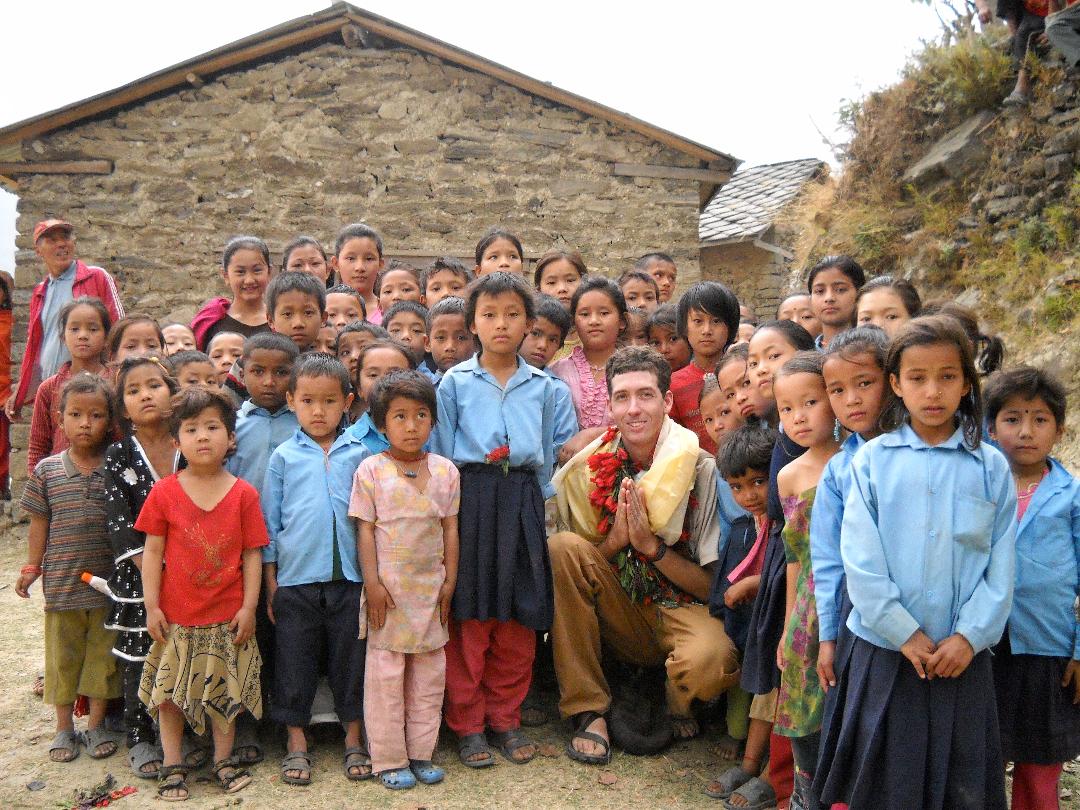
Danny Chaffin started HANDS in Nepal after volunteering at an orphanage called Buddhist Child Home in Kathmandu, Nepal.
Danny discovered many children in Nepal work on the streets or beg because of a lack of schools in the villages.
Most of Nepalese live in extremely remote, hard to reach areas. Rajan’s village Dharka is located in the Ganesh Himalayas, an area like many that most people have never heard of. Dharka is reached by first taking a bus from Kathmandu to Dhading Besi, then a bush taxi to where the road ends, then you hike about 5-6 hours up a mountain to the village. This is common for many villages in Nepal which demonstrates the immense challenge in development areas such as education, water and sanitation, health and more. Danny was blown away by his experience in Nepal, and it forever changed the trajectory of his life.
After returning to the US to start college at Naropa University, a private Buddhist University in Boulder, Colorado, Danny did all he could to save up money and return to Nepal to help build the school. The two of us returned the following summer and began figuring out a plan for how we would build their first school in Rajan’s village, Dharka. It would have to be through the creation of a non-profit. We returned home to the US, filed papers for a 501(c)(3) for the start of a non-profit. Hands in Nepal was officially founded in 2007 and the school in Dharka was completed in 2008 and a second school called Shree Ganesh Primary School was opened in 2009.
Danny founded the first school in Dharka, Dhading Besi, in the Ganesh Himalayas, one of the more remote and poorest areas of Nepal.
Awhile back, I was walking around one of my favorite urban lakes in Minneapolis with a good friend and she told me about an amazing program in Guatemala being run by two local non-profits, the Lutheran Partners in Global Ministry and the Community Cloud Forest Conservation. Through a unique partnership, they have been offering transformative intergenerational travel trips to a remote part of Guatemala where families, couples and solo travelers alike can work side by side the local community and do good. The trip brings travelers to the highlands of Guatemala for an intercultural and educational opportunity to work with the Community Cloud Forest Conservation on projects in education and agroecology.
As a strong supporter of sustainable travel, I was instantly intrigued and had the chance to meet with both Tricia Hall of the Community Cloud Forest Conservation and Mary Peterson of the Lutheran Partners in Global Ministry to learn more about their work and the trips to Guatemala. Tricia, a family doctor, humanitarian and mother of three, has been leading the trips to Guatemala since 2013 and I asked her to share a bit more about her inspiring work.
Tell me a bit about yourself. Where did you grow up and what were your hobbies when you were a child?
I grew up in Minneapolis and have always loved the lakes and parks of this area. We spent time in Minneapolis, but we also traveled to distant places. My parents are both social workers and we grew up with a strong sense of social justice, both locally and abroad. From an early age, I loved to travel and learn about new and different cultures.
Where did you go to school and what did you study?
I went to Calvin College in Grand Rapids, Michigan for undergrad and then to Chicago College of Osteopathic Medicine for medical school. I have always loved literature and so my undergraduate degree was in English, which I did alongside my pre-med science classes. I enjoyed the variety and have never regretted having both of these areas of study.
Why did you decide to become a doctor and what is your area of expertise?
I started to think about medicine in my high school anatomy class when we dissected a cat and I found it so interesting, particularly all of the muscles. Concurrently, I was starting to do service trips with my church. I knew that I wanted to work in some aspect of service and that muscles were cool, so there you have it! I decided on the specialty of Family Medicine because I loved the interactions with the whole family at the various stages of life.
Tricia and her daughter in Guatemala. Photo credit: Tricia Hall
How did you first get involved with the Community Cloud Forest Conservation (CCFC)?
We first visited Community Cloud Forest Conservation in 2013 when our daughter was just 18 months and our sons were 7 and 10. I wanted to see what my cousin Tara (CCFC co-director with Rob Cahill) and her family had been doing in Guatemala and I was immediately hooked on the beautiful area, but more importantly I was compelled by the beautiful people and the mission of CCFC.
Tell me more about the CCFC. What is their mission and how are they making an impact with the people they work with in Guatemala.
CCFC’s mission is to alleviate poverty and protect forests in the Highlands of Guatemala. These two objectives, although not obvious synergistic goals to most residents of the United States, definitely go hand in hand. The Q’eqchi’ Maya people of this region of Guatemala live in and by the land. As the land is deforested, their lives are denuded as well. Through education, reforestation, sustainable development, leadership scholarships, and ecological improvements to agriculture, CCFC is fulfilling its mission from the ground up. As kids learn about conservation, as young women are empowered to stay in school and fulfill their dreams, and as people from remote, rural villages are partners in collaboration, the physical landscape of the cloud forest improves and the personal landscape of the communities thrives.
Kids from the US and kids from the a village school making friendship bracelets together. Photo credit: Tricia Hall
Young women in a leadership training session at CCFC’s ecology center. Photo credit: Tricia Hall
Beautiful faces, learning, growing. Photo credit: Tricia Hall
Where in Guatemala do they work? What do most of the people in this community do for a living? What are some of the challenges they face?
CCFC is located in Alta Verapaz in the Central Highlands of Guatemala, a mountainous region which is largely indigenous and suffers from extreme poverty. The vast majority of the people in these communities are subsistence farmers, farming corn and beans on the steep sides of the mountains. Although corn is an important part of their diet and also the Mayan culture, when corn is grown as a monocrop, both the land and the nutrition of the people suffer. CCFC is working to increase agricultural diversity, often using ancient Mayan and native cloud forest heirloom crops to decrease deforestation and to dramatically improve nutrition.
What is your role with CCFC?
I feel very blessed to be able to work alongside the directors, staff and volunteers at CCFC and to bring a focus on community health. I have been working with Guatemalan nurses and nursing students over the past three years to assess the health needs and successes of the communities, identify areas for improvement, and develop initiatives to improve the health of the people in the communities.
CCFC in partnership with Lutheran Partners in Global Ministry, offers a unique intergenerational trip each year to see the work in Guatemala. How was the partnership formed?
We have been supporters of Lutheran Partners in Global Ministry for many years and I served on the board until recently and so I knew about LPGM’s partnerships with organizations around the world, building relationships, breaking down barriers, and partnering in the essential areas of need. A collaboration between LPGM and CCFC seemed like a great fit for both organizations. We started with a pilot travel experience and have continued to grow the partnership; because of this partnership, dozens of individuals and congregations around the United States have been able to travel to and work alongside CCFC in Guatemala, expanding the worldviews and potential of people both in Guatemala and here in the US.
Making dinner is fun! Photo credit: Tricia Hall
Peeling cacao beans to be made into chocolate. Photo credit: Tricia Hall
Cacao beans. Photo credit: Tricia Hall
Picking cloud forest native naranjilla fruit to be made into tasty jam. Photo credit: Tricia Hall
Weeding and planting with friends. Photo credit: Tricia Hall
What is the mission of the trip? What does a week look like?
The mission of the trip is to:
Experience and learn from a different culture,
Work alongside CCFC on projects that are ongoing in education and agro-ecology
Shareour lives and God’s love with each other and with those we meet in Guatemala.
When we arrive in Guatemala City, we get an introduction to Guatemalan culture and then we head to the mountains! We spend 4 days partnering with a group of children from a local village school, learning and experiencing together, and at the end of the week, we accompany them to their village, often with trees or other native products to plant. Throughout the week, we are hiking, cave-exploring, making native cloud-forest products, learning about coffee-production, playing soccer, and packing in as much learning and fun as we can. At the end of the trip, we spend a day “adventuring,” either in a natural waterpark or on a volcano.
Group photo of US travelers along with the village school children and teachers that we partnered with for the week. Photo credit: Tricia Hall
How does this experience change you?
This summer will be my 6thyear bringing a group to CCFC and I never tire of witnessing the beautiful connections that occur on these trips. To see a 7-year-old US girl from the city and a Q’eqchi’ Maya girl from a remote village walking together, smiling, communicating through hand gestures, and learning about themselves, each other and the world around them—it just doesn’t get any better than that!
Want to learn more about the upcoming summer trips?
June 19-29 2019 | Community Cloud Forest Conservation | Intergenerational Trip – Open
July 27 – August 6 2019 | Community Cloud Forest Conservation | Intergenerational Trip – Open
The usual trip size is around 10-18 people, filled with a mixture of families, couples and even solo travelers ranging from all ages. Cost is $1250 per person plus airfare. To learn more about the trips please click here.
Community Cloud Forest Conservation alleviates poverty and protects forests through education, reforestation, sustainable development, leadership training, and ecological improvements to agriculture. CCFC believes that holistic human / community development through education and capacity building is the key to conservation and development in Guatemala’s central highlands. Education, especially for young women, is key to building peace in this region.
Lutheran Partners in Global Ministry was created in 1995 out of a pressing need to connect people with opportunities around the world and build relationships. Lutheran Partners in Global Ministry shares resources and hope through: Partnerships (with local, national, and overseas organizations), Education (for women and children, transforming lives for a brighter future), Empowerment (empower peace, stability and sustainability through leadership development), and Transformational Travel (to India, Guatemala and the Central African Republic).
I love to ski and while here in the Midwest we don’t have the amazing mountains of Colorado or Utah, Minnesota surprisingly has quite a lot of ski areas to learn on and hone your skills. I grew up skiing Minnesota’s often icy and cold ski areas, learning to ski at the tender age of three. For me, skiing is the best way to survive our notoriously long Minnesota winters and a way to get outside in the depth of our coldest months.
When I tell my non-native friends that I spend my weekends skiing in Minnesota, they are often surprised until I remind them that it was little suburban ski area Buck Hill in Burnsville, Minnesota where one of the best skiers in the world got her start, Lindsey Vonn. Taught at Buck Hill by the renowned Erich Sailer who also groomed slalom racer Kristina Koznick, Vonn put Minnesota on the map for many young ski hopefuls. Vonn eventually moved to Colorado to train on the bigger mountains but often looks back nostalgically on the icy, sometimes brutal conditions of Minnesota skiing where she got began.
Given my love for skiing, my husband and I started our own kids skiing when they were toddlers with weekly lessons at Buck Hill. Once the kids were in elementary school, we joined a Twin Cities based ski and snowboard club called Blizzard that brings us to a different ski area every Saturday from December through March. We have been members of the ski club for six years and have skied all over the state. While one ski area crosses the Minnesota border slightly into Wisconsin and the best ski area is near the Canadian border, all ski areas are within an hour to four and a half hour drive of the Twin Cities. Here is a list of my favorites in order.
Located in Northern Minnesota near the Canadian border is Lutsen Ski Area, one of the largest ski areas in the Midwest. Nestled within the stunning Sawtooth Mountains with massive Lake Superior as a backdrop, Lutsen Ski Area encompasses four interconnected peaks, 95 runs, a gondola, and 825 feet vertical rise (not bad for the Midwest). Although it can be cold, it is by far the best skiing Minnesota has to offer and makes for a great family, friend or couple weekend trip. Besides skiing, there is also nordic skiing, snowshoeing, dog sledding and sleigh rides so there is plenty to keep you busy.
About a four and a half hour drive from the Twin Cities, Lutsen is best experienced over a weekend and there are tons of great lodging options available. You can stay mountainside, at the Lutsen resort or at a Lutsen Sea Villa along the edge of frozen Lake Superior. Lutsen has been a favorite ski area of mine since I was a kid. We usually go skiing in early March to escape the colder winter months however you never know when you may just luck out with warmer weather and good snow. Some friends of mine just got back from an early January trip and the conditions were outstanding.
As always, I cannot believe that another year has simply flown by. I swear, time seems to go faster and faster each and every year. 2018 has been yet another whirlwind year awash with highs and lows. It hasn’t been the easiest year yet there have been plenty of wonderful adventures, special moments, time with family and those not so pleasant yet necessary life lessons.
For some reason, it always feels like a shock to jump into another new year and perhaps that is why I love to take a moment to reflect on the year that has passed and be filled with gratitude.
January
We welcomed in the New Year in San Diego after spending the holidays with my family in Tucson, Arizona. Over the years, San Diego has become a special place for our family and we enjoy spending time hiking, watching sunsets, building sand castles on the beach and taking in the perfect weather. Torrey Pines Reserve is always a must see as well. My favorite post of January: “Why I Will Always Love Torrey Pines” shares some of my favorite photos of this magical place.
We also drove to LA where we discovered another treasure, El Matador Beach in Malibu which is lovely especially if you arrive before the crowds.