Street photography La Paz Bolivia

Daily Life in La Paz

The best place to get a feel for daily life in La Paz is to walk her chaotic, often serpentine streets and see it all for yourself. As the sun rises, the streets are relatively quiet save for the growing hum of the cars, vans and buses that transport people around. By nine o’clock, the streets begin to come alive as the street vendors open up the doors of their little green stalls, bringing a burst of riotous color to the scene. Children in uniforms walk to school while men and women move swiftly to get to work. Others pass their time lounging on the stoops of a building or on a bench in the park.

I found the best way to get a taste of daily life in La Paz was to capture as many different aspects of it as possible on film. I have already posted my street photography photos on street art, women, markets and vendors. Now it is time to take a look at how people express themselves in their daily lives.

Street photography La Paz Bolivia

Singing on the streets to earn a dime.

Street photography La Paz Bolivia

Eating breakfast outdoors before opening her stall for the day.

Street photography La Paz Bolivia

Relaxing in front of God’s house.

Bolivia TRAVEL TRAVEL PHOTOGRAPHY Weekly Photo Challenges
Produce Market La Paz Bolivia

The Unusual Street Markets of La Paz

In my opinion, the heart and soul of a country can almost always be found on the street. Street markets can tell you a lot about a place.  There is no place where this is more true than in La Paz. La Paz’ chaotic and colorful markets are abundant and diverse. You can find anything your heart desires and bartering always ensures the best price. It is at the unusual markets of La Paz that the old and new culture of the city collides. Whether you are looking for a specific door knob, light bulb or toilet seat, you can surely find it at rock bottom prices at the Mercado Negro (Black market). Want a llama fetus to set fire as an offering? No problem. There are plenty of dead ones to choose from at the Mercado de Hechiceria (Witches’ Market). Experiencing the fabulous markets of La Paz is the highlight of any trip and is bound to be a fascinating way to spend the day.

Our hotel, Hostal Naira was located just a block or two away from the start of the Witches’ Market on Calle Sagarnaga thus we spent a lot of time walking around the area. I already posted many of my photos from the street vendors near our hotel in this post  however I found that the further up the cobblestone streets we walked, the more interesting and unusual the markets became. As the traditional street vendors known as artesanias selling handicrafts and hand-woven goods dwindled so did the tourists. We knew that we were entering the markets meant for locals as we begin to see no tourists and more unique items for sale.

Markets of La Paz Bolivia

Bolivia TRAVEL TRAVEL BY REGION TRAVEL PHOTOGRAPHY
Street vendors in La Paz Bolivia

The Street Vendors of La Paz

Street vendors are everywhere in La Paz adding vibrancy and culture to the already colorful, hectic streets. You can pretty much buy anything on the street ranging from beautiful handicrafts and hand-woven goods to magazines, drinks, food and anything your heart desires inside the black market.

The life of a street vendor is not an easy one. Most open up their green-colored stalls around nine or ten o’clock in the morning and close well after ten at night. The majority of street vendors are women who have no other choice but to bring their babies and young children with them for a long day and night on the street. They eat at their stalls, watch their  children play and sleep at the stalls, and spend most of the time sitting there hoping for a customer so they can make enough money to survive.

I found the life to be a hard yet was amazed at their perseverance by coming day after day to the same spot for well over twelve hours to sell what they could to feed their families. I was heartbroken by the mothers with young kids crying or sleeping at their weary feet. But in a country of high unemployment, at least these women had some income to provide for their family. And the products they sold were lovely.

The neighborhood we stayed in was located in the heart of the Witches Market, a huge tourist attraction in La Paz. I enjoyed watching some of the street vendors set up and close their stalls each day. I enjoyed taking photos of them even more.

Street vendors in La Paz Bolivia

In the morning slowly the street vendors begin to arrive and open up their green-colored stalls for the day. These stalls were right outside our hotel.

Every morning this woman would open her small stall around nine o’clock, right outside our hotel door. She had a beautiful collection of handicrafts and also sold bottled water which was very helpful. Her location couldn’t be better given the high volume of customers in the hotel next door.

Street vendors in La Paz Bolivia

Street vendors in La Paz Bolivia

Bolivia TRAVEL TRAVEL BY REGION TRAVEL PHOTOGRAPHY
Street Art in La Paz, Bolivia

Street Art in La Paz

I adore street art.  While some people find street art and graffiti distasteful, I truly love a good work of art and enjoying it for free on the side of a building brings more flavor and culture to a place. Like many cities in South America, La Paz has its share of street art which adds to the riot of color already surrounding her vibrant streets.

My favorite pieces of street art were of the Aymara women who are so common on the streets of La Paz. Painted in vivid, bright colors I found these murals lovely. I wondered who had painted them and how long the art had been there. Had they been commissioned or did an artist become inspired to paint it for free?

The sensational colors made my soul sing.

Street Art in La Paz, Bolivia

Street Art in La Paz, Bolivia

Bolivia TRAVEL TRAVEL BY REGION TRAVEL PHOTOGRAPHY
Street Vendors La Paz, Bolivia

La Paz: A Lesson in Street Photography

La Paz is one of the most colorful, vibrant places I have ever been. Ranking high on the list with such photogenic darlings as India and Cuba, the endless opportunities to take pictures makes you never once put your camera away for fear that you will miss something great. You could seriously spend a week just walking around the winding, lively streets of the city taking thousands of photos. Unfortunately I only had a few days meaning I had to take as many as possible without the correct lighting or framing of the shot. Nevertheless, I am happy with the colorful captures I was able to get despite my hasty, rushed approach.

It took me weeks to sort through and edit my collection of photos. When I finally edited the very last photo, I was elated. However, at first glance I was also a tad bit disappointed. Looking back now, I realize that La Paz taught me a hard lesson in street photography. It is not as easy or simple as it seems.

Trying to capture random pictures of everyday life without attracting too much attention is difficult. I love to photograph every day people yet there is often a fine line between asking for their permission to get a shot or just taking it on the sly. It can feel like an invasion of privacy and if you are caught you may get an angry stare or worse.

My general rule of thumb when photographing people is that if they are only a part of the scene I am taking, then I generally don’t ask. I take the photo from far away and get the entire scene.  If I want a closer view of the subject, I crop it later when I am editing in Lightroom. If the photo is exclusively of a person and I need a close up shot, then I always ask their permission. The unfortunate part is that sometimes a shot that is not candid just doesn’t turn out as well. But I’d rather be respectful and ask permission than chance upsetting someone.

Another lesson I learned about street photography on this trip is that timing is everything. I may see the perfect photo but if my camera is not ready at that exact moment in time or if a bus or car drive through the photo, then it is ruined. La Paz is a very busy place with people, cars, buses, and tourists everywhere.  Oftentimes I would try my best to get a shot when all the sudden a pedestrian would walk right past my camera as I snap. If I was traveling on my own, I could try again but I’m usually always with an impatient non-blogger who doesn’t want to spend the entire day stopping every step to take pictures!

Timing is also important when it comes to the location of the sun. When you are only in a destination for a couple of days, you just have to take your chances on the photos. The sun may be in the worst spot possible but if I really like something than I take the photo anyway knowing even if it is not the best, at least I got it.

The last lesson I learned is that to be a true street photographer takes incredible talent. I’m just an amateur photographer who loves to capture the world through my eyes. Sometimes I get lucky and a photo I take turns out really great. But I acknowledge the fact that I am no expert. If my photos aren’t perfect that is ok. As long as they show the world through my eyes and help me share what I have seen, then I’ve done my job.

The next series of my Bolivia posts will all revolve around street photography. Here is a preview of the different subjects:

Street Art

Street Art in La Paz, Bolivia

Bolivia TRAVEL TRAVEL BY REGION TRAVEL PHOTOGRAPHY
La Paz, Bolivia

My Fascination with La Paz

I landed in Bolivia after a grueling overnight flight from Miami in El Alto, the highest international airport in the world at a dizzying altitude of 13,323 feet (4,061 m). Coming from the flat land of Minnesota at meager 830 feet (264 m) above sea level and a restless night’s sleep, I felt exhausted, unbalanced and elated all the same to finally be in Bolivia.

A driver from our hotel picked us up and drove us the short 8 miles or so down into the heart of La Paz. As we left the bustling run-down city of El Alto and meandered down the impossibly steep, colorful streets of La Paz I looked around me in fascination. In all my travels around the world, I had never seen anything quite like La Paz. Built within a giant bowl-shaped canyon with streets as steep as ski hills, there she laid before me:  A metropolitan area of over 2 million people densely populated within the sheer rocks that surround La Paz and lead to the majestic, snow-capped Andes.

La Paz, Bolivia

Leaving the high plateau of El Alto, I got the first real view of La Paz below and was stunned.

La Paz Bolivia

If ever you get lost in La Paz, simply head downhill. You are bound to find yourself again

And then I saw her in all her glory and was awestruck. La Paz seemed to go on forever into the distant altiplano, the highlands for which this part of Bolivia is known for.

La Paz, Bolivia

Bolivia TRAVEL TRAVEL BY REGION
Woman in La Paz Bolivia

Bolivian Street Photography: The Twinkle in her eye

Bolivia has the largest indigenous population in South America with an estimated 60% of her population claiming indigenous descent. In La Paz, the most prominent indigenous culture is the Aymara who are known for their rich, highland culture and colorful handicrafts.

Walking down the streets of La Paz, the landscape is awash is brilliant colors of tapestries, handwoven scarves, hats and sweaters, and tiny little street side shops and stalls run by the local Aymara women. Cholitas dressed in wide, layered skirts, a brightly colored handwoven blanket along the back and an English-style brown bowler hat atop their head, line the streets waiting expectantly for a sale.

I saw her alone, seated next to a small street side shop and a bucket of colorful dolls. I knew I’d have to stop and say hello and maybe purchase a doll for my daughter.

Woman in La Paz, Bolivia

Bolivia TRAVEL BY REGION TRAVEL PHOTOGRAPHY Weekly Photo Challenges
El Alto Bolivia

Getting to Bolivia

When I checked in my bags at the airport on November 25th, I let out a huge sigh of relief. Unless the plane broke, I was going. It seemed like some kind of minor miracle after all we’ve been through trying to plan this crazy one-week trip.

A year ago, our trip was booked and planned. We had our plane tickets, hotel reservations and trek booked for October however our trip had to be placed on hold indefinitely while my dad battled cancer. Fast forward a year later, he thankfully recovered and got himself back into tip, top shape. We rebooked our trip and were overjoyed that it was finally going to happen.

Then came the issue with my passport.

Adventure Travel Bolivia TRAVEL TRAVEL BY REGION Trekking/Hiking
Condoriri trailhead Bolivia

Gone but not forgotten in the Bolivian Andes

Over the past week, I’ve been off the grid so to speak, in the high Andes of Bolivia. My blog has been quiet while I spent four days sleeping at 15,400 feet at the foot of Condoriri Mountain (5648 m) in the Cordillera Real Range of Bolivia.

It was quite an adventure to say the least. One that I will never forget and one that I am still recovering from. My dad and I managed to climb two mountains in two days, the first at 16,899 feet (5152 m) and the second at a whopping 17,698 feet (5396 m). I still am in awe at the beauty of it all.

In honor of today’s photo challenge here are some photos of where I was. Many more will be coming soon as I play catch up and sort through all my colorful photos from Bolivia. Here is a sneak peak of a few unedited ones that capture the imagination of such a remote, spectacular place.

Condoriri Mountain Bolivia

Setting out to our destination: The foot of the Condoriri

Adventure Travel Bolivia TRAVEL TRAVEL BY REGION TRAVEL PHOTOGRAPHY Trekking/Hiking Weekly Photo Challenges
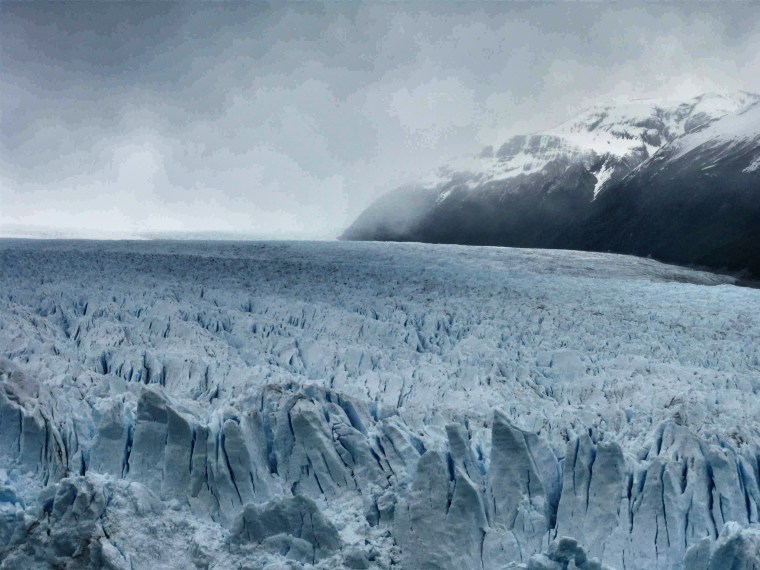
Perito Moreno Glacier in Argentina

Layers of Ice: Argentina’s Perito Moreno Glacier

Perhaps one of the most spectacular marvels of Mother Nature I’ve ever witnessed is the majestic Perito Moreno Glacier in Patagonia, Argentina. Spanning an area of 250 square kilometers/97 square miles and 30 km/19 miles in length, the sheer magnitude of this massive piece of layered ice is incomprehensible.

Ice trekking on the Perito Moreno Glacier was one of my highlights to a trip to Southern Patagonia in 2009. Take a peak for yourself and see the immense beauty and power of Argentina’s premier glacier.

“The question is not what you look at, but what you see”. – Henry David Thoreau

Perito Moreno Glacier in Argentina

Perito Moreno Glacier in Argentina

Perito Moreno Glacier in ArgentinaPerito Moreno Glacier in Argentina

Perito Moreno Glacier in ArgentinaThis post was inspired by the Weekly Photo Challenge: Layers. To view more entries click here.

Related posts:

Scotch on the 400-year-old Rocks

My Top Five Wild Hikes

The Surroundings of a Patagonian Outpost

Hike to Mount Fitz Roy (Freshly Pressed)

Argentina TRAVEL BY REGION TRAVEL PHOTOGRAPHY Weekly Photo Challenges
Los Glaciares National Park

My Top Five Wild Hikes

I just finished reading Cheryl Strayed’s “Wild: From Lost to Found on the Pacific Crest Trail” a dark, raw and fiercely humorous book on how one woman finds herself during a three-month long trek through the wild Pacific Crest Trail. The book is powerful, emotional, honest and inspiring, and Strayed uses her brilliant memoir to take a hard look at self-discovery, heeling and change.

Of course when times are tough, we can’t always pick up our bags and leave town. Yet, I often find that there is no better way to escape and reflect upon life than to go on a hike, and the more remote and wild, the better. I have been fortunate to have done many wonderful adventurous hikes over the years.  Although every hike I’ve done has been special and has brought me to a new place, there are a select few that have truly inspired me and are unforgettable.

Here is a list of the top five wild hikes that are bound to get your mind thinking.

Adventure Travel Argentina Chile Guatemala Iceland Nepal Sustainable Travel and Travel Resources Trekking/Hiking

The Surroundings of a Patagonian Outpost

“I climbed a path and from the top looked up-stream towards Chile. I could see the river, glinting and sliding through the bone-white cliffs with strips of emerald cultivation either side. Away from the cliffs was the desert. There was no sound but the wind, whirring through thorns and whistling through dead grass, and no other sign of life but a hawk, and a black beetle easing over white stones.”  – Bruce Chatwin, “In Patagonia”

Getting to the end of the world takes a very long time.  After multiple flights starting due north in Minneapolis, I found myself arriving at literally the end of the world in El Calafate, Argentina. From 44.9 degrees north to 49.3 degrees south, it would take another three and a half hour bus ride to reach El Chalten, a tiny Patagonian outpost that marks the setting off point for Los Glaciares National Park.

Adventure Travel Argentina TRAVEL BY REGION Trekking/Hiking