The ONE Campaign, an advocacy group who works tirelessly to end extreme poverty, yesterday launched “2013 AIDS Report: The Beginning of the End? Tracking Global Commitments on AIDS, Volume 2“ in time for World AIDS Day on December 1. Over the last few decades, we have made tremendous progress towards fighting AIDS and for the first time ever we are at a global tipping point: When the number of new HIV infections is surpassed by the number of people newly added to treatment meaning “The beginning of the end of AIDS”. Furthermore, we now can begin to talk about AIDS on a country by country basis within Africa. There are 16 countries within Africa who have already reached the beginning of the end of AIDS, a huge accomplishment.
One of the primary ways for tackling AIDS has been through the use of antriretrovirals which prevent the transmission of HIV from mother to child. For a mere $0.40 a day, an HIV/AIDS infected mother can be treated with antiretrovirals which provides a 98% chance of stopping the transmission from mother to child during birth.
We are so close to achieving an AIDS-free generation:
In 2010, 1000 babies were born every day with HIV. Today, that number is down to 700. With action and urgency we can get that number to ZERO.
A major funding source for ending AIDS comes from The Global Fund to Fight AIDS, Tuberculosis and Malaria which saves 100,000 lives a month. The ONE Campaign’s (RED) division works to eliminate AIDS through consumer activism by partnering with some of the world’s leading brands to offer a changing collection of iconic (RED) products. With the purchase of each (RED) product 100 % of the money raised is donated to The Global Fund. Thanks to (RED) Partners and Events over $215 million has been raised for the Global Fund, helping fund HIV/AIDS grants that have supported over 14 million people.
Be sure to check out all (RED) products on fab.com and see the Holiday 2013 Product (RED) Gift Guide.
Just in time for the holidays and World AIDS Day, (RED) has launched six exciting new partnerships to help raise money for the Global Fund to end AIDS. Here is a brief look into these unique, gifts that give back.
A couple of weeks ago as part of my role as a National Geographic Insider, I had the honor of participating in a conference call with Wildlife Biologist Luke Dollar to learn all about National Geographic’s two exciting campaigns: Big Cat Week and Build a Boma. I have always been a true lover of wildlife and nature and had the honor of seeing big cats in the wild on safari in South Africa in 2005. Little did I know that big cats are in huge danger and face the threat of extinction if we do not act soon to protect them.
Lion at Tanda Tula Reserve South Africa
Lion at Tanda Tula Reserve South Africa
Lions at Tanda Tula Reserve South Africa
Luke Dollar is professor at Duke University and Pfeiffer University in North Carolina and is one of big cats biggest advocates with over 20 years of conservation work. Luke is a wildlife biologist focusing on conservation, research and development and has logged more than eight of the past 18 calendar years in the field. His scientific research began in Madagascar focusing on Madagascar’s top predators, specifically the fosa (Cryptoprocta ferox). His work there brought him to National Geographic as an Emerging Explorer in 2007 and today Luke is the program director of National Geographic’s Big Cats Initiative.
Whole Planet Foundation, a non-profit run by Whole Foods Market, recently launched a new exciting initiative in the world of microfinancing. For the first time ever a donor can now give directly to specific projects around the globe which will give Whole Planet supporters an opportunity to choose exactly where their donation goes.
Tanzanian farmer assisted by BRAC and Whole Planet. Photo credit: Whole Planet Foundation
This month, Whole Planet is piloting a program in Tanzania where 68% of the population is lives on less than $1.25 a day. In Tanzania, Whole Planet has partnered with BRAC, Whole Planet will be able to empower micro entrepreneurs like Jackline to alleviate poverty in the region of Mbeya, where Theo Chocolate, sold in Whole Foods Market stores, is sourced. BRAC began working in Tanzania in 2006 by providing micro finance and small enterprise development programs in Tanzania to create opportunities for the poor in agriculture, livestock and poultry.
Friday marks the two week date since Super Typhoon Haiyan bombarded the Philippines, causing devastation, destruction and utter despair among this island nation. In the aftermath of Super Typhoon Haiyan, millions of Filipinos are displaced, 18,175 people were injured, 3,976 people are confirmed dead, 1,598 people are still missing and estimated damage continues to spike up to $674 million (Source: New York Times).
The storm, one of the most powerful ever recorded in the world, also destroyed homes, schools, hospitals, roads, communications and other basic infrastructure, and damaged power and water supply systems making relief services extremely complicated and difficult.
While world coverage of Super Typhoon Haiyan continues to filtrate the newspaper mostly speaking of the damage, destruction and despair, there are a few more subtle stories here and there about the most vulnerable victims of this devastating storm: The children.
On 12 November, a woman cradling a baby stands amid debris and other destruction caused by Super Typhoon Haiyan, in Tacloban City the area worst affected by the disaster on the central island of Leyte. Water, sanitation and hygiene, food, medicine, shelter, debris clearance and communications are among the priority needs. Blocked roads have limited access and the delivery of relief supplies. Photo credit: Jeoffrey Maitem/UNICEF
Early this fall, I wrote a post about END7, a global advocacy campaign run by the Global Network to raise awareness of the seven most common Neglected Tropical Diseases (NTDs) and cultivate the resources necessary to eliminate them as public health threats by 2020.
The Road to deliver treatment for NTDs in rural Kenya. Photo credit: Mo Scarpelli
I had honestly never heard of NTDs before even with all my international traveling. However, NTDs keep millions of children in the developing world out of school from preventable, treatable diseases further reinforcing the cycle of poverty and despair. Per END7, there are seven NTDs (Elephantiasis, river blindness, trachoma, snail fever, hookworm, whipworm and roundworm) that are responsible for 90% of the global burden of NTDs. NTDs are a huge problem: It is estimated that NTDs infect one in six peopleworldwide including one billion children.
Today’s post is a guest post written by Sarah Dobsevage, Institutional Development Manager of WaterAid America. The post is about her recent experience in Senegal when a water pipeline broke down causing severe water shortages throughout Dakar, the capital city of Senegal.
The author, Sarah, with her mom, Ruth, and daughters, Meira, standing, and Talia, in her arms, in Saly. Photo credit: Sarah Dobsevage
As a mom, as a professional and as someone who loves to dive deeply into new cultures and experiences through travel, I’ve had an admittedly good lot in life. I have two beautiful daughters, a tremendously fulfilling job at an international non-profit called WaterAid, and the opportunity to spend time overseas in support of WaterAid’s programs that are helping poor communities in 27 countries across the world get access to toilets and clean drinking water.
The tragic Typhoon Haiyan that ripped through the Philippines a week ago today left behind a trail of destruction, death and sorrow that continues to unfold. Words cannot express the utter despair that remains in the aftermath of the storm. The images of destruction, desperation and fear remind us how powerless we are and how fragile life can be especially in the face of Mother Nature. Thousands of people have lost their lives in just a blink of an eye and the exact number of casualties is yet to fully be known.
As we know, images are powerful reminders of our hopes and of our fears. A picture can paint a thousand words.
Thanks to my work as an advocate and voice for Save the Children, I was able to get access to exclusive photos from Typhoon Haiyan as well as speak with Francine Uenuma, Director of Media and Communications at Save the Children yesterday to learn more about Save the Children’s on the ground emergency response in the Philippines. Here’s the story.
A Filipino boy stands amidst rubbles of houses in the super typhoon devastated city of Tacloban, Leyte province, Philippines. Photo credit: Save the Children
Today’s post is a guest post written by a dear friend of mine Elizabeth Ataley of the beautiful blog Documama. I met Elizabeth a few years ago at BlogHer and we have worked together ever since as fellow members of Mom Bloggers for Social Good, the Global Team of 200 and ONE Moms. Elizabeth recently went on a social good blogging trip as part of Global Team of 200 to South Africa along with Jennifer James, Founder of Social Good Moms/Global Team of 200. Here is her report on their visit to Rebecca’s Well in Alexandra Township, South Africa.
Alexandra Township. Photo credit: Elizabeth Ataley/Documama
Hope Springs From Rebecca’s Well in Alexandra Township, South Africa
The shift was drastic. One second we were driving through what looked like typical city sprawl, passing industrial yards, a McDonald’s, and the next moment rubble heaps, and rusted corrugated tin sheds pulsing with people lined the sidewalk. It was as though we passed through some sort of invisible wall into a different reality. The reality that the people of Alexandra Township, which we had just entered, live in is light years away from the gleaming luxury hotels and shopping malls that rise up on the horizon just a few miles away in Sandton which is known to be one of the wealthiest areas in South Africa. Jennifer James and I were headed on our first site visit for our #socialgoodmomsjoburg Global Team of 200 trip to Johannesburg, South Africa, and the impact it had on us would be huge.
Alexandra Township. Photo credit: Elizabeth Ataley/Documama
It is that time of year again. The holidays are coming! And with the onset of the biggest consumer spending of the year comes the reminder that many people around the world are not so fortunate when it comes to lavishing themselves with gifts. That is why for the next several weeks I will be highlighting unique ways to purchase gifts that give back and help someone else in need.
On October 24th, ONE partnered with Heifer International to launch an amazing, exciting campaign just in time for the holidays: #GiveaGoat to end extreme poverty.
The ONE Campaign works to end extreme poverty particularly in Sub-Saharan Africa while Heifer International specializes in bringing sustainable agriculture and commerce to areas with a long history of poverty, and have programs throughout the world. Both non-profit organizations are fabulous and by working together will be able to create even a greater impact on fighting extreme poverty around the world.
I have worked a bit with ONE already as a ONE Mom and Community Partner yet this is my first time learning more about Heifer’s work. While ONE is primarily an advocacy group with over 3 million supporters, Heifer provides the framework on the ground by working with smallholder farmers to promote economic self-sustainability and good health. Like ONE, Heifer believes strongly in empowering people especially women and girls who are the majority of the small farmer holders throughout Africa.
What makes Heifer’s work so amazing is that they don’t simply stop by helping one family. Heifer utilizes a program called “Passing on the Gift” which assures that each participant in the program—the person who receives the initial gift of an animal—becomes a donor by giving the animal’s offspring to another family in need. This concept helps build community and participation in each project. The families continually give to others, ensuring greater self-sufficiency and human dignity, one family at a time.
Although Heifer provides a variety of livestock ranging from chicks, rabbits, pigs, and sheep to goats, llamas, water buffalos, and heifers, for this campaign Heifer and ONE are focusing exclusively on the value of providing a goat.
So why a goat? Here are some facts you probably didn’t know about the benefits of having a goat.
1 goat can produce 1 ton of milk/ year. That’s enough to pull 1 family out of poverty
A gift of livestock has up to 9x the impact, as families pass on the gift to others.
One goat can produce 15 liters, or nearly 4 gallons, of milk a day!
Goats were first herded by humans 10,000 years ago in what’s now Iran. Man’s most helpful friend for 10 millennia
Why goats are awesome?
Let’s meet Stella, ONE and Heifer’s mascot. Stella is quite popular and even has her own Twitter and Pinterest Account!
How #GiveAGoat works: Now through December 31, you can buy or give a goat for $120 or a share of a goat in various increments.
Each goat can provide up to 1 ton of milk a year, enough to provide 1 family with enough income for shelter, education, health care and more.
Read how goats have changed people’s lives in Africa: ONE will be reposting success stories from farmers who have received a Heifer goat. Checkhttp://www.one.org/us/partner/heifer-international/ each week for a new story.
In the first 24 hours since the campaign was launched, more than 280 goats were sent to families in need in Africa. These goats can help pull families out of extreme poverty by giving them milk to sell at the markets, providing a much-needed source of income.
During my visit to the Social Good Summit in New York City last month, I attended a meeting with a group of bloggers to learn more about (RED), a division of the ONE Campaign that works to eliminate AIDS through consumer activism. (RED) was founded in 2006 by Bono and Bobby Shriver as a way to engage people and businesses all over the world to fight the greatest challenge of our time – the fight to end AIDS.
Coffee with the women from RED and our RED bracelets.
RED ad on website of woman and child.
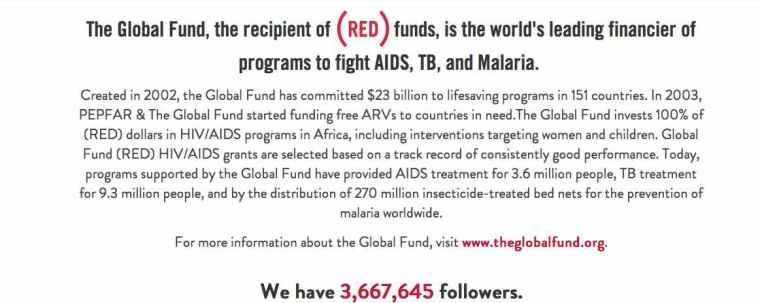
Updated October 2013 About (RED)™ (RED) was founded in 2006 by Bono and Bobby Shriver to engage businesses and people in the fight against AIDS. (RED) partners with the world’s most iconic brands who contribute up to 50% of profits from (RED) branded goods and services to the Global Fund. (RED) Proud Partners include: Apple, Starbucks, The Coca-Cola Company, Beats by Dr. Dre, Belvedere, Claro, SAP, Telcel and American Express (UK only). (RED) Special Edition partners include: Shazam, Girl Skateboards, Mophie, FEED, Nanda Home, Bottletop, Tourneau, Fatboy USA, Bed Bath & Beyond, HEAD. To date, (RED) has generated more than $215 million for the Global Fund to fight AIDS, Tuberculosis and Malaria, to support HIV/AIDS grants in Ghana, Lesotho, Rwanda, South Africa, Swaziland, Zambia, Kenya and Tanzania. 100 percent of that money goes to work on the ground – no overhead is taken. Global Fund grants that (RED) supports have impacted more than 14 million people with prevention, treatment, counseling, HIV testing and care services. (RED) is a division of The ONE Campaign. Learn more at http://www.red.org. About The Global Fund to Fight AIDS, Tuberculosis and Malaria The Global Fund is an international financing institution dedicated to attracting and disbursing resources to prevent and treat HIV and AIDS, TB and malaria. The Global Fund promotes partnerships between governments, civil society, the private sector and affected communities, the most effective way to help reach those in need. This innovative approach relies on country ownership and performance-based funding, meaning that people in countries implement their own programs based on their priorities and the Global Fund provides financing where verifiable results are achieved. Since its creation in 2002, the Global Fund has approved funding of US$ 22.9 billion for in 140 countries. To date, programs supported by the Global Fund have provided AIDS treatment for 5.3 million people, anti-tuberculosis treatment for 11 million people and 340 million insecticide-treated nets for the prevention of malaria. The Global Fund works in close collaboration with other bilateral and multilateral organizations to supplement existing efforts in dealing with the three diseases.
(RED) partners with some of the world’s leading brands to offer a changing collection of iconic (RED) products triggering a unique way of consumer activism: With each purchase of a (RED) product 50% of the proceeds are donated to The Global Fund to Fight AIDS, Tuberculosis and Malaria which saves 100,000 lives a month.
Here is an example of how (RED) works on the back end to fight AIDS.
What is so exciting about (RED) is that they make it so incredibly easy for consumers to give back and support the fight of AIDS. Just simply purchasing a (RED) product starts the process of donating to The Global Fund and every single dollar donated to The Global Fund is donated on the ground meaning there is no overhead. Pretty amazing.
Here is a current list of some of the brands who are going (RED). Remember the GAP collection of t-shirts called Inspi(RED)?
The (RED) Manifesto is a wonderful example at how organizations can inspire people to give back and make a difference in the world. Simply making a purchase of a (RED) product, can help save a person’s life.
So why is it important to fight HIV/AIDS and why now? Simply because we have never been so close to seeing an end of AIDS before. It is proven that antiretrovirals work. Today, over 6 million people are being effectively treated with antiretrovirals that have a 96% success rate in not transmitting the disease. With action and urgency, it is possible to see the end of the transmission of HIV from mothers to their newborns. We are so close to eradicating this horrible disease.
Fact: It is also estimated that nearly 30 million people have died from AIDS-related causes since the beginning of the epidemic (UNAID 2010 report).
Fact: AIDS remains a global epidemic infecting 2.7 million new people and claiming 2 million lives each year.
Topsy/AIDS Patient’s Dramatic Recovery from AIDS
An inspiring, one-minute video that was shown on World AIDS Day in 2011 marking the 30th anniversary of the discovery of AIDS.
My dear friend, Jeannine Harvey at The ONE Campaign shared this beautiful story below on the hope that anti-retrovirals can provide to a child born with HIV/AIDS.
I leave you with the story of Motselisi. (RED) first met Motselisi in the rural Nyakosoba Village in Lesotho when she was 11 months old, frail and weak without access to medication. Motselisi was put on anti-retroviral (ARV) medicine, and 90 days later, she had been brought back to life and was a healthy, happy baby. Hers is a true story of the Lazarus Effect and the life-saving power of HIV/AIDS treatment, treatment that costs around 40 cents a day in sub-Saharan Africa.
(RED) is a division of The ONE Campaign. Learn more at www.red.org.
About The Global Fund to Fight AIDS, Tuberculosis and Malaria
December 1st marks World AIDS Day
Every year, in the days and weeks leading up to World AIDS Day on December 1st, (RED) partners with premiere artists and leading brands to shine a global spotlight on the epidemic. To date, (RED) has raised over $215 million for the elimination of AIDS.
Today is World Polio Day where people across the globe come together to advocate on the eradication of polio and speak of the successes we’ve made and plan for the future. We have never been so close to eradicating a disease before and have only eradicating two diseases in the history of mankind. We are at a pivotal moment in time and we are within reach of wiping this terrible, debilitating disease off the face of this planet.
Per the World Health Organization’s article “10 Facts about Polio Eradication” here is where we stand today in our fight against polio:
Have you ever had an experience in your life that has changed you forever? For Babita Patel, a humanitarian photographer, that fateful day happened during an assignment to one of the poorest places in the Western Hemisphere: Haiti. In Babita’s words here is that moment that changed her life.
I WAS WALKING THROUGH CITÉ SOLEIL, the largest slum in the Western Hemisphere located in Haiti, one of the poorest places on Earth. Trash littered the streets and dirty stagnant rainwater was often used as latrines. The sun pulsated directly overhead, bleaching the blue sky to a blinding white. Sweat droplets raced down my spine and pooled at my lower back. Children dressed in rags – or for some, in nothing at all – played a spirited game of soccer with a half-inflated ball. I snapped a picture of a group of rambunctious kids, only to have eager young hands grab at my camera to see the image captured on my screen.
“Praying”. Photo credit: Dumas (one of the students).
The novelty of the reproduction faded and most darted off between the shanty houses. One remained, diligently pointing at each face on the screen, as if ticking them off in his head. He stopped at the last one. His own. He let out a burst of pure, innocent, giggling glee and scampered off. Alone, I realized that for people who have next to nothing, a mirror is an unattainable luxury. This child only met his reflection by process of elimination. For he knew which ones were his friends and which one was the stranger.
I was struck dumb. For I never realized a person could walk through life without knowing his own physical self. But photography can change that. It lets a child see himself and his world through different eyes. By learning tangible skills and creating new avenues of self-expression, he can contribute to his life and his community.
And thus, the seed for View Finder Workshop was planted. Babita Patel. founder, humanitarian photographer